

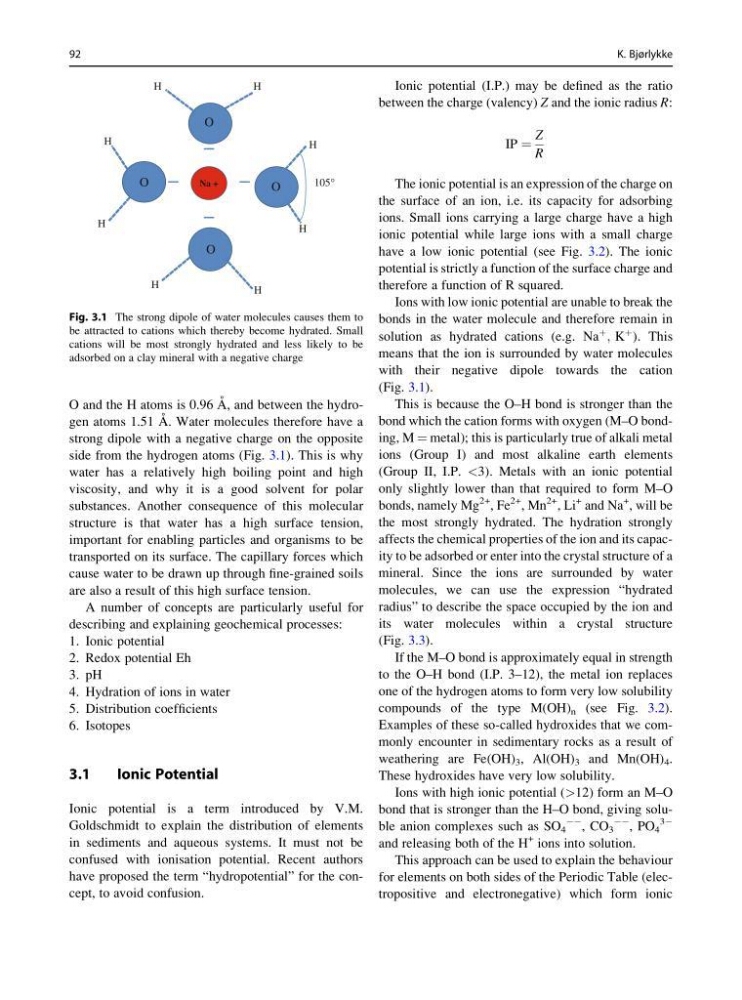
O and the H atoms is 0.96 A ˚ , and between the hydrogen atoms 1.51 A ˚ . Water molecules therefore have a
strong dipole with a negative charge on the opposite
side from the hydrogen atoms (Fig. 3.1). This is why
water has a relatively high boiling point and high
viscosity, and why it is a good solvent for polar
substances. Another consequence of this molecular
structure is that water has a high surface tension,
important for enabling particles and organisms to be
transported on its surface. The capillary forces which
cause water to be drawn up through fine-grained soils
are also a result of this high surface tension.
A number of concepts are particularly useful for
describing and explaining geochemical processes:
1. Ionic potential
2. Redox potential Eh
3. pH
4. Hydration of ions in water
5. Distribution coefficients
6. Isotopes
3.1
Ionic Potential
Ionic potential is a term introduced by V.M.
Goldschmidt to explain the distribution of elements
in sediments and aqueous systems. It must not be
confused with ionisation potential. Recent authors
have proposed the term “hydropotential” for the concept, to avoid confusion.
Ionic potential (I.P.) may be defined as the ratio
between the charge (valency) Z and the ionic radius R:
IP ¼
Z
R
The ionic potential is an expression of the charge on
the surface of an ion, i.e. its capacity for adsorbing
ions. Small ions carrying a large charge have a high
ionic potential while large ions with a small charge
have a low ionic potential (see Fig. 3.2). The ionic
potential is strictly a function of the surface charge and
therefore a function of R squared.
Ions with low ionic potential are unable to break the
bonds in the water molecule and therefore remain in
solution as hydrated cations (e.g. Na
þ
; K
þ ). This
means that the ion is surrounded by water molecules
with their negative dipole towards the cation
(Fig. 3.1).
This is because the O–H bond is stronger than the
bond which the cation forms with oxygen (M–O bonding, M ¼ metal); this is particularly true of alkali metal
ions (Group I) and most alkaline earth elements
(Group II, I.P. <3). Metals with an ionic potential
only slightly lower than that required to form M–O
bonds, namely Mg
2+ , Fe
2+ , Mn
2+ , Li
+ and Na
+ , will be
the most strongly hydrated. The hydration strongly
affects the chemical properties of the ion and its capacity to be adsorbed or enter into the crystal structure of a
mineral. Since the ions are surrounded by water
molecules, we can use the expression “hydrated
radius” to describe the space occupied by the ion and
its water molecules within a crystal structure
(Fig. 3.3).
If the M–O bond is approximately equal in strength
to the O–H bond (I.P. 3–12), the metal ion replaces
one of the hydrogen atoms to form very low solubility
compounds of the type M(OH) n (see Fig. 3.2).
Examples of these so-called hydroxides that we commonly encounter in sedimentary rocks as a result of
weathering are Fe(OH) 3 , Al(OH) 3 and Mn(OH) 4 .
These hydroxides have very low solubility.
Ions with high ionic potential (>12) form an M–O
bond that is stronger than the H–O bond, giving soluble anion complexes such as SO 4
ÀÀ , CO 3
ÀÀ , PO 4
3À
and releasing both of the H
+ ions into solution.
This approach can be used to explain the behaviour
for elements on both sides of the Periodic Table (electropositive and electronegative) which form ionic
Na +
H
H
H
H
H
H
H
H
O
O
O
O
105°
Fig. 3.1 The strong dipole of water molecules causes them to
be attracted to cations which thereby become hydrated. Small
cations will be most strongly hydrated and less likely to be
adsorbed on a clay mineral with a negative charge
92
K. Bjørlykke
strong dipole with a negative charge on the opposite
side from the hydrogen atoms (Fig. 3.1). This is why
water has a relatively high boiling point and high
viscosity, and why it is a good solvent for polar
substances. Another consequence of this molecular
structure is that water has a high surface tension,
important for enabling particles and organisms to be
transported on its surface. The capillary forces which
cause water to be drawn up through fine-grained soils
are also a result of this high surface tension.
A number of concepts are particularly useful for
describing and explaining geochemical processes:
1. Ionic potential
2. Redox potential Eh
3. pH
4. Hydration of ions in water
5. Distribution coefficients
6. Isotopes
3.1
Ionic Potential
Ionic potential is a term introduced by V.M.
Goldschmidt to explain the distribution of elements
in sediments and aqueous systems. It must not be
confused with ionisation potential. Recent authors
have proposed the term “hydropotential” for the concept, to avoid confusion.
Ionic potential (I.P.) may be defined as the ratio
between the charge (valency) Z and the ionic radius R:
IP ¼
Z
R
The ionic potential is an expression of the charge on
the surface of an ion, i.e. its capacity for adsorbing
ions. Small ions carrying a large charge have a high
ionic potential while large ions with a small charge
have a low ionic potential (see Fig. 3.2). The ionic
potential is strictly a function of the surface charge and
therefore a function of R squared.
Ions with low ionic potential are unable to break the
bonds in the water molecule and therefore remain in
solution as hydrated cations (e.g. Na
þ
; K
þ ). This
means that the ion is surrounded by water molecules
with their negative dipole towards the cation
(Fig. 3.1).
This is because the O–H bond is stronger than the
bond which the cation forms with oxygen (M–O bonding, M ¼ metal); this is particularly true of alkali metal
ions (Group I) and most alkaline earth elements
(Group II, I.P. <3). Metals with an ionic potential
only slightly lower than that required to form M–O
bonds, namely Mg
2+ , Fe
2+ , Mn
2+ , Li
+ and Na
+ , will be
the most strongly hydrated. The hydration strongly
affects the chemical properties of the ion and its capacity to be adsorbed or enter into the crystal structure of a
mineral. Since the ions are surrounded by water
molecules, we can use the expression “hydrated
radius” to describe the space occupied by the ion and
its water molecules within a crystal structure
(Fig. 3.3).
If the M–O bond is approximately equal in strength
to the O–H bond (I.P. 3–12), the metal ion replaces
one of the hydrogen atoms to form very low solubility
compounds of the type M(OH) n (see Fig. 3.2).
Examples of these so-called hydroxides that we commonly encounter in sedimentary rocks as a result of
weathering are Fe(OH) 3 , Al(OH) 3 and Mn(OH) 4 .
These hydroxides have very low solubility.
Ions with high ionic potential (>12) form an M–O
bond that is stronger than the H–O bond, giving soluble anion complexes such as SO 4
ÀÀ , CO 3
ÀÀ , PO 4
3À
and releasing both of the H
+ ions into solution.
This approach can be used to explain the behaviour
for elements on both sides of the Periodic Table (electropositive and electronegative) which form ionic
Na +
H
H
H
H
H
H
H
H
O
O
O
O
105°
Fig. 3.1 The strong dipole of water molecules causes them to
be attracted to cations which thereby become hydrated. Small
cations will be most strongly hydrated and less likely to be
adsorbed on a clay mineral with a negative charge
92
K. Bjørlykke