

sediment may also be carried down with the
subducting plates. The supply of sediment to the
deep-sea trenches themselves is often very limited,
which is why they do not fill up with sediment. They
represent the greatest depths in the ocean (up to
10 km) and this can be explained isostatically by the
fact that the oceanic plate which is undergoing subduction is cold, and therefore heavy. The downward
movement acts against the direction of heat flow,
resulting in low geothermal gradients and therefore
dense crust.
The sediments may be pelagic oozes or distal
turbidites. Since the oceanic plate is moving towards
the island arc, the sediments on the oceanic crust have
been deposited further away from the sediment source,
and in consequence we do not normally have very
thick sedimentary sequences in the subducting plate.
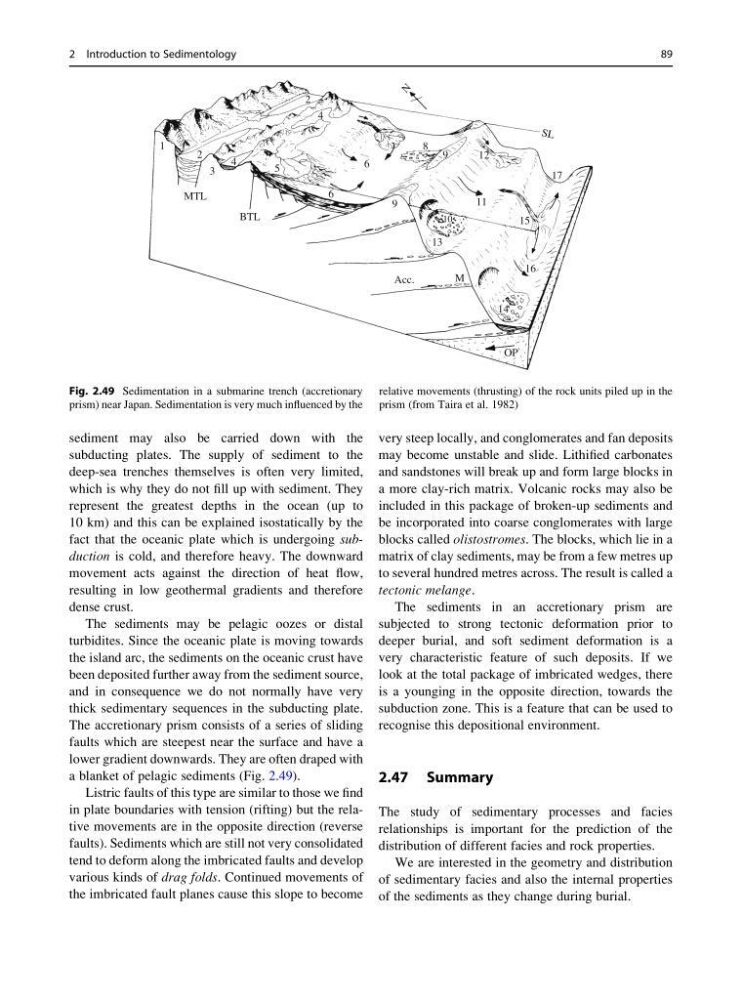
The accretionary prism consists of a series of sliding
faults which are steepest near the surface and have a
lower gradient downwards. They are often draped with
a blanket of pelagic sediments (Fig. 2.49).
Listric faults of this type are similar to those we find
in plate boundaries with tension (rifting) but the relative movements are in the opposite direction (reverse
faults). Sediments which are still not very consolidated
tend to deform along the imbricated faults and develop
various kinds of drag folds. Continued movements of
the imbricated fault planes cause this slope to become
very steep locally, and conglomerates and fan deposits
may become unstable and slide. Lithified carbonates
and sandstones will break up and form large blocks in
a more clay-rich matrix. Volcanic rocks may also be
included in this package of broken-up sediments and
be incorporated into coarse conglomerates with large
blocks called olistostromes. The blocks, which lie in a
matrix of clay sediments, may be from a few metres up
to several hundred metres across. The result is called a
tectonic melange.
The sediments in an accretionary prism are
subjected to strong tectonic deformation prior to
deeper burial, and soft sediment deformation is a
very characteristic feature of such deposits. If we
look at the total package of imbricated wedges, there
is a younging in the opposite direction, towards the
subduction zone. This is a feature that can be used to
recognise this depositional environment.
2.47 Summary
The study of sedimentary processes and facies
relationships is important for the prediction of the
distribution of different facies and rock properties.
We are interested in the geometry and distribution
of sedimentary facies and also the internal properties
of the sediments as they change during burial.
1
2
3
MTL
BTL
5
4
4
2
6
6
9
13
10
Acc.
M
16
14
OP
15
17
11
12
9
8
N
SL
Fig. 2.49 Sedimentation in a submarine trench (accretionary
prism) near Japan. Sedimentation is very much influenced by the
relative movements (thrusting) of the rock units piled up in the
prism (from Taira et al. 1982)
2 Introduction to Sedimentology
89
subducting plates. The supply of sediment to the
deep-sea trenches themselves is often very limited,
which is why they do not fill up with sediment. They
represent the greatest depths in the ocean (up to
10 km) and this can be explained isostatically by the
fact that the oceanic plate which is undergoing subduction is cold, and therefore heavy. The downward
movement acts against the direction of heat flow,
resulting in low geothermal gradients and therefore
dense crust.
The sediments may be pelagic oozes or distal
turbidites. Since the oceanic plate is moving towards
the island arc, the sediments on the oceanic crust have
been deposited further away from the sediment source,
and in consequence we do not normally have very
thick sedimentary sequences in the subducting plate.
The accretionary prism consists of a series of sliding
faults which are steepest near the surface and have a
lower gradient downwards. They are often draped with
a blanket of pelagic sediments (Fig. 2.49).
Listric faults of this type are similar to those we find
in plate boundaries with tension (rifting) but the relative movements are in the opposite direction (reverse
faults). Sediments which are still not very consolidated
tend to deform along the imbricated faults and develop
various kinds of drag folds. Continued movements of
the imbricated fault planes cause this slope to become
very steep locally, and conglomerates and fan deposits
may become unstable and slide. Lithified carbonates
and sandstones will break up and form large blocks in
a more clay-rich matrix. Volcanic rocks may also be
included in this package of broken-up sediments and
be incorporated into coarse conglomerates with large
blocks called olistostromes. The blocks, which lie in a
matrix of clay sediments, may be from a few metres up
to several hundred metres across. The result is called a
tectonic melange.
The sediments in an accretionary prism are
subjected to strong tectonic deformation prior to
deeper burial, and soft sediment deformation is a
very characteristic feature of such deposits. If we
look at the total package of imbricated wedges, there
is a younging in the opposite direction, towards the
subduction zone. This is a feature that can be used to
recognise this depositional environment.
2.47 Summary
The study of sedimentary processes and facies
relationships is important for the prediction of the
distribution of different facies and rock properties.
We are interested in the geometry and distribution
of sedimentary facies and also the internal properties
of the sediments as they change during burial.
1
2
3
MTL
BTL
5
4
4
2
6
6
9
13
10
Acc.
M
16
14
OP
15
17
11
12
9
8
N
SL
Fig. 2.49 Sedimentation in a submarine trench (accretionary
prism) near Japan. Sedimentation is very much influenced by the
relative movements (thrusting) of the rock units piled up in the
prism (from Taira et al. 1982)
2 Introduction to Sedimentology
89