

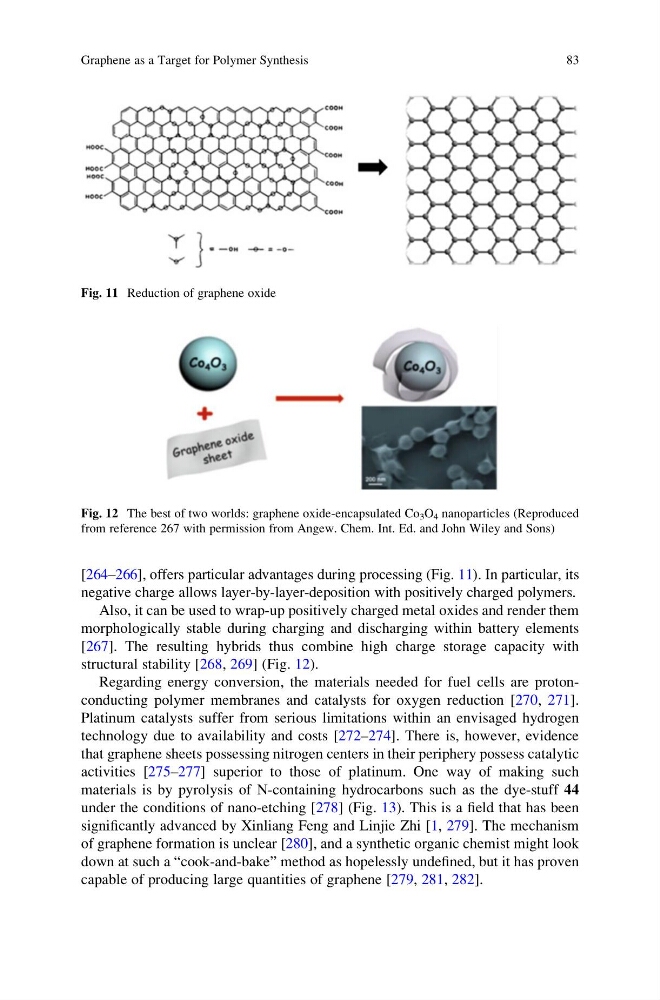
[264–266], offers particular advantages during processing (Fig. 11). In particular, its
negative charge allows layer-by-layer-deposition with positively charged polymers.
Also, it can be used to wrap-up positively charged metal oxides and render them
morphologically stable during charging and discharging within battery elements
[267]. The resulting hybrids thus combine high charge storage capacity with
structural stability [268, 269] (Fig. 12).
Regarding energy conversion, the materials needed for fuel cells are protonconducting polymer membranes and catalysts for oxygen reduction [270, 271].
Platinum catalysts suffer from serious limitations within an envisaged hydrogen
technology due to availability and costs [272–274]. There is, however, evidence
that graphene sheets possessing nitrogen centers in their periphery possess catalytic
activities [275–277] superior to those of platinum. One way of making such
materials is by pyrolysis of N-containing hydrocarbons such as the dye-stuff 44
under the conditions of nano-etching [278] (Fig. 13). This is a field that has been
significantly advanced by Xinliang Feng and Linjie Zhi [1, 279]. The mechanism
of graphene formation is unclear [280], and a synthetic organic chemist might look
down at such a “cook-and-bake” method as hopelessly undefined, but it has proven
capable of producing large quantities of graphene [279, 281, 282].
Fig. 11 Reduction of graphene oxide
Fig. 12 The best of two worlds: graphene oxide-encapsulated Co 3 O 4 nanoparticles (Reproduced
from reference 267 with permission from Angew. Chem. Int. Ed. and John Wiley and Sons)
Graphene as a Target for Polymer Synthesis
83
negative charge allows layer-by-layer-deposition with positively charged polymers.
Also, it can be used to wrap-up positively charged metal oxides and render them
morphologically stable during charging and discharging within battery elements
[267]. The resulting hybrids thus combine high charge storage capacity with
structural stability [268, 269] (Fig. 12).
Regarding energy conversion, the materials needed for fuel cells are protonconducting polymer membranes and catalysts for oxygen reduction [270, 271].
Platinum catalysts suffer from serious limitations within an envisaged hydrogen
technology due to availability and costs [272–274]. There is, however, evidence
that graphene sheets possessing nitrogen centers in their periphery possess catalytic
activities [275–277] superior to those of platinum. One way of making such
materials is by pyrolysis of N-containing hydrocarbons such as the dye-stuff 44
under the conditions of nano-etching [278] (Fig. 13). This is a field that has been
significantly advanced by Xinliang Feng and Linjie Zhi [1, 279]. The mechanism
of graphene formation is unclear [280], and a synthetic organic chemist might look
down at such a “cook-and-bake” method as hopelessly undefined, but it has proven
capable of producing large quantities of graphene [279, 281, 282].
Fig. 11 Reduction of graphene oxide
Fig. 12 The best of two worlds: graphene oxide-encapsulated Co 3 O 4 nanoparticles (Reproduced
from reference 267 with permission from Angew. Chem. Int. Ed. and John Wiley and Sons)
Graphene as a Target for Polymer Synthesis
83