

focused on armchair and cove-type peripheries, a transition to zig-zag edges has
important consequences for the electronic structure [13]. A cove-type edge occurs in
the octabenzocircumbiphenyl 29 introduced by Colin Nuckolls and coworkers [159];
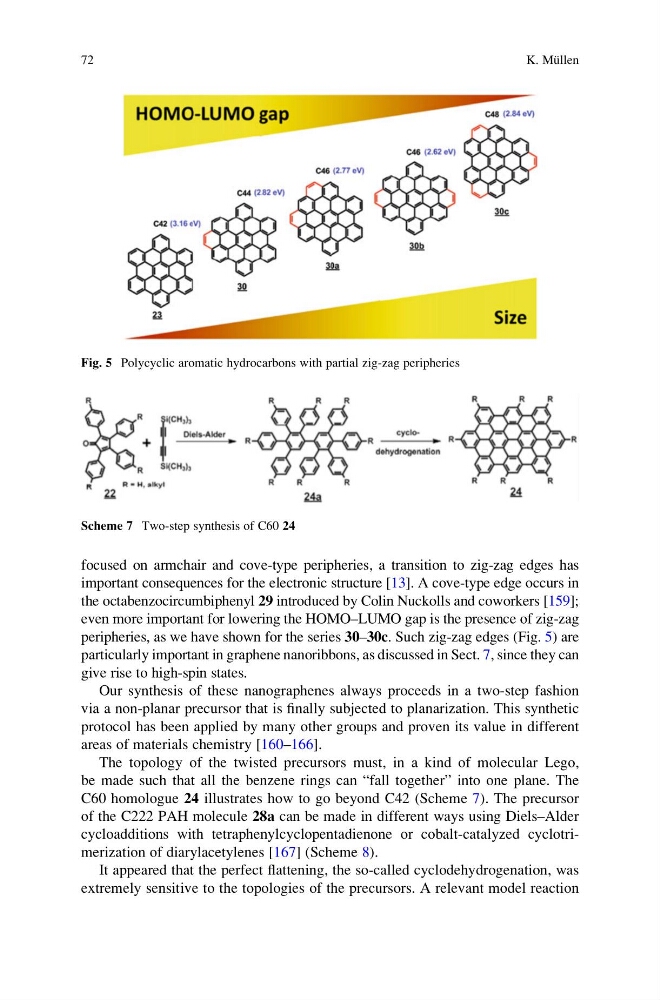
even more important for lowering the HOMO–LUMO gap is the presence of zig-zag
peripheries, as we have shown for the series 30–30c. Such zig-zag edges (Fig. 5) are
particularly important in graphene nanoribbons, as discussed in Sect. 7, since they can
give rise to high-spin states.
Our synthesis of these nanographenes always proceeds in a two-step fashion
via a non-planar precursor that is finally subjected to planarization. This synthetic
protocol has been applied by many other groups and proven its value in different
areas of materials chemistry [160–166].
The topology of the twisted precursors must, in a kind of molecular Lego,
be made such that all the benzene rings can “fall together” into one plane. The
C60 homologue 24 illustrates how to go beyond C42 (Scheme 7). The precursor
of the C222 PAH molecule 28a can be made in different ways using Diels–Alder
cycloadditions with tetraphenylcyclopentadienone or cobalt-catalyzed cyclotrimerization of diarylacetylenes [167] (Scheme 8).
It appeared that the perfect flattening, the so-called cyclodehydrogenation, was
extremely sensitive to the topologies of the precursors. A relevant model reaction
Fig. 5 Polycyclic aromatic hydrocarbons with partial zig-zag peripheries
Scheme 7 Two-step synthesis of C60 24
72
K. Mu ¨llen
important consequences for the electronic structure [13]. A cove-type edge occurs in
the octabenzocircumbiphenyl 29 introduced by Colin Nuckolls and coworkers [159];
even more important for lowering the HOMO–LUMO gap is the presence of zig-zag
peripheries, as we have shown for the series 30–30c. Such zig-zag edges (Fig. 5) are
particularly important in graphene nanoribbons, as discussed in Sect. 7, since they can
give rise to high-spin states.
Our synthesis of these nanographenes always proceeds in a two-step fashion
via a non-planar precursor that is finally subjected to planarization. This synthetic
protocol has been applied by many other groups and proven its value in different
areas of materials chemistry [160–166].
The topology of the twisted precursors must, in a kind of molecular Lego,
be made such that all the benzene rings can “fall together” into one plane. The
C60 homologue 24 illustrates how to go beyond C42 (Scheme 7). The precursor
of the C222 PAH molecule 28a can be made in different ways using Diels–Alder
cycloadditions with tetraphenylcyclopentadienone or cobalt-catalyzed cyclotrimerization of diarylacetylenes [167] (Scheme 8).
It appeared that the perfect flattening, the so-called cyclodehydrogenation, was
extremely sensitive to the topologies of the precursors. A relevant model reaction
Fig. 5 Polycyclic aromatic hydrocarbons with partial zig-zag peripheries
Scheme 7 Two-step synthesis of C60 24
72
K. Mu ¨llen