

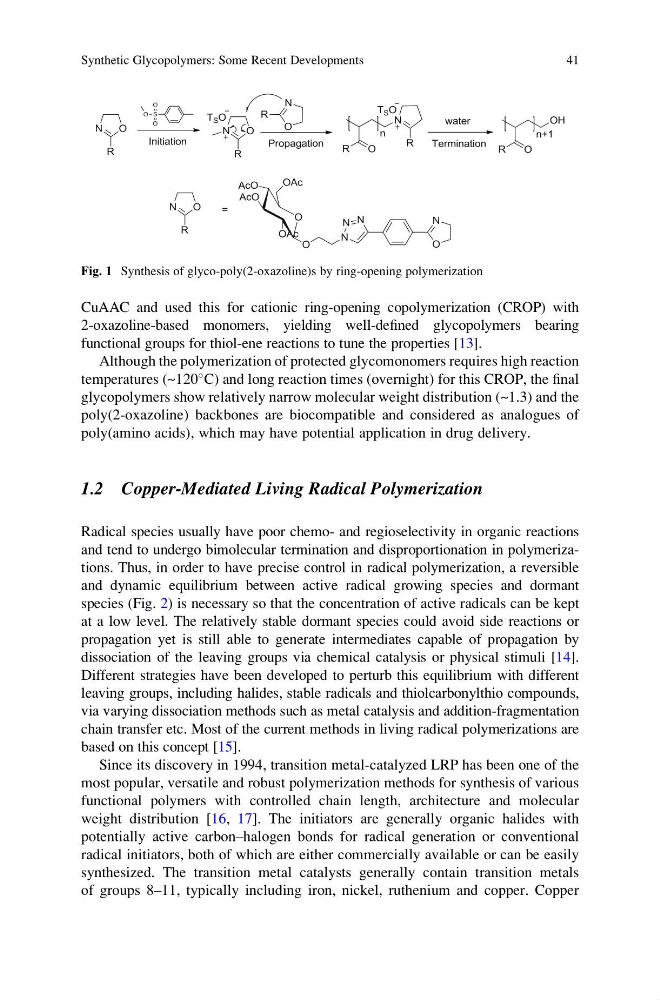
CuAAC and used this for cationic ring-opening copolymerization (CROP) with
2-oxazoline-based monomers, yielding well-defined glycopolymers bearing
functional groups for thiol-ene reactions to tune the properties [13].
Although the polymerization of protected glycomonomers requires high reaction
temperatures (~120
C) and long reaction times (overnight) for this CROP, the final
glycopolymers show relatively narrow molecular weight distribution (~1.3) and the
poly(2-oxazoline) backbones are biocompatible and considered as analogues of
poly(amino acids), which may have potential application in drug delivery.
1.2 Copper-Mediated Living Radical Polymerization
Radical species usually have poor chemo- and regioselectivity in organic reactions
and tend to undergo bimolecular termination and disproportionation in polymerizations. Thus, in order to have precise control in radical polymerization, a reversible
and dynamic equilibrium between active radical growing species and dormant
species (Fig. 2) is necessary so that the concentration of active radicals can be kept
at a low level. The relatively stable dormant species could avoid side reactions or
propagation yet is still able to generate intermediates capable of propagation by
dissociation of the leaving groups via chemical catalysis or physical stimuli [14].
Different strategies have been developed to perturb this equilibrium with different
leaving groups, including halides, stable radicals and thiolcarbonylthio compounds,
via varying dissociation methods such as metal catalysis and addition-fragmentation
chain transfer etc. Most of the current methods in living radical polymerizations are
based on this concept [15].
Since its discovery in 1994, transition metal-catalyzed LRP has been one of the
most popular, versatile and robust polymerization methods for synthesis of various
functional polymers with controlled chain length, architecture and molecular
weight distribution [16, 17]. The initiators are generally organic halides with
potentially active carbon–halogen bonds for radical generation or conventional
radical initiators, both of which are either commercially available or can be easily
synthesized. The transition metal catalysts generally contain transition metals
of groups 8–11, typically including iron, nickel, ruthenium and copper. Copper
Fig. 1 Synthesis of glyco-poly(2-oxazoline)s by ring-opening polymerization
Synthetic Glycopolymers: Some Recent Developments
41
2-oxazoline-based monomers, yielding well-defined glycopolymers bearing
functional groups for thiol-ene reactions to tune the properties [13].
Although the polymerization of protected glycomonomers requires high reaction
temperatures (~120
C) and long reaction times (overnight) for this CROP, the final
glycopolymers show relatively narrow molecular weight distribution (~1.3) and the
poly(2-oxazoline) backbones are biocompatible and considered as analogues of
poly(amino acids), which may have potential application in drug delivery.
1.2 Copper-Mediated Living Radical Polymerization
Radical species usually have poor chemo- and regioselectivity in organic reactions
and tend to undergo bimolecular termination and disproportionation in polymerizations. Thus, in order to have precise control in radical polymerization, a reversible
and dynamic equilibrium between active radical growing species and dormant
species (Fig. 2) is necessary so that the concentration of active radicals can be kept
at a low level. The relatively stable dormant species could avoid side reactions or
propagation yet is still able to generate intermediates capable of propagation by
dissociation of the leaving groups via chemical catalysis or physical stimuli [14].
Different strategies have been developed to perturb this equilibrium with different
leaving groups, including halides, stable radicals and thiolcarbonylthio compounds,
via varying dissociation methods such as metal catalysis and addition-fragmentation
chain transfer etc. Most of the current methods in living radical polymerizations are
based on this concept [15].
Since its discovery in 1994, transition metal-catalyzed LRP has been one of the
most popular, versatile and robust polymerization methods for synthesis of various
functional polymers with controlled chain length, architecture and molecular
weight distribution [16, 17]. The initiators are generally organic halides with
potentially active carbon–halogen bonds for radical generation or conventional
radical initiators, both of which are either commercially available or can be easily
synthesized. The transition metal catalysts generally contain transition metals
of groups 8–11, typically including iron, nickel, ruthenium and copper. Copper
Fig. 1 Synthesis of glyco-poly(2-oxazoline)s by ring-opening polymerization
Synthetic Glycopolymers: Some Recent Developments
41