

helices, provides a robust structure that is unperturbed under a variety of conditions,
including variation of pH, ionic strength, and temperature.
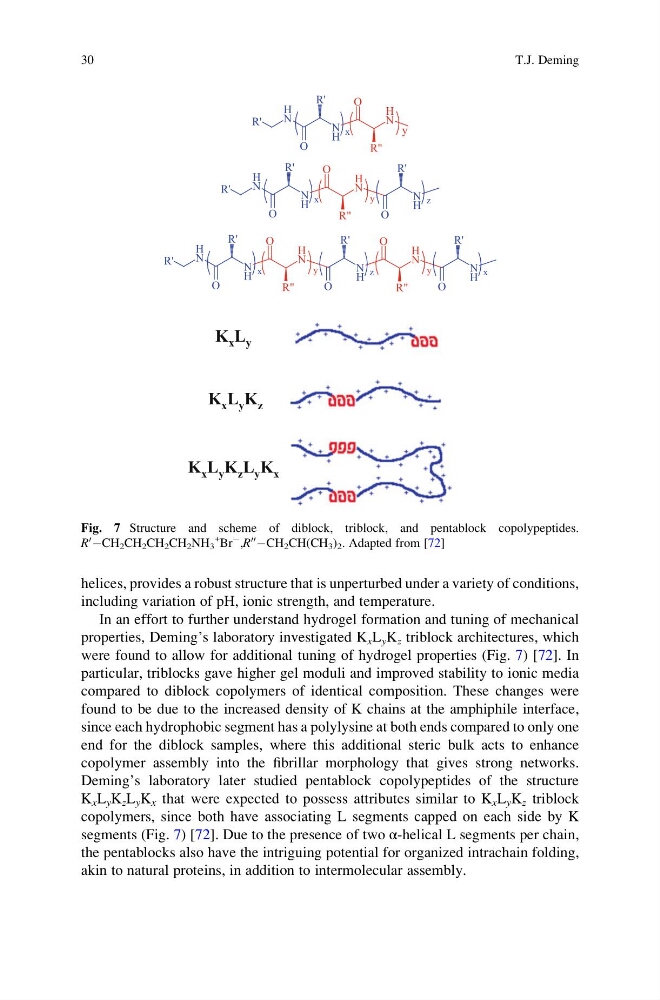
In an effort to further understand hydrogel formation and tuning of mechanical
properties, Deming’s laboratory investigated K x L y K z triblock architectures, which
were found to allow for additional tuning of hydrogel properties (Fig. 7) [72]. In
particular, triblocks gave higher gel moduli and improved stability to ionic media
compared to diblock copolymers of identical composition. These changes were
found to be due to the increased density of K chains at the amphiphile interface,
since each hydrophobic segment has a polylysine at both ends compared to only one
end for the diblock samples, where this additional steric bulk acts to enhance
copolymer assembly into the fibrillar morphology that gives strong networks.
Deming’s laboratory later studied pentablock copolypeptides of the structure
K x L y K z L y K x that were expected to possess attributes similar to K x L y K z triblock
copolymers, since both have associating L segments capped on each side by K
segments (Fig. 7) [72]. Due to the presence of two α-helical L segments per chain,
the pentablocks also have the intriguing potential for organized intrachain folding,
akin to natural proteins, in addition to intermolecular assembly.
N
H
N
H
N
H
O
O
x
y
R'
R'
R"
N
H
N
H
N
H
O
O
x
y
R'
R'
R"
N
H
O
z
R'
N
H
O
y
R"
N
H
O
x
R'
N
H
N
H
N
H
N
H
O
O
x
y
R'
R'
R"
O
z
R'
K x L y
K x L y K z
K x L y K z L y K x
Fig. 7 Structure and scheme of diblock, triblock, and pentablock copolypeptides.
R
0 ÀCH 2 CH 2 CH 2 CH 2 NH 3
+ Br
À ,R
00 ÀCH 2 CH(CH 3 ) 2 . Adapted from [72]
30
T.J. Deming
including variation of pH, ionic strength, and temperature.
In an effort to further understand hydrogel formation and tuning of mechanical
properties, Deming’s laboratory investigated K x L y K z triblock architectures, which
were found to allow for additional tuning of hydrogel properties (Fig. 7) [72]. In
particular, triblocks gave higher gel moduli and improved stability to ionic media
compared to diblock copolymers of identical composition. These changes were
found to be due to the increased density of K chains at the amphiphile interface,
since each hydrophobic segment has a polylysine at both ends compared to only one
end for the diblock samples, where this additional steric bulk acts to enhance
copolymer assembly into the fibrillar morphology that gives strong networks.
Deming’s laboratory later studied pentablock copolypeptides of the structure
K x L y K z L y K x that were expected to possess attributes similar to K x L y K z triblock
copolymers, since both have associating L segments capped on each side by K
segments (Fig. 7) [72]. Due to the presence of two α-helical L segments per chain,
the pentablocks also have the intriguing potential for organized intrachain folding,
akin to natural proteins, in addition to intermolecular assembly.
N
H
N
H
N
H
O
O
x
y
R'
R'
R"
N
H
N
H
N
H
O
O
x
y
R'
R'
R"
N
H
O
z
R'
N
H
O
y
R"
N
H
O
x
R'
N
H
N
H
N
H
N
H
O
O
x
y
R'
R'
R"
O
z
R'
K x L y
K x L y K z
K x L y K z L y K x
Fig. 7 Structure and scheme of diblock, triblock, and pentablock copolypeptides.
R
0 ÀCH 2 CH 2 CH 2 CH 2 NH 3
+ Br
À ,R
00 ÀCH 2 CH(CH 3 ) 2 . Adapted from [72]
30
T.J. Deming