

architecture, in addition to the conventional method of varying copolymer
concentration. By having many means to adjust gel strength, it is possible to
optimize or adjust other hydrogel properties (i.e., mesh size, injectability, or surface
functionality) while keeping gel strength constant.
To test their suitability for cell culture applications, hydrogel samples were also
prepared in DMEM and DMEM containing 5% fetal calf serum and penicillin
[113]. Samples of K 170 L 30 hydrogels were found to be stable and remained
transparent in these media, which was somewhat surprising, since they contain
numerous multivalent ions and anionically charged proteins. It is likely that the
proteins coat the polylysine segments in the gel since it is known that polylysine
homopolymer will complex with many serum proteins in solution [114].
Apparently, the resulting polyelectrolyte complexes retain enough charge or
hydrophilicity to solubilize the hydrophobic gel scaffold and prevent precipitation
and collapse of the network. The porous microscale morphology was found to
persist in the K 170 L 30 hydrogels in both the presence of 150 mM NaCl and in
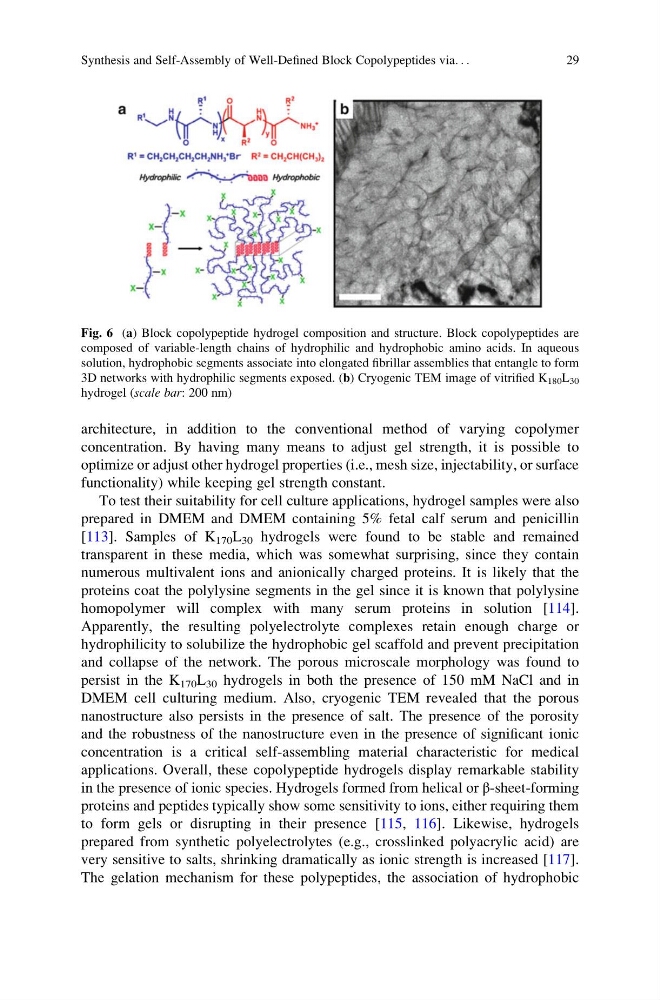
DMEM cell culturing medium. Also, cryogenic TEM revealed that the porous
nanostructure also persists in the presence of salt. The presence of the porosity
and the robustness of the nanostructure even in the presence of significant ionic
concentration is a critical self-assembling material characteristic for medical
applications. Overall, these copolypeptide hydrogels display remarkable stability
in the presence of ionic species. Hydrogels formed from helical or β-sheet-forming
proteins and peptides typically show some sensitivity to ions, either requiring them
to form gels or disrupting in their presence [115, 116]. Likewise, hydrogels
prepared from synthetic polyelectrolytes (e.g., crosslinked polyacrylic acid) are
very sensitive to salts, shrinking dramatically as ionic strength is increased [117].
The gelation mechanism for these polypeptides, the association of hydrophobic
Fig. 6 (a) Block copolypeptide hydrogel composition and structure. Block copolypeptides are
composed of variable-length chains of hydrophilic and hydrophobic amino acids. In aqueous
solution, hydrophobic segments associate into elongated fibrillar assemblies that entangle to form
3D networks with hydrophilic segments exposed. (b) Cryogenic TEM image of vitrified K 180 L 30
hydrogel (scale bar: 200 nm)
Synthesis and Self-Assembly of Well-Defined Block Copolypeptides via. . .
29
concentration. By having many means to adjust gel strength, it is possible to
optimize or adjust other hydrogel properties (i.e., mesh size, injectability, or surface
functionality) while keeping gel strength constant.
To test their suitability for cell culture applications, hydrogel samples were also
prepared in DMEM and DMEM containing 5% fetal calf serum and penicillin
[113]. Samples of K 170 L 30 hydrogels were found to be stable and remained
transparent in these media, which was somewhat surprising, since they contain
numerous multivalent ions and anionically charged proteins. It is likely that the
proteins coat the polylysine segments in the gel since it is known that polylysine
homopolymer will complex with many serum proteins in solution [114].
Apparently, the resulting polyelectrolyte complexes retain enough charge or
hydrophilicity to solubilize the hydrophobic gel scaffold and prevent precipitation
and collapse of the network. The porous microscale morphology was found to
persist in the K 170 L 30 hydrogels in both the presence of 150 mM NaCl and in
DMEM cell culturing medium. Also, cryogenic TEM revealed that the porous
nanostructure also persists in the presence of salt. The presence of the porosity
and the robustness of the nanostructure even in the presence of significant ionic
concentration is a critical self-assembling material characteristic for medical
applications. Overall, these copolypeptide hydrogels display remarkable stability
in the presence of ionic species. Hydrogels formed from helical or β-sheet-forming
proteins and peptides typically show some sensitivity to ions, either requiring them
to form gels or disrupting in their presence [115, 116]. Likewise, hydrogels
prepared from synthetic polyelectrolytes (e.g., crosslinked polyacrylic acid) are
very sensitive to salts, shrinking dramatically as ionic strength is increased [117].
The gelation mechanism for these polypeptides, the association of hydrophobic
Fig. 6 (a) Block copolypeptide hydrogel composition and structure. Block copolypeptides are
composed of variable-length chains of hydrophilic and hydrophobic amino acids. In aqueous
solution, hydrophobic segments associate into elongated fibrillar assemblies that entangle to form
3D networks with hydrophilic segments exposed. (b) Cryogenic TEM image of vitrified K 180 L 30
hydrogel (scale bar: 200 nm)
Synthesis and Self-Assembly of Well-Defined Block Copolypeptides via. . .
29