

[108]. To replace natural materials, however, many structural and functional
features must be built into synthetic hydrogels. Desirable features include
biocompatibility; degradability to allow cell in-growth; injectability and fast setting
in the wound site; mechanical properties that can be tuned for different uses; control
over cell adhesion to the hydrogel matrix; and tunable sustained release of growth
factors and biologically active agents [109]. There are many examples where some,
or even most, of these features have been incorporated into hydrogels [110].
However, in many cases, hydrogel synthesis and formation becomes very
complicated, which limits the practicality of such materials. More importantly,
the complexity of these systems, combined with limited means for adjustment of
molecular parameters, leads to the inability for independent adjustment of most of
the features. For example, it would be advantageous to be able to adjust scaffold
rigidity while maintaining a constant hydrogel mesh size. Such a system would
allow one to directly measure the effects of scaffold rigidity on cell proliferation.
Also, since hydrogel degradation is commonly accomplished using degradable
crosslinkers (e.g., in PEG-based hydrogels) [109], it can be difficult to adjust
degradation rate without also altering crosslink density and, hence, initial gel
mechanical properties [109]. It would be advantageous to have a hydrogel system
where many of these desired adjustable features (e.g., gel strength, gel density,
adhesive capability, degradation rate, growth factor release rate) could be
controlled more or less independently so that meaningful evaluation of their roles
in applications could be systematically carried out. Currently, in many systems it is
difficult to identify the most important gel characteristics because many features are
adjusted simultaneously [110]. Synthetic block copolypeptide hydrogels provide a
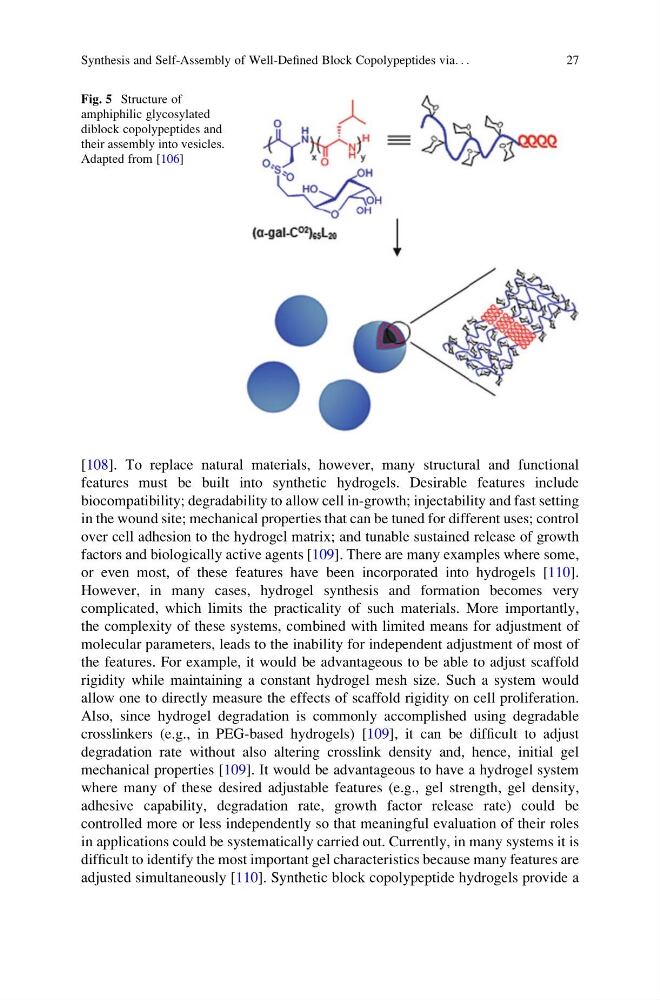
Fig. 5 Structure of
amphiphilic glycosylated
diblock copolypeptides and
their assembly into vesicles.
Adapted from [106]
Synthesis and Self-Assembly of Well-Defined Block Copolypeptides via. . .
27
features must be built into synthetic hydrogels. Desirable features include
biocompatibility; degradability to allow cell in-growth; injectability and fast setting
in the wound site; mechanical properties that can be tuned for different uses; control
over cell adhesion to the hydrogel matrix; and tunable sustained release of growth
factors and biologically active agents [109]. There are many examples where some,
or even most, of these features have been incorporated into hydrogels [110].
However, in many cases, hydrogel synthesis and formation becomes very
complicated, which limits the practicality of such materials. More importantly,
the complexity of these systems, combined with limited means for adjustment of
molecular parameters, leads to the inability for independent adjustment of most of
the features. For example, it would be advantageous to be able to adjust scaffold
rigidity while maintaining a constant hydrogel mesh size. Such a system would
allow one to directly measure the effects of scaffold rigidity on cell proliferation.
Also, since hydrogel degradation is commonly accomplished using degradable
crosslinkers (e.g., in PEG-based hydrogels) [109], it can be difficult to adjust
degradation rate without also altering crosslink density and, hence, initial gel
mechanical properties [109]. It would be advantageous to have a hydrogel system
where many of these desired adjustable features (e.g., gel strength, gel density,
adhesive capability, degradation rate, growth factor release rate) could be
controlled more or less independently so that meaningful evaluation of their roles
in applications could be systematically carried out. Currently, in many systems it is
difficult to identify the most important gel characteristics because many features are
adjusted simultaneously [110]. Synthetic block copolypeptide hydrogels provide a
Fig. 5 Structure of
amphiphilic glycosylated
diblock copolypeptides and
their assembly into vesicles.
Adapted from [106]
Synthesis and Self-Assembly of Well-Defined Block Copolypeptides via. . .
27