

N
H
O
N
H
O
y
x
H 3 N
OH
OH
N
H
O
N
H
O
y
x
NH 3
O
O
H
N
H
O
N
H
O
y
x
H 3 N
O
OH
+ Cl -
Oxidation
+ Cl -
+
Cl -
ð18Þ
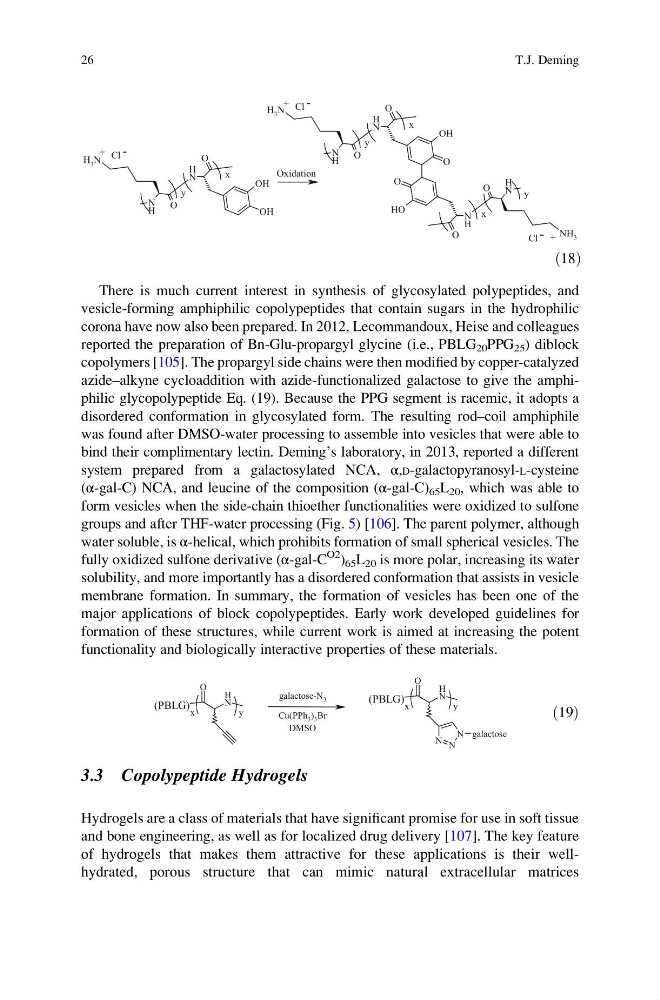
There is much current interest in synthesis of glycosylated polypeptides, and
vesicle-forming amphiphilic copolypeptides that contain sugars in the hydrophilic
corona have now also been prepared. In 2012, Lecommandoux, Heise and colleagues
reported the preparation of Bn-Glu-propargyl glycine (i.e., PBLG 20 PPG 25 ) diblock
copolymers [105]. The propargyl side chains were then modified by copper-catalyzed
azide–alkyne cycloaddition with azide-functionalized galactose to give the amphiphilic glycopolypeptide Eq. (19). Because the PPG segment is racemic, it adopts a
disordered conformation in glycosylated form. The resulting rod–coil amphiphile
was found after DMSO-water processing to assemble into vesicles that were able to
bind their complimentary lectin. Deming’s laboratory, in 2013, reported a different
system prepared from a galactosylated NCA, α,D-galactopyranosyl-L-cysteine
(α-gal-C) NCA, and leucine of the composition (α-gal-C) 65 L 20 , which was able to
form vesicles when the side-chain thioether functionalities were oxidized to sulfone
groups and after THF-water processing (Fig. 5) [106]. The parent polymer, although
water soluble, is α-helical, which prohibits formation of small spherical vesicles. The
fully oxidized sulfone derivative (α-gal-C
O2
) 65 L 20 is more polar, increasing its water
solubility, and more importantly has a disordered conformation that assists in vesicle
membrane formation. In summary, the formation of vesicles has been one of the
major applications of block copolypeptides. Early work developed guidelines for
formation of these structures, while current work is aimed at increasing the potent
functionality and biologically interactive properties of these materials.
N
H
O
*
N N
N
N
H
O
*
galactose
(PBLG)
x
galactose-N 3
y
Cu(PPh 3 ) 3 Br
DMSO
(PBLG)
x
y
ð19Þ
3.3 Copolypeptide Hydrogels
Hydrogels are a class of materials that have significant promise for use in soft tissue
and bone engineering, as well as for localized drug delivery [107]. The key feature
of hydrogels that makes them attractive for these applications is their wellhydrated, porous structure that can mimic natural extracellular matrices
26
T.J. Deming
H
O
N
H
O
y
x
H 3 N
OH
OH
N
H
O
N
H
O
y
x
NH 3
O
O
H
N
H
O
N
H
O
y
x
H 3 N
O
OH
+ Cl -
Oxidation
+ Cl -
+
Cl -
ð18Þ
There is much current interest in synthesis of glycosylated polypeptides, and
vesicle-forming amphiphilic copolypeptides that contain sugars in the hydrophilic
corona have now also been prepared. In 2012, Lecommandoux, Heise and colleagues
reported the preparation of Bn-Glu-propargyl glycine (i.e., PBLG 20 PPG 25 ) diblock
copolymers [105]. The propargyl side chains were then modified by copper-catalyzed
azide–alkyne cycloaddition with azide-functionalized galactose to give the amphiphilic glycopolypeptide Eq. (19). Because the PPG segment is racemic, it adopts a
disordered conformation in glycosylated form. The resulting rod–coil amphiphile
was found after DMSO-water processing to assemble into vesicles that were able to
bind their complimentary lectin. Deming’s laboratory, in 2013, reported a different
system prepared from a galactosylated NCA, α,D-galactopyranosyl-L-cysteine
(α-gal-C) NCA, and leucine of the composition (α-gal-C) 65 L 20 , which was able to
form vesicles when the side-chain thioether functionalities were oxidized to sulfone
groups and after THF-water processing (Fig. 5) [106]. The parent polymer, although
water soluble, is α-helical, which prohibits formation of small spherical vesicles. The
fully oxidized sulfone derivative (α-gal-C
O2
) 65 L 20 is more polar, increasing its water
solubility, and more importantly has a disordered conformation that assists in vesicle
membrane formation. In summary, the formation of vesicles has been one of the
major applications of block copolypeptides. Early work developed guidelines for
formation of these structures, while current work is aimed at increasing the potent
functionality and biologically interactive properties of these materials.
N
H
O
*
N N
N
N
H
O
*
galactose
(PBLG)
x
galactose-N 3
y
Cu(PPh 3 ) 3 Br
DMSO
(PBLG)
x
y
ð19Þ
3.3 Copolypeptide Hydrogels
Hydrogels are a class of materials that have significant promise for use in soft tissue
and bone engineering, as well as for localized drug delivery [107]. The key feature
of hydrogels that makes them attractive for these applications is their wellhydrated, porous structure that can mimic natural extracellular matrices
26
T.J. Deming