

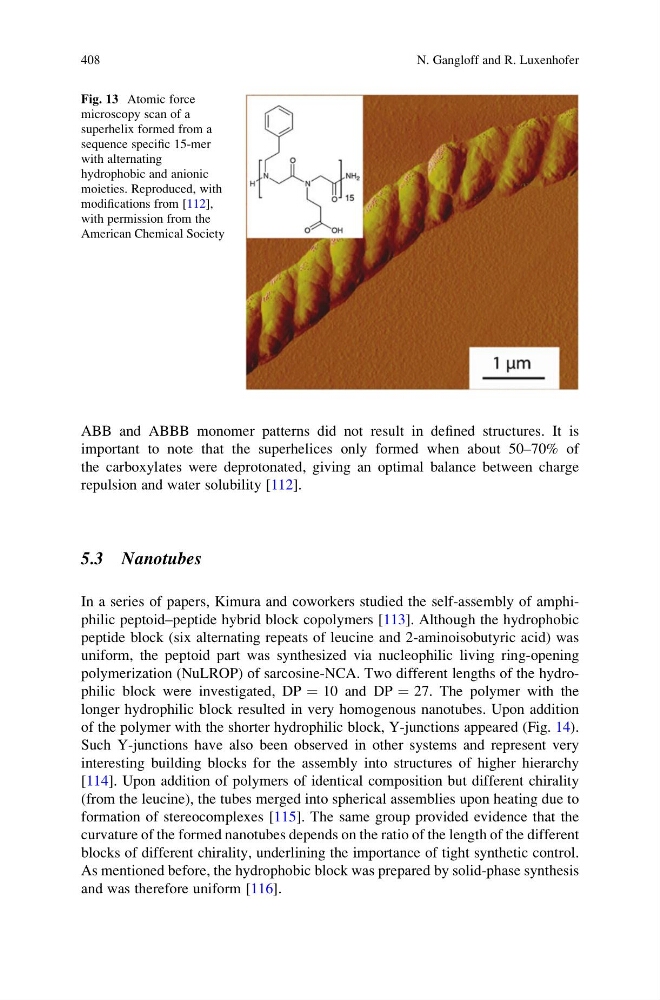
ABB and ABBB monomer patterns did not result in defined structures. It is
important to note that the superhelices only formed when about 50–70% of
the carboxylates were deprotonated, giving an optimal balance between charge
repulsion and water solubility [112].
5.3 Nanotubes
In a series of papers, Kimura and coworkers studied the self-assembly of amphiphilic peptoid–peptide hybrid block copolymers [113]. Although the hydrophobic
peptide block (six alternating repeats of leucine and 2-aminoisobutyric acid) was
uniform, the peptoid part was synthesized via nucleophilic living ring-opening
polymerization (NuLROP) of sarcosine-NCA. Two different lengths of the hydrophilic block were investigated, DP ¼ 10 and DP ¼ 27. The polymer with the
longer hydrophilic block resulted in very homogenous nanotubes. Upon addition
of the polymer with the shorter hydrophilic block, Y-junctions appeared (Fig. 14).
Such Y-junctions have also been observed in other systems and represent very
interesting building blocks for the assembly into structures of higher hierarchy
[114]. Upon addition of polymers of identical composition but different chirality
(from the leucine), the tubes merged into spherical assemblies upon heating due to
formation of stereocomplexes [115]. The same group provided evidence that the
curvature of the formed nanotubes depends on the ratio of the length of the different
blocks of different chirality, underlining the importance of tight synthetic control.
As mentioned before, the hydrophobic block was prepared by solid-phase synthesis
and was therefore uniform [116].
Fig. 13 Atomic force
microscopy scan of a
superhelix formed from a
sequence specific 15-mer
with alternating
hydrophobic and anionic
moieties. Reproduced, with
modifications from [112],
with permission from the
American Chemical Society
408
N. Gangloff and R. Luxenhofer
important to note that the superhelices only formed when about 50–70% of
the carboxylates were deprotonated, giving an optimal balance between charge
repulsion and water solubility [112].
5.3 Nanotubes
In a series of papers, Kimura and coworkers studied the self-assembly of amphiphilic peptoid–peptide hybrid block copolymers [113]. Although the hydrophobic
peptide block (six alternating repeats of leucine and 2-aminoisobutyric acid) was
uniform, the peptoid part was synthesized via nucleophilic living ring-opening
polymerization (NuLROP) of sarcosine-NCA. Two different lengths of the hydrophilic block were investigated, DP ¼ 10 and DP ¼ 27. The polymer with the
longer hydrophilic block resulted in very homogenous nanotubes. Upon addition
of the polymer with the shorter hydrophilic block, Y-junctions appeared (Fig. 14).
Such Y-junctions have also been observed in other systems and represent very
interesting building blocks for the assembly into structures of higher hierarchy
[114]. Upon addition of polymers of identical composition but different chirality
(from the leucine), the tubes merged into spherical assemblies upon heating due to
formation of stereocomplexes [115]. The same group provided evidence that the
curvature of the formed nanotubes depends on the ratio of the length of the different
blocks of different chirality, underlining the importance of tight synthetic control.
As mentioned before, the hydrophobic block was prepared by solid-phase synthesis
and was therefore uniform [116].
Fig. 13 Atomic force
microscopy scan of a
superhelix formed from a
sequence specific 15-mer
with alternating
hydrophobic and anionic
moieties. Reproduced, with
modifications from [112],
with permission from the
American Chemical Society
408
N. Gangloff and R. Luxenhofer