

5.2 Superhelices
Another important structural feature that can be viewed as a quaternary structure
according to our definition and that is regularly found in proteins and nucleic acids
is the superhelix (e.g. collagen fibrils) or coiled-coils.
Superhelices are also accessible via self-assembly of peptoids. For this, the same
peptoids that were described for sheet formation in the previous section were used.
Only in this case, peptoids of the same charge were dissolved in water. When
anionic and hydrophobic monomer units were strictly alternating, the polymers
formed nanosheets upon dissolution in water. After several days, however,
superhelical structures appeared that, once formed, were stable for months in
solution (Fig. 13). The helices were submicron (624 Æ 69 nm) in diameter and
were found to be up to 40 μm long. Most interestingly, the observed helices were
homochiral, despite the fact that the building blocks are achiral (Fig. 13). Again,
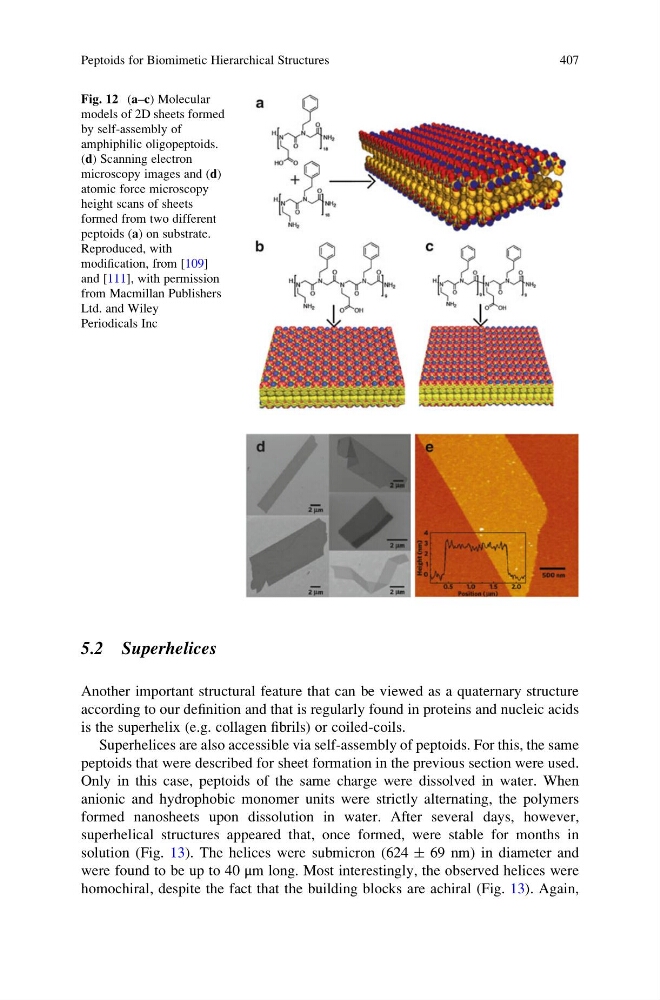
Fig. 12 (a–c) Molecular
models of 2D sheets formed
by self-assembly of
amphiphilic oligopeptoids.
(d) Scanning electron
microscopy images and (d)
atomic force microscopy
height scans of sheets
formed from two different
peptoids (a) on substrate.
Reproduced, with
modification, from [109]
and [111], with permission
from Macmillan Publishers
Ltd. and Wiley
Periodicals Inc
Peptoids for Biomimetic Hierarchical Structures
407
Another important structural feature that can be viewed as a quaternary structure
according to our definition and that is regularly found in proteins and nucleic acids
is the superhelix (e.g. collagen fibrils) or coiled-coils.
Superhelices are also accessible via self-assembly of peptoids. For this, the same
peptoids that were described for sheet formation in the previous section were used.
Only in this case, peptoids of the same charge were dissolved in water. When
anionic and hydrophobic monomer units were strictly alternating, the polymers
formed nanosheets upon dissolution in water. After several days, however,
superhelical structures appeared that, once formed, were stable for months in
solution (Fig. 13). The helices were submicron (624 Æ 69 nm) in diameter and
were found to be up to 40 μm long. Most interestingly, the observed helices were
homochiral, despite the fact that the building blocks are achiral (Fig. 13). Again,
Fig. 12 (a–c) Molecular
models of 2D sheets formed
by self-assembly of
amphiphilic oligopeptoids.
(d) Scanning electron
microscopy images and (d)
atomic force microscopy
height scans of sheets
formed from two different
peptoids (a) on substrate.
Reproduced, with
modification, from [109]
and [111], with permission
from Macmillan Publishers
Ltd. and Wiley
Periodicals Inc
Peptoids for Biomimetic Hierarchical Structures
407