

4.2 Multihelical Bundles
Bundles of helices are an important feature of tertiary structure in transmembrane
proteins and elsewhere. Zuckermann and co-workers used a combinatorial
approach to screen 3,400 different 15-mer peptoids for their ability to form
aggregates of helices [101]. As a design concept, every third residue unit was
chosen from a pool of 12 hydrophobic residues and the remaining monomer units
were hydrophilic. Such amphiphilic helices result in structures in which one sector
(approximately one third to one half of the outer surface) of the helix is hydrophobic
and the rest is hydrophilic (Fig. 11). Hits were identified by fluorescence assay
because peptoids that assemble into a structure with a hydrophobic core should
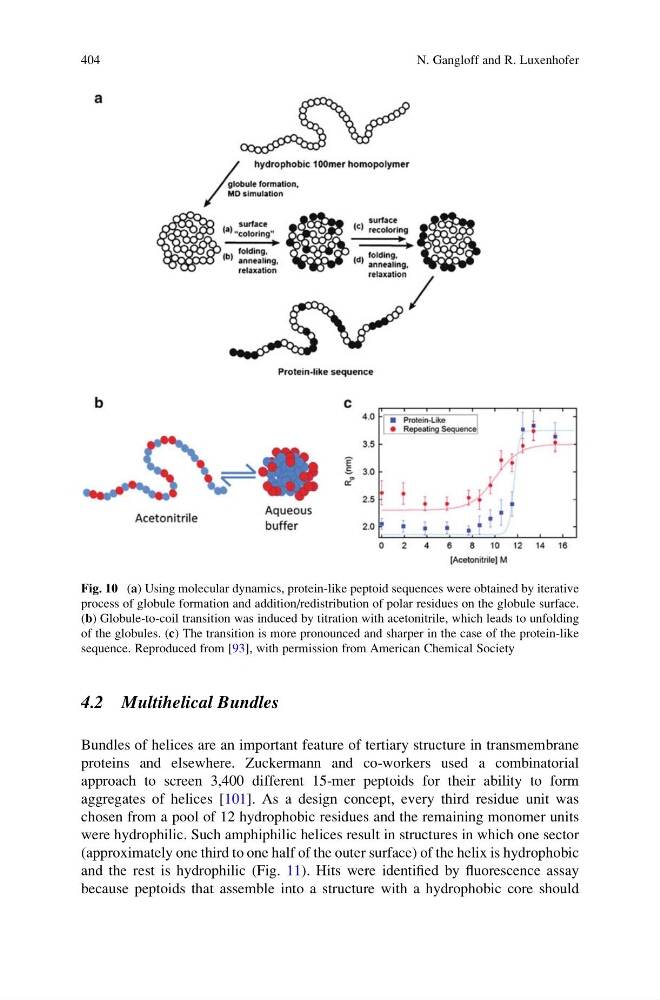
Fig. 10 (a) Using molecular dynamics, protein-like peptoid sequences were obtained by iterative
process of globule formation and addition/redistribution of polar residues on the globule surface.
(b) Globule-to-coil transition was induced by titration with acetonitrile, which leads to unfolding
of the globules. (c) The transition is more pronounced and sharper in the case of the protein-like
sequence. Reproduced from [93], with permission from American Chemical Society
404
N. Gangloff and R. Luxenhofer
Bundles of helices are an important feature of tertiary structure in transmembrane
proteins and elsewhere. Zuckermann and co-workers used a combinatorial
approach to screen 3,400 different 15-mer peptoids for their ability to form
aggregates of helices [101]. As a design concept, every third residue unit was
chosen from a pool of 12 hydrophobic residues and the remaining monomer units
were hydrophilic. Such amphiphilic helices result in structures in which one sector
(approximately one third to one half of the outer surface) of the helix is hydrophobic
and the rest is hydrophilic (Fig. 11). Hits were identified by fluorescence assay
because peptoids that assemble into a structure with a hydrophobic core should
Fig. 10 (a) Using molecular dynamics, protein-like peptoid sequences were obtained by iterative
process of globule formation and addition/redistribution of polar residues on the globule surface.
(b) Globule-to-coil transition was induced by titration with acetonitrile, which leads to unfolding
of the globules. (c) The transition is more pronounced and sharper in the case of the protein-like
sequence. Reproduced from [93], with permission from American Chemical Society
404
N. Gangloff and R. Luxenhofer