

that such structures could be interesting as molecular wires and for the fabrication
of artificial photosynthetic complexes.
3.2 Loops, Turns, and Ribbons
Loops and turns are of fundamental importance in many proteins [79–82]. In order
to mimic proteins, the successful fabrication of such structures is an important
milestone. Barron, Radhakrishnan and coworkers were the first to report on a
peptoid nonamer that exhibits a loop-like structure [83]. Interestingly, the nonamer
comprised 1-phenylethyl substituents (Nspe 9 ) which, according to reasons
discussed earlier, is considered helicogenic. Indeed Nspe 6 and Nspe 12 did give
CD spectra that suggest a helical character of the peptoid, whereas the CD spectrum
of the nonamer Nspe 9 is quite distinct from the other two (Fig. 8). Instead of the
expected all-cis-conformation, four amide bonds were found to exhibit transconformation. Formation of the loop is entirely dependent on the formation of
H-bonding, which stands in contrast to the peptoid-based secondary structure
discussed hitherto. The loop becomes unstable in solvents that can undergo
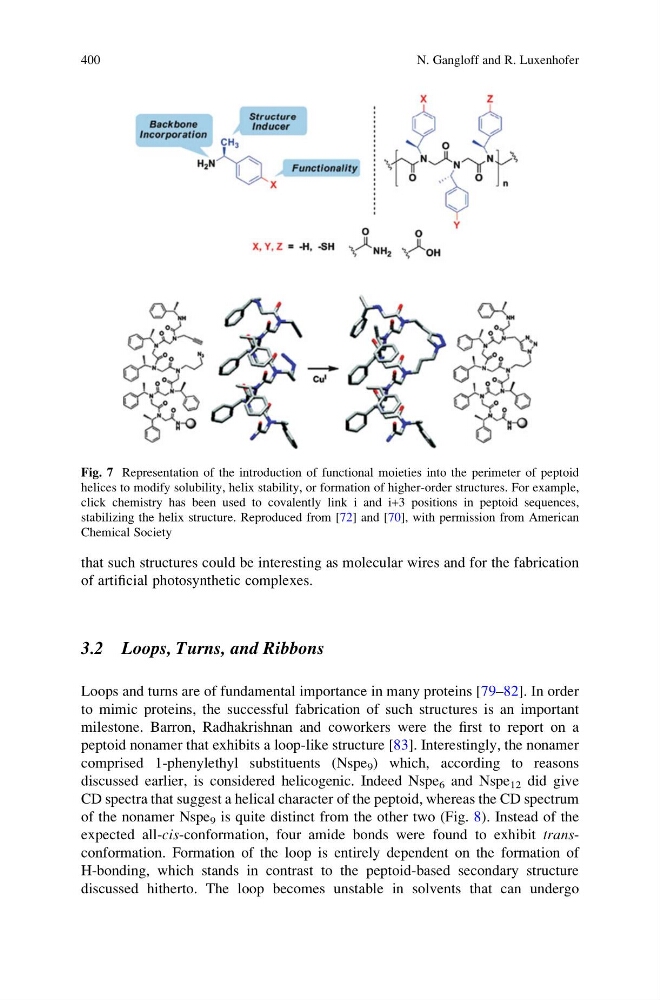
Fig. 7 Representation of the introduction of functional moieties into the perimeter of peptoid
helices to modify solubility, helix stability, or formation of higher-order structures. For example,
click chemistry has been used to covalently link i and i+3 positions in peptoid sequences,
stabilizing the helix structure. Reproduced from [72] and [70], with permission from American
Chemical Society
400
N. Gangloff and R. Luxenhofer
of artificial photosynthetic complexes.
3.2 Loops, Turns, and Ribbons
Loops and turns are of fundamental importance in many proteins [79–82]. In order
to mimic proteins, the successful fabrication of such structures is an important
milestone. Barron, Radhakrishnan and coworkers were the first to report on a
peptoid nonamer that exhibits a loop-like structure [83]. Interestingly, the nonamer
comprised 1-phenylethyl substituents (Nspe 9 ) which, according to reasons
discussed earlier, is considered helicogenic. Indeed Nspe 6 and Nspe 12 did give
CD spectra that suggest a helical character of the peptoid, whereas the CD spectrum
of the nonamer Nspe 9 is quite distinct from the other two (Fig. 8). Instead of the
expected all-cis-conformation, four amide bonds were found to exhibit transconformation. Formation of the loop is entirely dependent on the formation of
H-bonding, which stands in contrast to the peptoid-based secondary structure
discussed hitherto. The loop becomes unstable in solvents that can undergo
Fig. 7 Representation of the introduction of functional moieties into the perimeter of peptoid
helices to modify solubility, helix stability, or formation of higher-order structures. For example,
click chemistry has been used to covalently link i and i+3 positions in peptoid sequences,
stabilizing the helix structure. Reproduced from [72] and [70], with permission from American
Chemical Society
400
N. Gangloff and R. Luxenhofer