

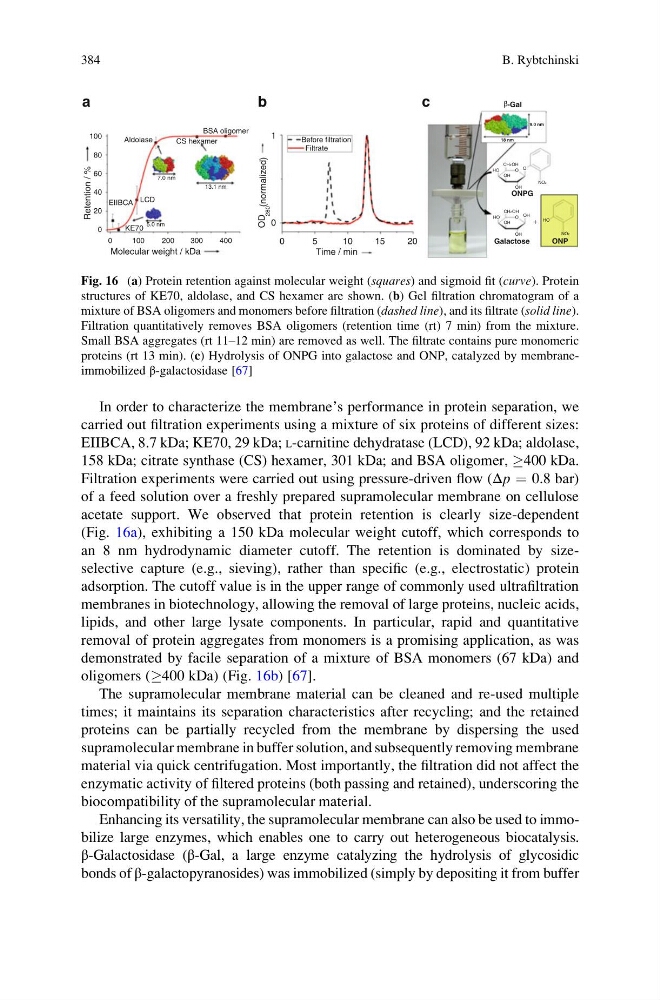
In order to characterize the membrane’s performance in protein separation, we
carried out filtration experiments using a mixture of six proteins of different sizes:
EIIBCA, 8.7 kDa; KE70, 29 kDa; L-carnitine dehydratase (LCD), 92 kDa; aldolase,
158 kDa; citrate synthase (CS) hexamer, 301 kDa; and BSA oligomer, !400 kDa.
Filtration experiments were carried out using pressure-driven flow (Δp ¼ 0.8 bar)
of a feed solution over a freshly prepared supramolecular membrane on cellulose
acetate support. We observed that protein retention is clearly size-dependent
(Fig. 16a), exhibiting a 150 kDa molecular weight cutoff, which corresponds to
an 8 nm hydrodynamic diameter cutoff. The retention is dominated by sizeselective capture (e.g., sieving), rather than specific (e.g., electrostatic) protein
adsorption. The cutoff value is in the upper range of commonly used ultrafiltration
membranes in biotechnology, allowing the removal of large proteins, nucleic acids,
lipids, and other large lysate components. In particular, rapid and quantitative
removal of protein aggregates from monomers is a promising application, as was
demonstrated by facile separation of a mixture of BSA monomers (67 kDa) and
oligomers (!400 kDa) (Fig. 16b) [67].
The supramolecular membrane material can be cleaned and re-used multiple
times; it maintains its separation characteristics after recycling; and the retained
proteins can be partially recycled from the membrane by dispersing the used
supramolecular membrane in buffer solution, and subsequently removing membrane
material via quick centrifugation. Most importantly, the filtration did not affect the
enzymatic activity of filtered proteins (both passing and retained), underscoring the
biocompatibility of the supramolecular material.
Enhancing its versatility, the supramolecular membrane can also be used to immobilize large enzymes, which enables one to carry out heterogeneous biocatalysis.
β-Galactosidase (β-Gal, a large enzyme catalyzing the hydrolysis of glycosidic
bonds of β-galactopyranosides) was immobilized (simply by depositing it from buffer
100
80
60
40
20
0
0
100
KE70
LCD
EIIBCA
Aldolase
BSA oligomer
CS hexamer
5.0 nm
7.0 nm
13.1 nm
Molecular weight / kDa
Retention / %
200
300
400
0
1
0
5
1 0
Time / min
Before filtration
Filtrate
(normalized)
OD
280
15
20
ONPG
-Gal
β
ONP
Galactose
OH
NO2
NO2
O
18 nm
9.0 nm
O
OH
HO
OH
CH2
OH
OH
+
O
OH
HO
HO
OH
CH2
a
b
c
Fig. 16 (a) Protein retention against molecular weight (squares) and sigmoid fit (curve). Protein
structures of KE70, aldolase, and CS hexamer are shown. (b) Gel filtration chromatogram of a
mixture of BSA oligomers and monomers before filtration (dashed line), and its filtrate (solid line).
Filtration quantitatively removes BSA oligomers (retention time (rt) 7 min) from the mixture.
Small BSA aggregates (rt 11–12 min) are removed as well. The filtrate contains pure monomeric
proteins (rt 13 min). (c) Hydrolysis of ONPG into galactose and ONP, catalyzed by membraneimmobilized β-galactosidase [67]
384
B. Rybtchinski
carried out filtration experiments using a mixture of six proteins of different sizes:
EIIBCA, 8.7 kDa; KE70, 29 kDa; L-carnitine dehydratase (LCD), 92 kDa; aldolase,
158 kDa; citrate synthase (CS) hexamer, 301 kDa; and BSA oligomer, !400 kDa.
Filtration experiments were carried out using pressure-driven flow (Δp ¼ 0.8 bar)
of a feed solution over a freshly prepared supramolecular membrane on cellulose
acetate support. We observed that protein retention is clearly size-dependent
(Fig. 16a), exhibiting a 150 kDa molecular weight cutoff, which corresponds to
an 8 nm hydrodynamic diameter cutoff. The retention is dominated by sizeselective capture (e.g., sieving), rather than specific (e.g., electrostatic) protein
adsorption. The cutoff value is in the upper range of commonly used ultrafiltration
membranes in biotechnology, allowing the removal of large proteins, nucleic acids,
lipids, and other large lysate components. In particular, rapid and quantitative
removal of protein aggregates from monomers is a promising application, as was
demonstrated by facile separation of a mixture of BSA monomers (67 kDa) and
oligomers (!400 kDa) (Fig. 16b) [67].
The supramolecular membrane material can be cleaned and re-used multiple
times; it maintains its separation characteristics after recycling; and the retained
proteins can be partially recycled from the membrane by dispersing the used
supramolecular membrane in buffer solution, and subsequently removing membrane
material via quick centrifugation. Most importantly, the filtration did not affect the
enzymatic activity of filtered proteins (both passing and retained), underscoring the
biocompatibility of the supramolecular material.
Enhancing its versatility, the supramolecular membrane can also be used to immobilize large enzymes, which enables one to carry out heterogeneous biocatalysis.
β-Galactosidase (β-Gal, a large enzyme catalyzing the hydrolysis of glycosidic
bonds of β-galactopyranosides) was immobilized (simply by depositing it from buffer
100
80
60
40
20
0
0
100
KE70
LCD
EIIBCA
Aldolase
BSA oligomer
CS hexamer
5.0 nm
7.0 nm
13.1 nm
Molecular weight / kDa
Retention / %
200
300
400
0
1
0
5
1 0
Time / min
Before filtration
Filtrate
(normalized)
OD
280
15
20
ONPG
-Gal
β
ONP
Galactose
OH
NO2
NO2
O
18 nm
9.0 nm
O
OH
HO
OH
CH2
OH
OH
+
O
OH
HO
HO
OH
CH2
a
b
c
Fig. 16 (a) Protein retention against molecular weight (squares) and sigmoid fit (curve). Protein
structures of KE70, aldolase, and CS hexamer are shown. (b) Gel filtration chromatogram of a
mixture of BSA oligomers and monomers before filtration (dashed line), and its filtrate (solid line).
Filtration quantitatively removes BSA oligomers (retention time (rt) 7 min) from the mixture.
Small BSA aggregates (rt 11–12 min) are removed as well. The filtrate contains pure monomeric
proteins (rt 13 min). (c) Hydrolysis of ONPG into galactose and ONP, catalyzed by membraneimmobilized β-galactosidase [67]
384
B. Rybtchinski