

Importantly, the membrane’s stability critically depends on hydrophobic interactions. Addition of ethanol to the aqueous solution traversing the membrane drastically weakens these interactions, leading to an instantaneous disassembly of the
supramolecular membrane [61]. In this way, the membrane material is recycled: it is
easily cleaned, reassembled, and deposited again to produce another ultrafiltration
membrane, making possible multiple, consecutive recycling sequences with reproducible membrane performance (Fig. 15). Disassembly of the membrane with aqueous
ethanol also released retained nanoparticles. It is worthwhile noting that obtaining
retained particles is not always feasible with classic filters when using simple “deadend” filtration setups, Which are the ones most commonly used at the laboratory scale.
The simple fabrication of the membrane, as well as its performance, versatility
(filtration and chromatographic regimes), and recyclability represent a significant
advantage over conventional membranes with similar rejection properties and
performances.
4.2.2 Protein Separation
Following our work on nanoparticle separations, we were interested in membranebased separations of biological systems, such as proteins, DNA, and viruses, which
are important in the field of biotechnology, where polymeric ultrafiltration membranes are used on an industrial scale. Bioseparations represent two key challenges
for noncovalent materials: (1) stability at physiological pH and salt concentration,
and (2) biocompatibility, i.e., maintaining the structure and function of the filtered
biomolecules. In particular, the high salt concentrations under physiological conditions may significantly alter the structure of supramolecular assemblies,
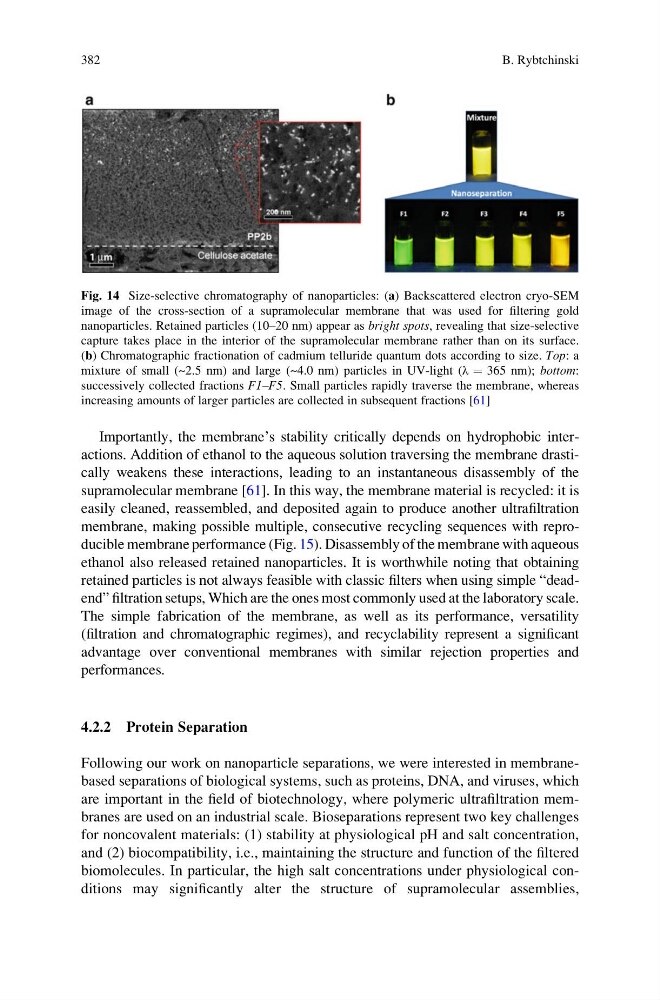
Fig. 14 Size-selective chromatography of nanoparticles: (a) Backscattered electron cryo-SEM
image of the cross-section of a supramolecular membrane that was used for filtering gold
nanoparticles. Retained particles (10–20 nm) appear as bright spots, revealing that size-selective
capture takes place in the interior of the supramolecular membrane rather than on its surface.
(b) Chromatographic fractionation of cadmium telluride quantum dots according to size. Top: a
mixture of small (~2.5 nm) and large (~4.0 nm) particles in UV-light (λ ¼ 365 nm); bottom:
successively collected fractions F1–F5. Small particles rapidly traverse the membrane, whereas
increasing amounts of larger particles are collected in subsequent fractions [61]
382
B. Rybtchinski
supramolecular membrane [61]. In this way, the membrane material is recycled: it is
easily cleaned, reassembled, and deposited again to produce another ultrafiltration
membrane, making possible multiple, consecutive recycling sequences with reproducible membrane performance (Fig. 15). Disassembly of the membrane with aqueous
ethanol also released retained nanoparticles. It is worthwhile noting that obtaining
retained particles is not always feasible with classic filters when using simple “deadend” filtration setups, Which are the ones most commonly used at the laboratory scale.
The simple fabrication of the membrane, as well as its performance, versatility
(filtration and chromatographic regimes), and recyclability represent a significant
advantage over conventional membranes with similar rejection properties and
performances.
4.2.2 Protein Separation
Following our work on nanoparticle separations, we were interested in membranebased separations of biological systems, such as proteins, DNA, and viruses, which
are important in the field of biotechnology, where polymeric ultrafiltration membranes are used on an industrial scale. Bioseparations represent two key challenges
for noncovalent materials: (1) stability at physiological pH and salt concentration,
and (2) biocompatibility, i.e., maintaining the structure and function of the filtered
biomolecules. In particular, the high salt concentrations under physiological conditions may significantly alter the structure of supramolecular assemblies,
Fig. 14 Size-selective chromatography of nanoparticles: (a) Backscattered electron cryo-SEM
image of the cross-section of a supramolecular membrane that was used for filtering gold
nanoparticles. Retained particles (10–20 nm) appear as bright spots, revealing that size-selective
capture takes place in the interior of the supramolecular membrane rather than on its surface.
(b) Chromatographic fractionation of cadmium telluride quantum dots according to size. Top: a
mixture of small (~2.5 nm) and large (~4.0 nm) particles in UV-light (λ ¼ 365 nm); bottom:
successively collected fractions F1–F5. Small particles rapidly traverse the membrane, whereas
increasing amounts of larger particles are collected in subsequent fractions [61]
382
B. Rybtchinski