

3 Summary, Conclusions, and Outlook
The main challenges in colloid chemistry nowadays are oriented towards the
strategic fields of health and medicine, energy and resource savings, and the design
of so-called smart materials allowing the automation of tasks without human
intervention. The colloids recently prepared have gained increased complexity
either in their shape, chemistry, and/or functions and their design has been largely
inspired by the cellular and subcellular systems present in nature. This is the case
for the block-copolymer assemblies in nanoparticles and nanocapsules that allows
for the coexistence of multicompartmentation and stimuli-responsive exchange of
chemicals in the same objects. Because the increase in complexity can be achieved
by colloid engineering but also by the subsequent utilization of other processes such
as electrospinning of nanoparticles [100], the portfolio of achievable structures is
almost unlimited.
A very interesting combination for the preparation of complex nanoparticles is
the use of miniemulsions droplets as templates to perform the evaporation of the
solvent. Indeed, miniemulsions are particularly stable colloidal systems without
significant mass transfer between the droplets, which in turn can be precisely tuned
by the concentration of the surfactant. It has been shown that the solvent evaporation process from miniemulsion droplets is uniquely suited to prepare a wide variety
of single- and multicompartment nanoparticles and nanoparticles with unprecedented properties. Furthermore, it was shown that the coalescence between
miniemulsion droplets does not significantly affect the size distribution of the
final nanoparticles obtained by the miniemulsion–solvent evaporation method
[52]. Recently, the process of emulsion–solvent evaporation has been significantly
improved by the emulsification step being possible without surfactant, and the solid
content being increased by successive and reversible aggregation/re-dispersion
steps.
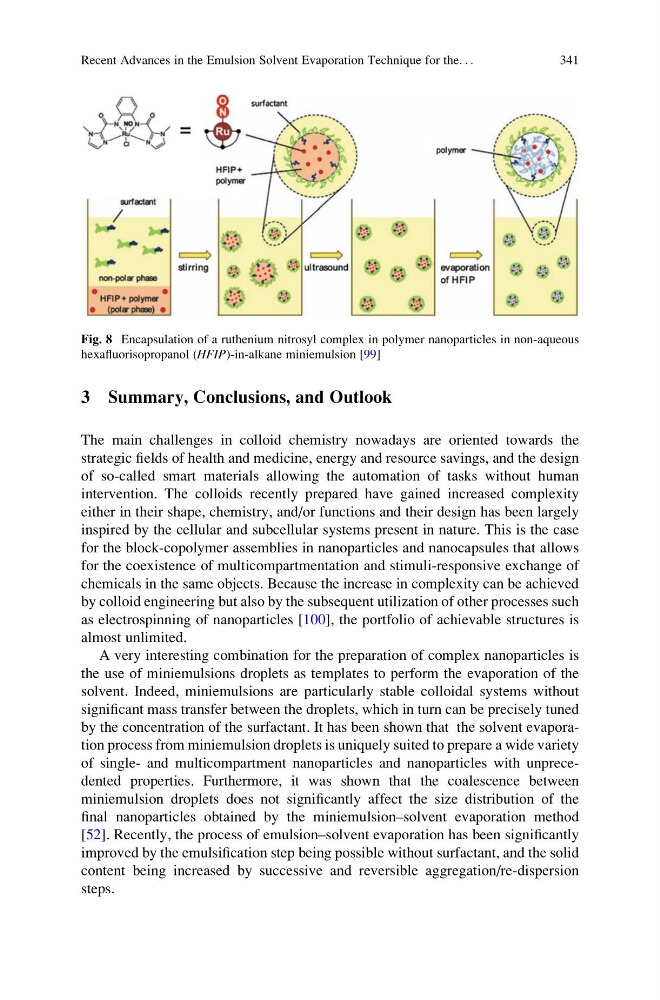
Fig. 8 Encapsulation of a ruthenium nitrosyl complex in polymer nanoparticles in non-aqueous
hexafluorisopropanol (HFIP)-in-alkane miniemulsion [99]
Recent Advances in the Emulsion Solvent Evaporation Technique for the. . .
341
The main challenges in colloid chemistry nowadays are oriented towards the
strategic fields of health and medicine, energy and resource savings, and the design
of so-called smart materials allowing the automation of tasks without human
intervention. The colloids recently prepared have gained increased complexity
either in their shape, chemistry, and/or functions and their design has been largely
inspired by the cellular and subcellular systems present in nature. This is the case
for the block-copolymer assemblies in nanoparticles and nanocapsules that allows
for the coexistence of multicompartmentation and stimuli-responsive exchange of
chemicals in the same objects. Because the increase in complexity can be achieved
by colloid engineering but also by the subsequent utilization of other processes such
as electrospinning of nanoparticles [100], the portfolio of achievable structures is
almost unlimited.
A very interesting combination for the preparation of complex nanoparticles is
the use of miniemulsions droplets as templates to perform the evaporation of the
solvent. Indeed, miniemulsions are particularly stable colloidal systems without
significant mass transfer between the droplets, which in turn can be precisely tuned
by the concentration of the surfactant. It has been shown that the solvent evaporation process from miniemulsion droplets is uniquely suited to prepare a wide variety
of single- and multicompartment nanoparticles and nanoparticles with unprecedented properties. Furthermore, it was shown that the coalescence between
miniemulsion droplets does not significantly affect the size distribution of the
final nanoparticles obtained by the miniemulsion–solvent evaporation method
[52]. Recently, the process of emulsion–solvent evaporation has been significantly
improved by the emulsification step being possible without surfactant, and the solid
content being increased by successive and reversible aggregation/re-dispersion
steps.
Fig. 8 Encapsulation of a ruthenium nitrosyl complex in polymer nanoparticles in non-aqueous
hexafluorisopropanol (HFIP)-in-alkane miniemulsion [99]
Recent Advances in the Emulsion Solvent Evaporation Technique for the. . .
341