

liquid core and forming a reservoir for the subsequent release of chemicals – was
married with the concept of stimuli-responsive materials. Indeed, chemicals could
be released from the reservoir compartment by selective oxidation of the responsive
patches of poly(vinyl ferrocene) [23].
As previously mentioned, multicompartment morphologies [69] were easily be
obtained by using block copolymers [23, 36–40, 62, 71–76]. Such structures can be
further compartmentalized by adding inorganic nanoparticles that preferentially
migrate to one domain [77, 78].
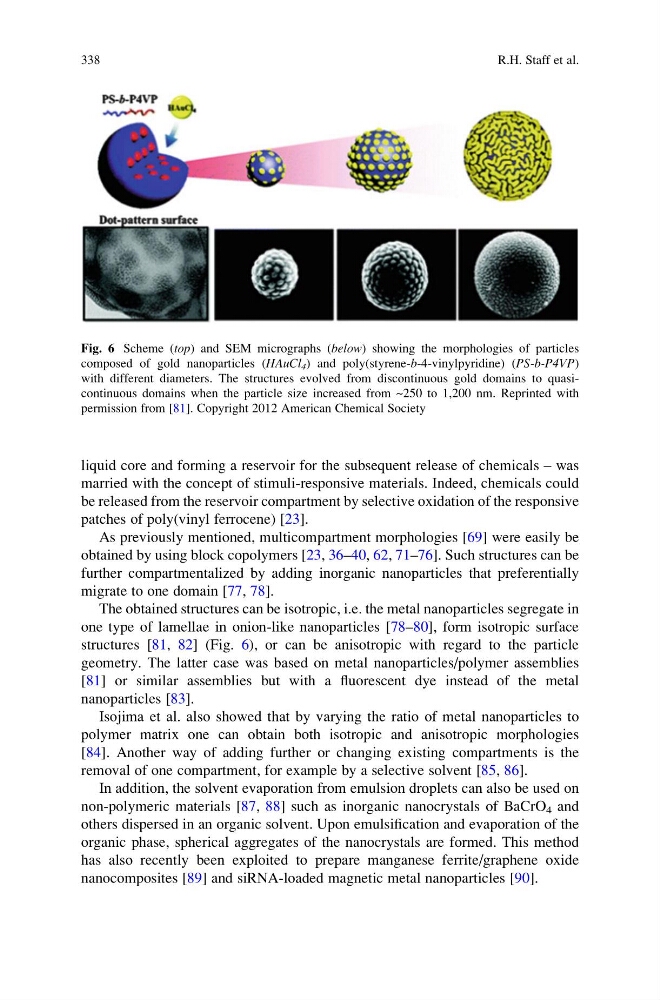
The obtained structures can be isotropic, i.e. the metal nanoparticles segregate in
one type of lamellae in onion-like nanoparticles [78–80], form isotropic surface
structures [81, 82] (Fig. 6), or can be anisotropic with regard to the particle
geometry. The latter case was based on metal nanoparticles/polymer assemblies
[81] or similar assemblies but with a fluorescent dye instead of the metal
nanoparticles [83].
Isojima et al. also showed that by varying the ratio of metal nanoparticles to
polymer matrix one can obtain both isotropic and anisotropic morphologies
[84]. Another way of adding further or changing existing compartments is the
removal of one compartment, for example by a selective solvent [85, 86].
In addition, the solvent evaporation from emulsion droplets can also be used on
non-polymeric materials [87, 88] such as inorganic nanocrystals of BaCrO 4 and
others dispersed in an organic solvent. Upon emulsification and evaporation of the
organic phase, spherical aggregates of the nanocrystals are formed. This method
has also recently been exploited to prepare manganese ferrite/graphene oxide
nanocomposites [89] and siRNA-loaded magnetic metal nanoparticles [90].
Fig. 6 Scheme (top) and SEM micrographs (below) showing the morphologies of particles
composed of gold nanoparticles (HAuCl 4 ) and poly(styrene-b-4-vinylpyridine) (PS-b-P4VP)
with different diameters. The structures evolved from discontinuous gold domains to quasicontinuous domains when the particle size increased from ~250 to 1,200 nm. Reprinted with
permission from [81]. Copyright 2012 American Chemical Society
338
R.H. Staff et al.
married with the concept of stimuli-responsive materials. Indeed, chemicals could
be released from the reservoir compartment by selective oxidation of the responsive
patches of poly(vinyl ferrocene) [23].
As previously mentioned, multicompartment morphologies [69] were easily be
obtained by using block copolymers [23, 36–40, 62, 71–76]. Such structures can be
further compartmentalized by adding inorganic nanoparticles that preferentially
migrate to one domain [77, 78].
The obtained structures can be isotropic, i.e. the metal nanoparticles segregate in
one type of lamellae in onion-like nanoparticles [78–80], form isotropic surface
structures [81, 82] (Fig. 6), or can be anisotropic with regard to the particle
geometry. The latter case was based on metal nanoparticles/polymer assemblies
[81] or similar assemblies but with a fluorescent dye instead of the metal
nanoparticles [83].
Isojima et al. also showed that by varying the ratio of metal nanoparticles to
polymer matrix one can obtain both isotropic and anisotropic morphologies
[84]. Another way of adding further or changing existing compartments is the
removal of one compartment, for example by a selective solvent [85, 86].
In addition, the solvent evaporation from emulsion droplets can also be used on
non-polymeric materials [87, 88] such as inorganic nanocrystals of BaCrO 4 and
others dispersed in an organic solvent. Upon emulsification and evaporation of the
organic phase, spherical aggregates of the nanocrystals are formed. This method
has also recently been exploited to prepare manganese ferrite/graphene oxide
nanocomposites [89] and siRNA-loaded magnetic metal nanoparticles [90].
Fig. 6 Scheme (top) and SEM micrographs (below) showing the morphologies of particles
composed of gold nanoparticles (HAuCl 4 ) and poly(styrene-b-4-vinylpyridine) (PS-b-P4VP)
with different diameters. The structures evolved from discontinuous gold domains to quasicontinuous domains when the particle size increased from ~250 to 1,200 nm. Reprinted with
permission from [81]. Copyright 2012 American Chemical Society
338
R.H. Staff et al.