

by the emulsion–solvent evaporation process. However, these theoretical studies
clearly show that many more interesting and highly complex morphologies could
be still prepared.
Kinetic morphologies are formed once the free Gibbs energy G s cannot be
minimized to its global minimum, but only to a kinetically stable local minimum.
The main reason for a kinetically trapped morphology is a hindered phase separation of the materials inside the particle. This phenomenon can occur when high
molecular weight polymers are employed in the process. As diffusion of the chains
is necessary for phase separation, one possibility to obtain kinetically trapped
morphologies is to increase the viscosity of the polymeric emulsion droplets
[68]. One possibility to control the viscosity inside the droplets of polymeric
emulsions is to vary the molecular weight of the polymer or the solubility of the
polymer in the chosen solvent. Additionally, both the evaporation temperature and
the evaporation rate of the solvent are of high importance for the build-up of a
thermodynamically stable morphology [36, 37, 69]. However, structures that
resemble kinetically trapped morphologies can also be thermodynamically stable
when specific ratios of block length in the block copolymers are achieved [23] or if
the phase separation occurs in the weak segregation limit [40]. Both cases were
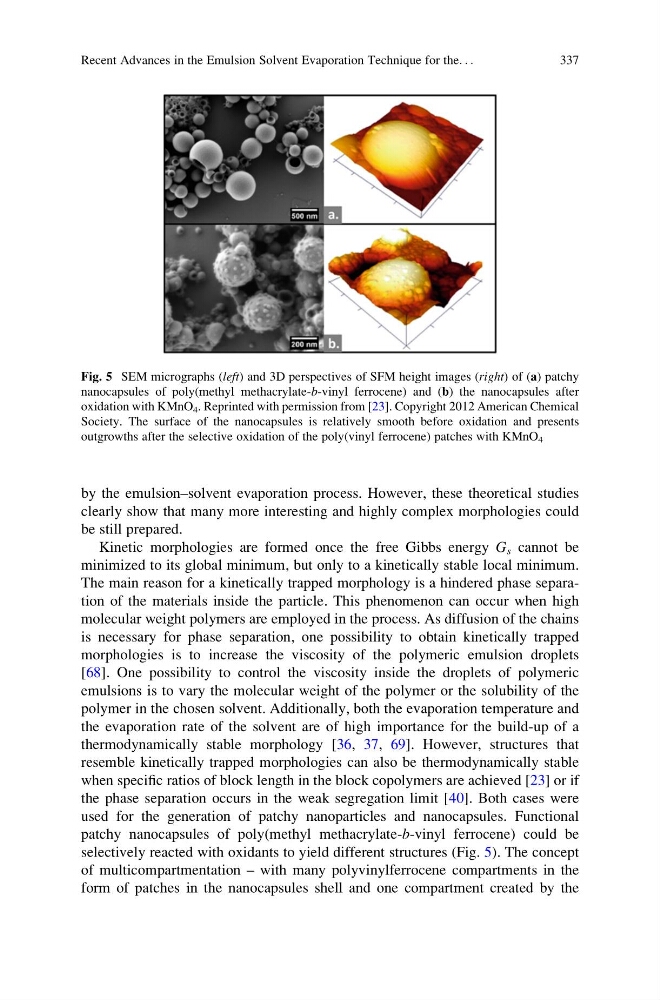
used for the generation of patchy nanoparticles and nanocapsules. Functional
patchy nanocapsules of poly(methyl methacrylate-b-vinyl ferrocene) could be
selectively reacted with oxidants to yield different structures (Fig. 5). The concept
of multicompartmentation – with many polyvinylferrocene compartments in the
form of patches in the nanocapsules shell and one compartment created by the
Fig. 5 SEM micrographs (left) and 3D perspectives of SFM height images (right) of (a) patchy
nanocapsules of poly(methyl methacrylate-b-vinyl ferrocene) and (b) the nanocapsules after
oxidation with KMnO 4 . Reprinted with permission from [23]. Copyright 2012 American Chemical
Society. The surface of the nanocapsules is relatively smooth before oxidation and presents
outgrowths after the selective oxidation of the poly(vinyl ferrocene) patches with KMnO 4
Recent Advances in the Emulsion Solvent Evaporation Technique for the. . .
337
clearly show that many more interesting and highly complex morphologies could
be still prepared.
Kinetic morphologies are formed once the free Gibbs energy G s cannot be
minimized to its global minimum, but only to a kinetically stable local minimum.
The main reason for a kinetically trapped morphology is a hindered phase separation of the materials inside the particle. This phenomenon can occur when high
molecular weight polymers are employed in the process. As diffusion of the chains
is necessary for phase separation, one possibility to obtain kinetically trapped
morphologies is to increase the viscosity of the polymeric emulsion droplets
[68]. One possibility to control the viscosity inside the droplets of polymeric
emulsions is to vary the molecular weight of the polymer or the solubility of the
polymer in the chosen solvent. Additionally, both the evaporation temperature and
the evaporation rate of the solvent are of high importance for the build-up of a
thermodynamically stable morphology [36, 37, 69]. However, structures that
resemble kinetically trapped morphologies can also be thermodynamically stable
when specific ratios of block length in the block copolymers are achieved [23] or if
the phase separation occurs in the weak segregation limit [40]. Both cases were
used for the generation of patchy nanoparticles and nanocapsules. Functional
patchy nanocapsules of poly(methyl methacrylate-b-vinyl ferrocene) could be
selectively reacted with oxidants to yield different structures (Fig. 5). The concept
of multicompartmentation – with many polyvinylferrocene compartments in the
form of patches in the nanocapsules shell and one compartment created by the
Fig. 5 SEM micrographs (left) and 3D perspectives of SFM height images (right) of (a) patchy
nanocapsules of poly(methyl methacrylate-b-vinyl ferrocene) and (b) the nanocapsules after
oxidation with KMnO 4 . Reprinted with permission from [23]. Copyright 2012 American Chemical
Society. The surface of the nanocapsules is relatively smooth before oxidation and presents
outgrowths after the selective oxidation of the poly(vinyl ferrocene) patches with KMnO 4
Recent Advances in the Emulsion Solvent Evaporation Technique for the. . .
337