

2.2 Colloidal Structures
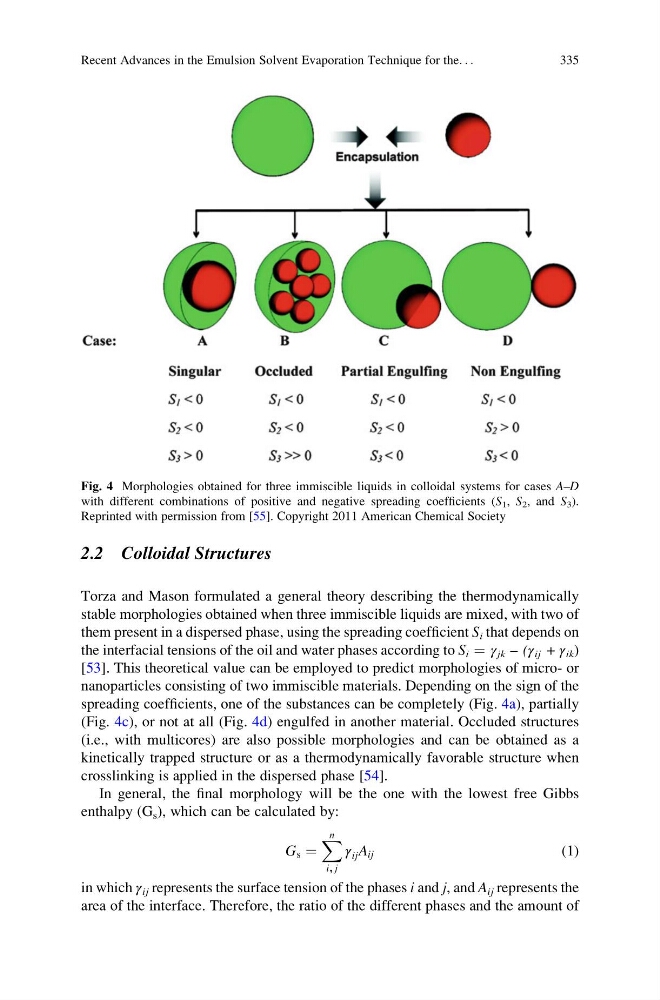
Torza and Mason formulated a general theory describing the thermodynamically
stable morphologies obtained when three immiscible liquids are mixed, with two of
them present in a dispersed phase, using the spreading coefficient S i that depends on
the interfacial tensions of the oil and water phases according to S i ¼ γ jk – (γ ij + γ ik )
[53]. This theoretical value can be employed to predict morphologies of micro- or
nanoparticles consisting of two immiscible materials. Depending on the sign of the
spreading coefficients, one of the substances can be completely (Fig. 4a), partially
(Fig. 4c), or not at all (Fig. 4d) engulfed in another material. Occluded structures
(i.e., with multicores) are also possible morphologies and can be obtained as a
kinetically trapped structure or as a thermodynamically favorable structure when
crosslinking is applied in the dispersed phase [54].
In general, the final morphology will be the one with the lowest free Gibbs
enthalpy (G s ), which can be calculated by:
G s ¼
X n
i, j
γ ij A ij
(1)
in which γ ij represents the surface tension of the phases i and j, and A ij represents the
area of the interface. Therefore, the ratio of the different phases and the amount of
Fig. 4 Morphologies obtained for three immiscible liquids in colloidal systems for cases A–D
with different combinations of positive and negative spreading coefficients (S 1 , S 2 , and S 3 ).
Reprinted with permission from [55]. Copyright 2011 American Chemical Society
Recent Advances in the Emulsion Solvent Evaporation Technique for the. . .
335
Torza and Mason formulated a general theory describing the thermodynamically
stable morphologies obtained when three immiscible liquids are mixed, with two of
them present in a dispersed phase, using the spreading coefficient S i that depends on
the interfacial tensions of the oil and water phases according to S i ¼ γ jk – (γ ij + γ ik )
[53]. This theoretical value can be employed to predict morphologies of micro- or
nanoparticles consisting of two immiscible materials. Depending on the sign of the
spreading coefficients, one of the substances can be completely (Fig. 4a), partially
(Fig. 4c), or not at all (Fig. 4d) engulfed in another material. Occluded structures
(i.e., with multicores) are also possible morphologies and can be obtained as a
kinetically trapped structure or as a thermodynamically favorable structure when
crosslinking is applied in the dispersed phase [54].
In general, the final morphology will be the one with the lowest free Gibbs
enthalpy (G s ), which can be calculated by:
G s ¼
X n
i, j
γ ij A ij
(1)
in which γ ij represents the surface tension of the phases i and j, and A ij represents the
area of the interface. Therefore, the ratio of the different phases and the amount of
Fig. 4 Morphologies obtained for three immiscible liquids in colloidal systems for cases A–D
with different combinations of positive and negative spreading coefficients (S 1 , S 2 , and S 3 ).
Reprinted with permission from [55]. Copyright 2011 American Chemical Society
Recent Advances in the Emulsion Solvent Evaporation Technique for the. . .
335