

on these measurements, it was concluded that coalescence plays an important role
in particle formation under certain conditions. However, it was shown recently by
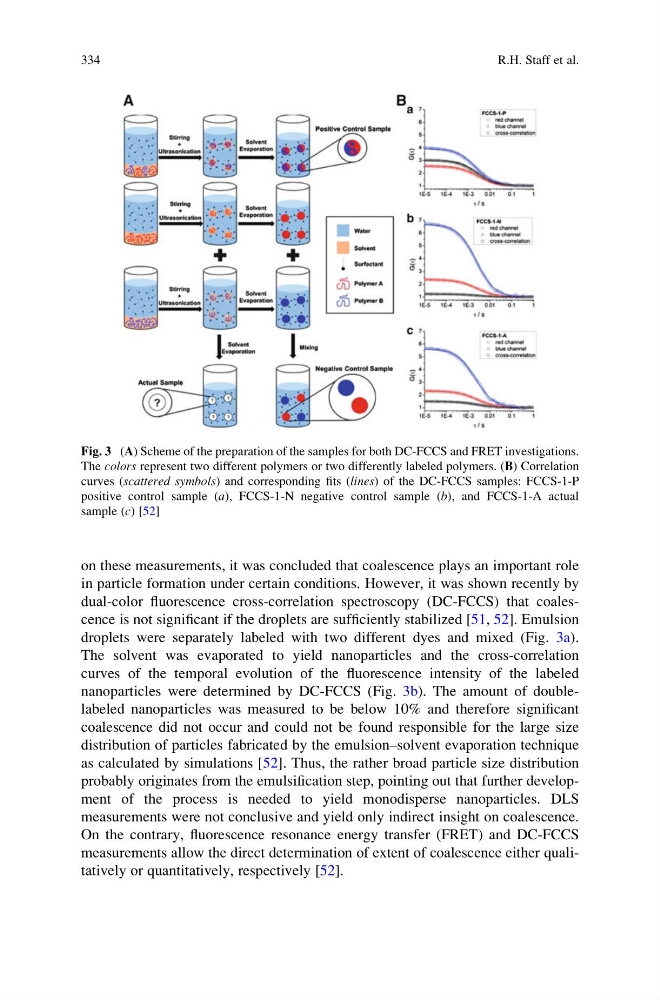
dual-color fluorescence cross-correlation spectroscopy (DC-FCCS) that coalescence is not significant if the droplets are sufficiently stabilized [51, 52]. Emulsion
droplets were separately labeled with two different dyes and mixed (Fig. 3a).
The solvent was evaporated to yield nanoparticles and the cross-correlation
curves of the temporal evolution of the fluorescence intensity of the labeled
nanoparticles were determined by DC-FCCS (Fig. 3b). The amount of doublelabeled nanoparticles was measured to be below 10% and therefore significant
coalescence did not occur and could not be found responsible for the large size
distribution of particles fabricated by the emulsion–solvent evaporation technique
as calculated by simulations [52]. Thus, the rather broad particle size distribution
probably originates from the emulsification step, pointing out that further development of the process is needed to yield monodisperse nanoparticles. DLS
measurements were not conclusive and yield only indirect insight on coalescence.
On the contrary, fluorescence resonance energy transfer (FRET) and DC-FCCS
measurements allow the direct determination of extent of coalescence either qualitatively or quantitatively, respectively [52].
Fig. 3 (A) Scheme of the preparation of the samples for both DC-FCCS and FRET investigations.
The colors represent two different polymers or two differently labeled polymers. (B) Correlation
curves (scattered symbols) and corresponding fits (lines) of the DC-FCCS samples: FCCS-1-P
positive control sample (a), FCCS-1-N negative control sample (b), and FCCS-1-A actual
sample (c) [52]
334
R.H. Staff et al.
in particle formation under certain conditions. However, it was shown recently by
dual-color fluorescence cross-correlation spectroscopy (DC-FCCS) that coalescence is not significant if the droplets are sufficiently stabilized [51, 52]. Emulsion
droplets were separately labeled with two different dyes and mixed (Fig. 3a).
The solvent was evaporated to yield nanoparticles and the cross-correlation
curves of the temporal evolution of the fluorescence intensity of the labeled
nanoparticles were determined by DC-FCCS (Fig. 3b). The amount of doublelabeled nanoparticles was measured to be below 10% and therefore significant
coalescence did not occur and could not be found responsible for the large size
distribution of particles fabricated by the emulsion–solvent evaporation technique
as calculated by simulations [52]. Thus, the rather broad particle size distribution
probably originates from the emulsification step, pointing out that further development of the process is needed to yield monodisperse nanoparticles. DLS
measurements were not conclusive and yield only indirect insight on coalescence.
On the contrary, fluorescence resonance energy transfer (FRET) and DC-FCCS
measurements allow the direct determination of extent of coalescence either qualitatively or quantitatively, respectively [52].
Fig. 3 (A) Scheme of the preparation of the samples for both DC-FCCS and FRET investigations.
The colors represent two different polymers or two differently labeled polymers. (B) Correlation
curves (scattered symbols) and corresponding fits (lines) of the DC-FCCS samples: FCCS-1-P
positive control sample (a), FCCS-1-N negative control sample (b), and FCCS-1-A actual
sample (c) [52]
334
R.H. Staff et al.