

nanocapsules [18]. Nowadays, the process is widely used to generate both microand nanosized particles and capsules from a wide variety of different polymers,
including but not limited to semiconducting [19], biodegradable [20–22], stimuliresponsive [23] or naturally occurring polymers such as cellulose derivatives
[24]. These materials are also used to encapsulate other materials such as magnetic
nanoparticles [25, 26], biomaterials [27], perfluorocarbons as contrast agents
for ultrasonic imaging [28, 29], dyes for up-conversion [30], or self-healing agents
[31, 32] (Fig. 2). It was shown that nanocapsules with hydrophobic liquid core
could be successfully fabricated with polymers having completely different thermal
and mechanical properties such as poly(L-lactide), poly(methyl methacrylate), poly
(phenylene oxide), poly(vinyl formal), poly(vinyl cinnamate), and poly(vinyl acetate) (Fig. 2) [31]. The use of different polymer mixtures or architectures such
as polymer blends [19, 33–35], statistical copolymers [32], and block copolymers
[23, 36–40] is possible. The latter polymer architecture is especially interesting for
introducing an additional spatial segregation in nanoparticles to yield new
multicompartment structures, such as nanocapsules or polymer particles with two
or more phases, which are discussed in more detail below.
The main advantages of the process as opposed to heterophase polymerizations
are its versatility with respect to the polymer that can be used, the simplicity of the
method, the fast handling for the preparation of the nanoparticles, and the fact that
the produced polymer dispersions do not contain any non-reacted monomers
or residual initiator when the pre-synthesized polymer is purified before. The
drawbacks lie in the usually broad (20–50%) size distribution of the produced
particles and capsules, the usually low solid content of the dispersions, and the
presence of residual surfactants. However, the last two issues can be overcome by
concentrating the dispersions in vacuo [8] and by dialysis [41], respectively. Both
issues were recently simultaneously solved by employing a copolymer with masked
amphiphilic and pH-responsive properties. Indeed, the masked groups yielded ionic
groups for electrostatic repulsion of the colloids upon reaction with water during the
emulsification. The produced carboxylic acid groups were in a sufficient amount
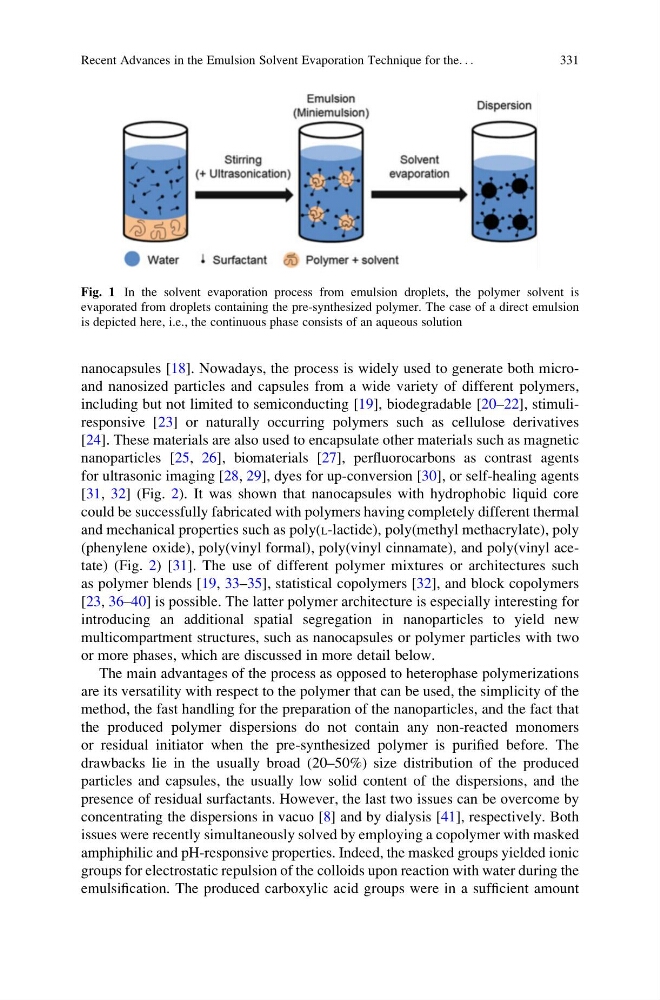
Fig. 1 In the solvent evaporation process from emulsion droplets, the polymer solvent is
evaporated from droplets containing the pre-synthesized polymer. The case of a direct emulsion
is depicted here, i.e., the continuous phase consists of an aqueous solution
Recent Advances in the Emulsion Solvent Evaporation Technique for the. . .
331
including but not limited to semiconducting [19], biodegradable [20–22], stimuliresponsive [23] or naturally occurring polymers such as cellulose derivatives
[24]. These materials are also used to encapsulate other materials such as magnetic
nanoparticles [25, 26], biomaterials [27], perfluorocarbons as contrast agents
for ultrasonic imaging [28, 29], dyes for up-conversion [30], or self-healing agents
[31, 32] (Fig. 2). It was shown that nanocapsules with hydrophobic liquid core
could be successfully fabricated with polymers having completely different thermal
and mechanical properties such as poly(L-lactide), poly(methyl methacrylate), poly
(phenylene oxide), poly(vinyl formal), poly(vinyl cinnamate), and poly(vinyl acetate) (Fig. 2) [31]. The use of different polymer mixtures or architectures such
as polymer blends [19, 33–35], statistical copolymers [32], and block copolymers
[23, 36–40] is possible. The latter polymer architecture is especially interesting for
introducing an additional spatial segregation in nanoparticles to yield new
multicompartment structures, such as nanocapsules or polymer particles with two
or more phases, which are discussed in more detail below.
The main advantages of the process as opposed to heterophase polymerizations
are its versatility with respect to the polymer that can be used, the simplicity of the
method, the fast handling for the preparation of the nanoparticles, and the fact that
the produced polymer dispersions do not contain any non-reacted monomers
or residual initiator when the pre-synthesized polymer is purified before. The
drawbacks lie in the usually broad (20–50%) size distribution of the produced
particles and capsules, the usually low solid content of the dispersions, and the
presence of residual surfactants. However, the last two issues can be overcome by
concentrating the dispersions in vacuo [8] and by dialysis [41], respectively. Both
issues were recently simultaneously solved by employing a copolymer with masked
amphiphilic and pH-responsive properties. Indeed, the masked groups yielded ionic
groups for electrostatic repulsion of the colloids upon reaction with water during the
emulsification. The produced carboxylic acid groups were in a sufficient amount
Fig. 1 In the solvent evaporation process from emulsion droplets, the polymer solvent is
evaporated from droplets containing the pre-synthesized polymer. The case of a direct emulsion
is depicted here, i.e., the continuous phase consists of an aqueous solution
Recent Advances in the Emulsion Solvent Evaporation Technique for the. . .
331