

monomers and found, using MALDI-MS analysis of endgroups, that most of these,
including monomer mixtures for preparation of statistical copolymers, show fewer
side reactions at 0
C than at elevated temperatures. In a follow-up study, they
combined low temperature polymerizatons with those run under low pressure in
order to identify optimal polymerization conditions [49]. Surprisingly, only
α-helical-favoring monomers (Bn-Glu, alanine, Z-Lys) showed rate accelerations
upon reduction in pressure (and consequent CO 2 removal), whereas
non-helicogenic monomers (β-benzyl-L-aspartate, O-benzyl-L-serine, O-benzyl-Lthreonine) were not affected by reaction pressure. Thus, the use of high vacuum or
other methods for CO 2 removal to obtain controlled NCA polymerization seems to
be highly monomer dependent. Also, the enhancements in polymerization rates
seen by removing CO 2 at 20
C were found to be minimal at 0
C, thus indicating
that there is no advantage in conducting an NCA polymerization under reduced
pressure at 0
C. From this study, it was concluded that helicogenic NCA monomers
could be polymerized in a controlled manner at 20
C if CO 2 was removed from the
reaction mixture, whereas non-helicogenic monomers should be polymerized at
0
C for optimal control over polymerization [49]. This strategy was validated by
preparation of a tetrablock copolypeptide of PBLG-PA-PZLL-PBLA.
A different innovative approach to controlling amine-initiated NCA polymerizations was reported in 2003 by Schlaad and coworkers [56]. Their strategy was to
avoid formation of NCA anions, which cause significant chain termination after
rearranging to isocyanocarboxylates [11, 12], through use of primary amine
hydrochloride salts as initiators. The reactivity of amine hydrochlorides with
NCAs was first explored by the group of Knobler, who found that amine
hydrochlorides can react with NCAs to give single NCA addition products
[57, 58]. Use of the hydrochloride salt takes advantage of its diminished reactivity
as a nucleophile compared to the parent amine, which effectively halts the reaction
after a single NCA insertion by formation of an inert amine hydrochloride in the
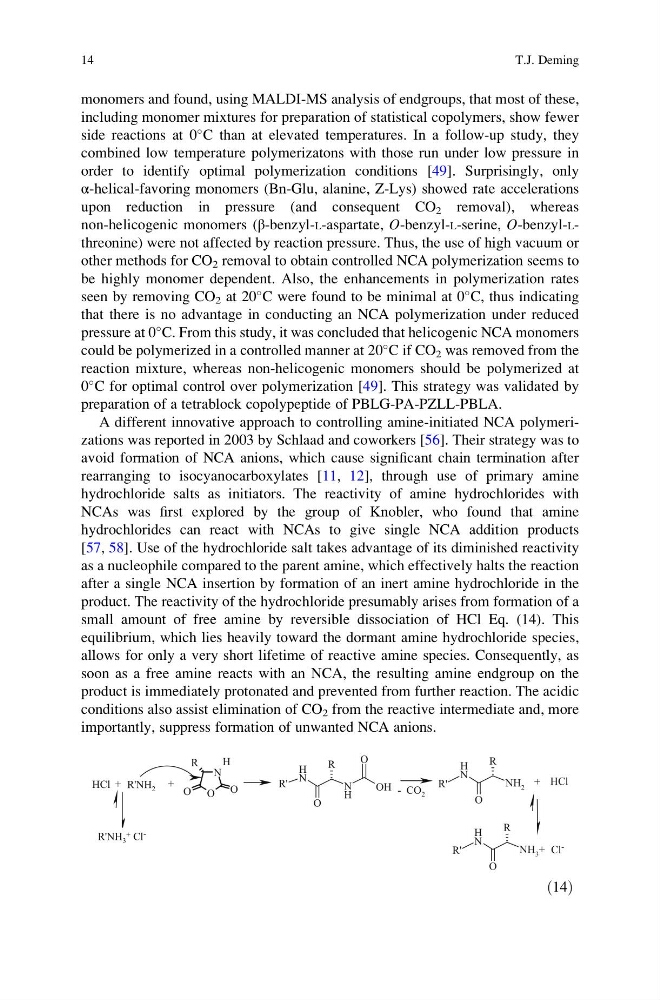
product. The reactivity of the hydrochloride presumably arises from formation of a
small amount of free amine by reversible dissociation of HCl Eq. (14). This
equilibrium, which lies heavily toward the dormant amine hydrochloride species,
allows for only a very short lifetime of reactive amine species. Consequently, as
soon as a free amine reacts with an NCA, the resulting amine endgroup on the
product is immediately protonated and prevented from further reaction. The acidic
conditions also assist elimination of CO 2 from the reactive intermediate and, more
importantly, suppress formation of unwanted NCA anions.
N
O
R
O O
H
R'
N
H
N
H
OH
O
R
O
R'
N
H
NH 2
O
R
R'
N
H
NH 3 +
O
R
R'NH 2 +
+
- CO 2
HCl
+
HCl
R'NH 3
+ Cl -
Cl -
ð14Þ
14
T.J. Deming
including monomer mixtures for preparation of statistical copolymers, show fewer
side reactions at 0
C than at elevated temperatures. In a follow-up study, they
combined low temperature polymerizatons with those run under low pressure in
order to identify optimal polymerization conditions [49]. Surprisingly, only
α-helical-favoring monomers (Bn-Glu, alanine, Z-Lys) showed rate accelerations
upon reduction in pressure (and consequent CO 2 removal), whereas
non-helicogenic monomers (β-benzyl-L-aspartate, O-benzyl-L-serine, O-benzyl-Lthreonine) were not affected by reaction pressure. Thus, the use of high vacuum or
other methods for CO 2 removal to obtain controlled NCA polymerization seems to
be highly monomer dependent. Also, the enhancements in polymerization rates
seen by removing CO 2 at 20
C were found to be minimal at 0
C, thus indicating
that there is no advantage in conducting an NCA polymerization under reduced
pressure at 0
C. From this study, it was concluded that helicogenic NCA monomers
could be polymerized in a controlled manner at 20
C if CO 2 was removed from the
reaction mixture, whereas non-helicogenic monomers should be polymerized at
0
C for optimal control over polymerization [49]. This strategy was validated by
preparation of a tetrablock copolypeptide of PBLG-PA-PZLL-PBLA.
A different innovative approach to controlling amine-initiated NCA polymerizations was reported in 2003 by Schlaad and coworkers [56]. Their strategy was to
avoid formation of NCA anions, which cause significant chain termination after
rearranging to isocyanocarboxylates [11, 12], through use of primary amine
hydrochloride salts as initiators. The reactivity of amine hydrochlorides with
NCAs was first explored by the group of Knobler, who found that amine
hydrochlorides can react with NCAs to give single NCA addition products
[57, 58]. Use of the hydrochloride salt takes advantage of its diminished reactivity
as a nucleophile compared to the parent amine, which effectively halts the reaction
after a single NCA insertion by formation of an inert amine hydrochloride in the
product. The reactivity of the hydrochloride presumably arises from formation of a
small amount of free amine by reversible dissociation of HCl Eq. (14). This
equilibrium, which lies heavily toward the dormant amine hydrochloride species,
allows for only a very short lifetime of reactive amine species. Consequently, as
soon as a free amine reacts with an NCA, the resulting amine endgroup on the
product is immediately protonated and prevented from further reaction. The acidic
conditions also assist elimination of CO 2 from the reactive intermediate and, more
importantly, suppress formation of unwanted NCA anions.
N
O
R
O O
H
R'
N
H
N
H
OH
O
R
O
R'
N
H
NH 2
O
R
R'
N
H
NH 3 +
O
R
R'NH 2 +
+
- CO 2
HCl
+
HCl
R'NH 3
+ Cl -
Cl -
ð14Þ
14
T.J. Deming