

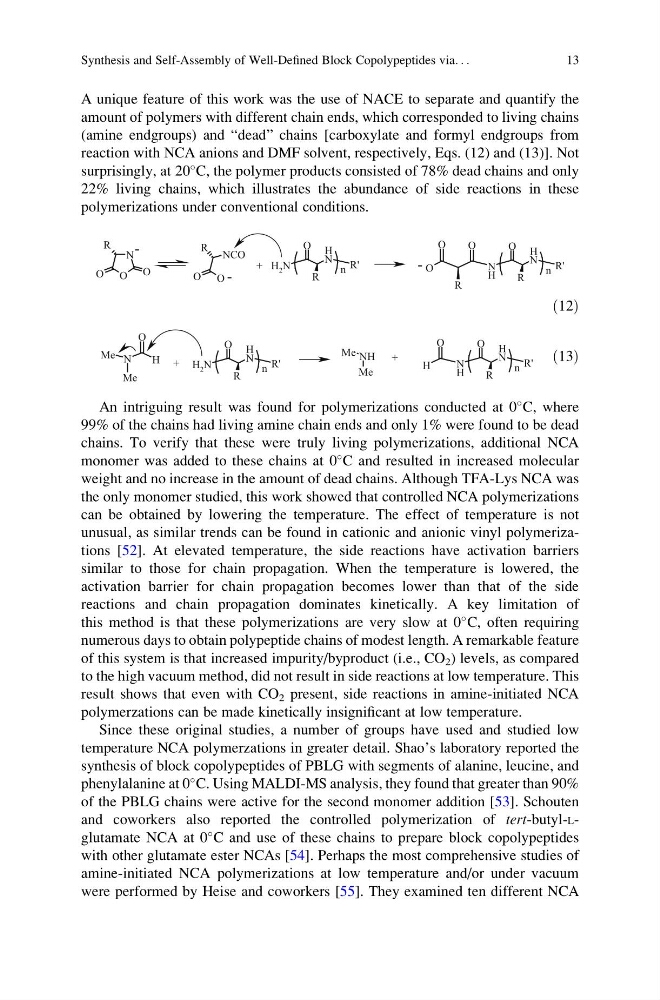
A unique feature of this work was the use of NACE to separate and quantify the
amount of polymers with different chain ends, which corresponded to living chains
(amine endgroups) and “dead” chains [carboxylate and formyl endgroups from
reaction with NCA anions and DMF solvent, respectively, Eqs. (12) and (13)]. Not
surprisingly, at 20
C, the polymer products consisted of 78% dead chains and only
22% living chains, which illustrates the abundance of side reactions in these
polymerizations under conventional conditions.
N
O
R
O O
O
R
O
NCO
N
H
O
R
n
N
H 2
R'
N
H
O
R
n
N
H
R'
O
R
O
O
-
-
+
-
ð12Þ
N
H
O
R
n
N
H 2
R'
N
H
O
R
n
N
H
R'
O
H
N
O
H
Me
Me
NH
Me
Me
+
+
ð13Þ
An intriguing result was found for polymerizations conducted at 0
C, where
99% of the chains had living amine chain ends and only 1% were found to be dead
chains. To verify that these were truly living polymerizations, additional NCA
monomer was added to these chains at 0
C and resulted in increased molecular
weight and no increase in the amount of dead chains. Although TFA-Lys NCA was
the only monomer studied, this work showed that controlled NCA polymerizations
can be obtained by lowering the temperature. The effect of temperature is not
unusual, as similar trends can be found in cationic and anionic vinyl polymerizations [52]. At elevated temperature, the side reactions have activation barriers
similar to those for chain propagation. When the temperature is lowered, the
activation barrier for chain propagation becomes lower than that of the side
reactions and chain propagation dominates kinetically. A key limitation of
this method is that these polymerizations are very slow at 0
C, often requiring
numerous days to obtain polypeptide chains of modest length. A remarkable feature
of this system is that increased impurity/byproduct (i.e., CO 2 ) levels, as compared
to the high vacuum method, did not result in side reactions at low temperature. This
result shows that even with CO 2 present, side reactions in amine-initiated NCA
polymerzations can be made kinetically insignificant at low temperature.
Since these original studies, a number of groups have used and studied low
temperature NCA polymerzations in greater detail. Shao’s laboratory reported the
synthesis of block copolypeptides of PBLG with segments of alanine, leucine, and
phenylalanine at 0
C. Using MALDI-MS analysis, they found that greater than 90%
of the PBLG chains were active for the second monomer addition [53]. Schouten
and coworkers also reported the controlled polymerization of tert-butyl-Lglutamate NCA at 0
C and use of these chains to prepare block copolypeptides
with other glutamate ester NCAs [54]. Perhaps the most comprehensive studies of
amine-initiated NCA polymerizations at low temperature and/or under vacuum
were performed by Heise and coworkers [55]. They examined ten different NCA
Synthesis and Self-Assembly of Well-Defined Block Copolypeptides via. . .
13
amount of polymers with different chain ends, which corresponded to living chains
(amine endgroups) and “dead” chains [carboxylate and formyl endgroups from
reaction with NCA anions and DMF solvent, respectively, Eqs. (12) and (13)]. Not
surprisingly, at 20
C, the polymer products consisted of 78% dead chains and only
22% living chains, which illustrates the abundance of side reactions in these
polymerizations under conventional conditions.
N
O
R
O O
O
R
O
NCO
N
H
O
R
n
N
H 2
R'
N
H
O
R
n
N
H
R'
O
R
O
O
-
-
+
-
ð12Þ
N
H
O
R
n
N
H 2
R'
N
H
O
R
n
N
H
R'
O
H
N
O
H
Me
Me
NH
Me
Me
+
+
ð13Þ
An intriguing result was found for polymerizations conducted at 0
C, where
99% of the chains had living amine chain ends and only 1% were found to be dead
chains. To verify that these were truly living polymerizations, additional NCA
monomer was added to these chains at 0
C and resulted in increased molecular
weight and no increase in the amount of dead chains. Although TFA-Lys NCA was
the only monomer studied, this work showed that controlled NCA polymerizations
can be obtained by lowering the temperature. The effect of temperature is not
unusual, as similar trends can be found in cationic and anionic vinyl polymerizations [52]. At elevated temperature, the side reactions have activation barriers
similar to those for chain propagation. When the temperature is lowered, the
activation barrier for chain propagation becomes lower than that of the side
reactions and chain propagation dominates kinetically. A key limitation of
this method is that these polymerizations are very slow at 0
C, often requiring
numerous days to obtain polypeptide chains of modest length. A remarkable feature
of this system is that increased impurity/byproduct (i.e., CO 2 ) levels, as compared
to the high vacuum method, did not result in side reactions at low temperature. This
result shows that even with CO 2 present, side reactions in amine-initiated NCA
polymerzations can be made kinetically insignificant at low temperature.
Since these original studies, a number of groups have used and studied low
temperature NCA polymerzations in greater detail. Shao’s laboratory reported the
synthesis of block copolypeptides of PBLG with segments of alanine, leucine, and
phenylalanine at 0
C. Using MALDI-MS analysis, they found that greater than 90%
of the PBLG chains were active for the second monomer addition [53]. Schouten
and coworkers also reported the controlled polymerization of tert-butyl-Lglutamate NCA at 0
C and use of these chains to prepare block copolypeptides
with other glutamate ester NCAs [54]. Perhaps the most comprehensive studies of
amine-initiated NCA polymerizations at low temperature and/or under vacuum
were performed by Heise and coworkers [55]. They examined ten different NCA
Synthesis and Self-Assembly of Well-Defined Block Copolypeptides via. . .
13