

gyroidal titania facilitated backfilling with the solid-state hole conductor. Since,
in these first experiments, film thickness was limited to below half a micron, the
external power conversion efficiency was below 2%. In subsequent experiments,
it was shown that ABC triblock terpolymer-directed gyroidal titania electrodes
exhibit a high availability of subbandgap states, thus improving photo-induced charge
generation [69]. This led to 5% efficiency and ssDSSC devices outperforming, for the
first time, back-to-back fabricated titania nanoparticle-based solar cells.
A second strategy for improving photovoltaic efficiency is to integrate photonic
crystals into solar cells, thereby controlling the flow of light in the cells [68]. Since
photonic crystals and metamaterials can both effectively control the path of light and
the near-field profile of electromagnetic waves, their combination with existing solar
cell technologies can improve solar cell efficiency, e.g., by extending the path of light
in thin-film solar cells. Although BCP SA has been used to generate photonic crystal
structures including photonic band gap structures [16], as discussed earlier, typical
restrictions of lattice dimensions limit its usefulness for photovoltaics.
In contrast, such limitations are not significant in a metamaterial. Therefore, one
could incorporate a BCP SA-directed metamaterial architecture into photovoltaic
cells for light management, such as light-trapping inside photovoltaic cells with a
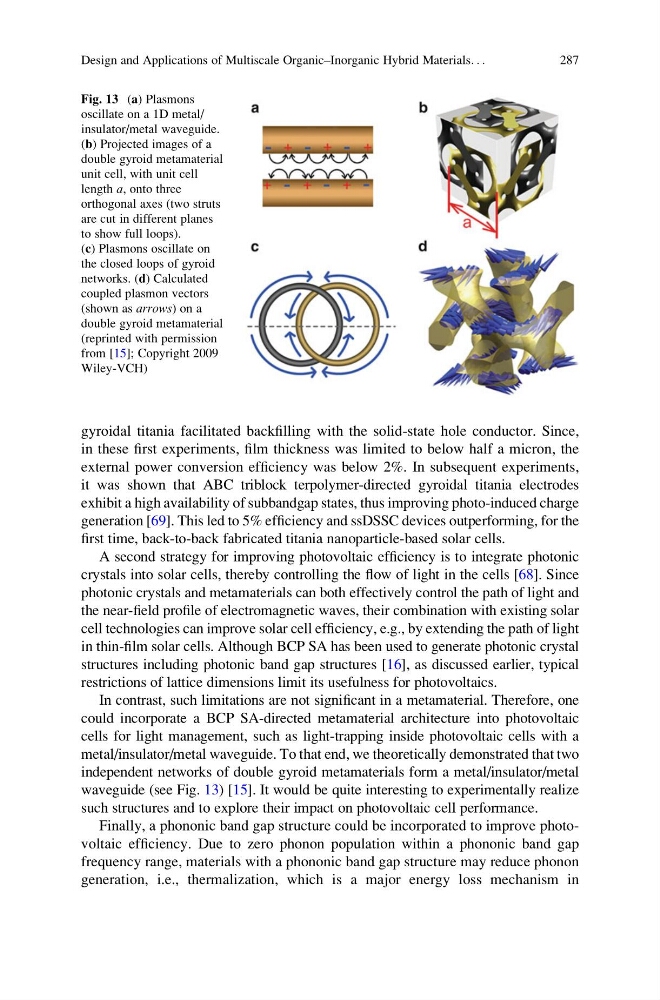
metal/insulator/metal waveguide. To that end, we theoretically demonstrated that two
independent networks of double gyroid metamaterials form a metal/insulator/metal
waveguide (see Fig. 13) [15]. It would be quite interesting to experimentally realize
such structures and to explore their impact on photovoltaic cell performance.
Finally, a phononic band gap structure could be incorporated to improve photovoltaic efficiency. Due to zero phonon population within a phononic band gap
frequency range, materials with a phononic band gap structure may reduce phonon
generation, i.e., thermalization, which is a major energy loss mechanism in
Fig. 13 (a) Plasmons
oscillate on a 1D metal/
insulator/metal waveguide.
(b) Projected images of a
double gyroid metamaterial
unit cell, with unit cell
length a, onto three
orthogonal axes (two struts
are cut in different planes
to show full loops).
(c) Plasmons oscillate on
the closed loops of gyroid
networks. (d) Calculated
coupled plasmon vectors
(shown as arrows) on a
double gyroid metamaterial
(reprinted with permission
from [15]; Copyright 2009
Wiley-VCH)
Design and Applications of Multiscale Organic–Inorganic Hybrid Materials. . .
287
in these first experiments, film thickness was limited to below half a micron, the
external power conversion efficiency was below 2%. In subsequent experiments,
it was shown that ABC triblock terpolymer-directed gyroidal titania electrodes
exhibit a high availability of subbandgap states, thus improving photo-induced charge
generation [69]. This led to 5% efficiency and ssDSSC devices outperforming, for the
first time, back-to-back fabricated titania nanoparticle-based solar cells.
A second strategy for improving photovoltaic efficiency is to integrate photonic
crystals into solar cells, thereby controlling the flow of light in the cells [68]. Since
photonic crystals and metamaterials can both effectively control the path of light and
the near-field profile of electromagnetic waves, their combination with existing solar
cell technologies can improve solar cell efficiency, e.g., by extending the path of light
in thin-film solar cells. Although BCP SA has been used to generate photonic crystal
structures including photonic band gap structures [16], as discussed earlier, typical
restrictions of lattice dimensions limit its usefulness for photovoltaics.
In contrast, such limitations are not significant in a metamaterial. Therefore, one
could incorporate a BCP SA-directed metamaterial architecture into photovoltaic
cells for light management, such as light-trapping inside photovoltaic cells with a
metal/insulator/metal waveguide. To that end, we theoretically demonstrated that two
independent networks of double gyroid metamaterials form a metal/insulator/metal
waveguide (see Fig. 13) [15]. It would be quite interesting to experimentally realize
such structures and to explore their impact on photovoltaic cell performance.
Finally, a phononic band gap structure could be incorporated to improve photovoltaic efficiency. Due to zero phonon population within a phononic band gap
frequency range, materials with a phononic band gap structure may reduce phonon
generation, i.e., thermalization, which is a major energy loss mechanism in
Fig. 13 (a) Plasmons
oscillate on a 1D metal/
insulator/metal waveguide.
(b) Projected images of a
double gyroid metamaterial
unit cell, with unit cell
length a, onto three
orthogonal axes (two struts
are cut in different planes
to show full loops).
(c) Plasmons oscillate on
the closed loops of gyroid
networks. (d) Calculated
coupled plasmon vectors
(shown as arrows) on a
double gyroid metamaterial
(reprinted with permission
from [15]; Copyright 2009
Wiley-VCH)
Design and Applications of Multiscale Organic–Inorganic Hybrid Materials. . .
287