

6.4 Photovoltaics
Much effort has been devoted to developing photovoltaics with better conversion
efficiency from photonic to electric energy. There are many sources of efficiency
losses associated with current photovoltaic technologies, such as thermalization, lack
of absorption, absorption angle restrictions, and so on [68]. Not all these challenges
can be overcome by BCP-derived nanostructures. However, several important issues
may benefit from nanostructures derived from BCP SA. We will discuss three
strategies based on BCP SA to improve photovoltaic efficiency.
One of the strategies is to minimize the diffusion path of exitons (bound states
between an electron and electron hole) generated by photons hitting the active
material in a photovoltaic cell. Once separated, holes and electrons should reach
anode and cathode electrodes, respectively. During the process, recombination of
holes and electrons lead to energy losses via thermal dissipation. In order to reduce
such losses, minimizing the diffusion paths of exitons by means of BCP-derived
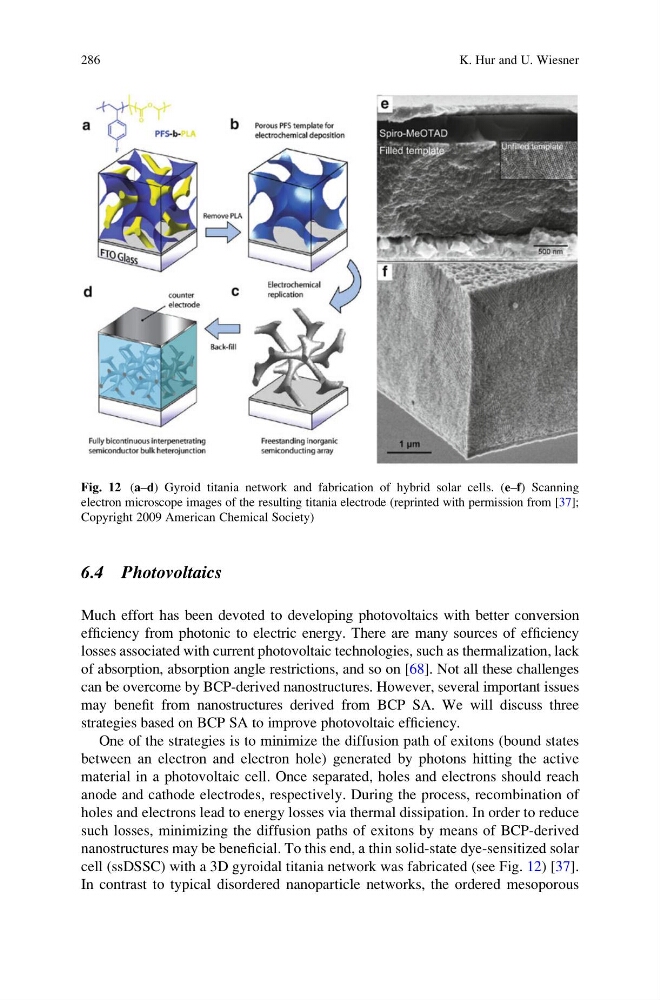
nanostructures may be beneficial. To this end, a thin solid-state dye-sensitized solar
cell (ssDSSC) with a 3D gyroidal titania network was fabricated (see Fig. 12) [37].
In contrast to typical disordered nanoparticle networks, the ordered mesoporous
Fig. 12 (a–d) Gyroid titania network and fabrication of hybrid solar cells. (e–f) Scanning
electron microscope images of the resulting titania electrode (reprinted with permission from [37];
Copyright 2009 American Chemical Society)
286
K. Hur and U. Wiesner
Much effort has been devoted to developing photovoltaics with better conversion
efficiency from photonic to electric energy. There are many sources of efficiency
losses associated with current photovoltaic technologies, such as thermalization, lack
of absorption, absorption angle restrictions, and so on [68]. Not all these challenges
can be overcome by BCP-derived nanostructures. However, several important issues
may benefit from nanostructures derived from BCP SA. We will discuss three
strategies based on BCP SA to improve photovoltaic efficiency.
One of the strategies is to minimize the diffusion path of exitons (bound states
between an electron and electron hole) generated by photons hitting the active
material in a photovoltaic cell. Once separated, holes and electrons should reach
anode and cathode electrodes, respectively. During the process, recombination of
holes and electrons lead to energy losses via thermal dissipation. In order to reduce
such losses, minimizing the diffusion paths of exitons by means of BCP-derived
nanostructures may be beneficial. To this end, a thin solid-state dye-sensitized solar
cell (ssDSSC) with a 3D gyroidal titania network was fabricated (see Fig. 12) [37].
In contrast to typical disordered nanoparticle networks, the ordered mesoporous
Fig. 12 (a–d) Gyroid titania network and fabrication of hybrid solar cells. (e–f) Scanning
electron microscope images of the resulting titania electrode (reprinted with permission from [37];
Copyright 2009 American Chemical Society)
286
K. Hur and U. Wiesner