

However, this process often leads to the loss of ordered mesoporous structures
during the crystallization at a high temperature. The Wiesner group developed a
novel thermalization process, the “combined assembly by soft and hard (CASH)”
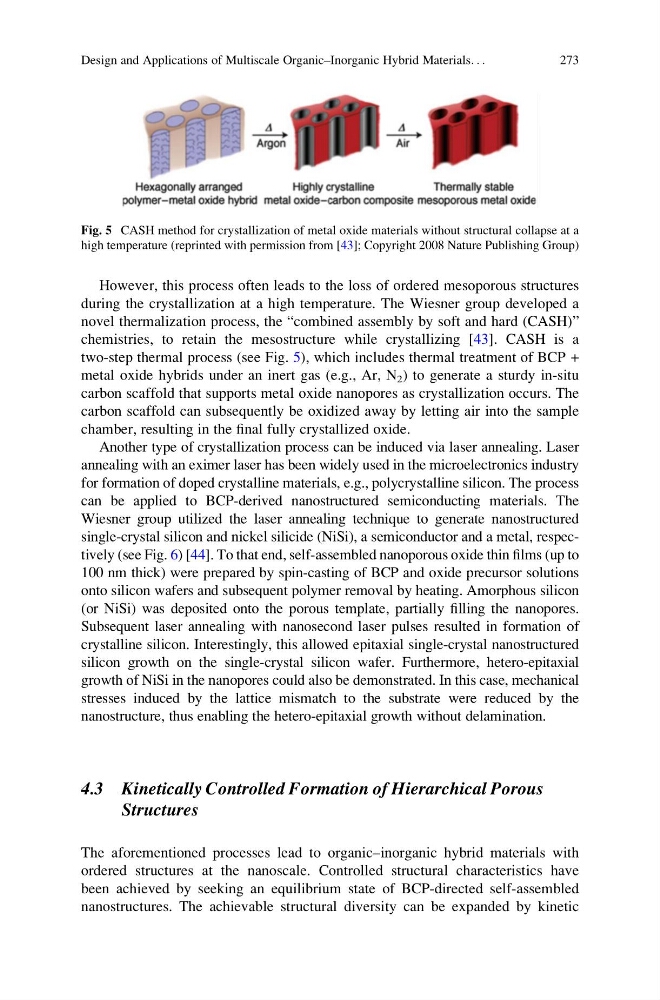
chemistries, to retain the mesostructure while crystallizing [43]. CASH is a
two-step thermal process (see Fig. 5), which includes thermal treatment of BCP +
metal oxide hybrids under an inert gas (e.g., Ar, N 2 ) to generate a sturdy in-situ
carbon scaffold that supports metal oxide nanopores as crystallization occurs. The
carbon scaffold can subsequently be oxidized away by letting air into the sample
chamber, resulting in the final fully crystallized oxide.
Another type of crystallization process can be induced via laser annealing. Laser
annealing with an eximer laser has been widely used in the microelectronics industry
for formation of doped crystalline materials, e.g., polycrystalline silicon. The process
can be applied to BCP-derived nanostructured semiconducting materials. The
Wiesner group utilized the laser annealing technique to generate nanostructured
single-crystal silicon and nickel silicide (NiSi), a semiconductor and a metal, respectively (see Fig. 6) [44]. To that end, self-assembled nanoporous oxide thin films (up to
100 nm thick) were prepared by spin-casting of BCP and oxide precursor solutions
onto silicon wafers and subsequent polymer removal by heating. Amorphous silicon
(or NiSi) was deposited onto the porous template, partially filling the nanopores.
Subsequent laser annealing with nanosecond laser pulses resulted in formation of
crystalline silicon. Interestingly, this allowed epitaxial single-crystal nanostructured
silicon growth on the single-crystal silicon wafer. Furthermore, hetero-epitaxial
growth of NiSi in the nanopores could also be demonstrated. In this case, mechanical
stresses induced by the lattice mismatch to the substrate were reduced by the
nanostructure, thus enabling the hetero-epitaxial growth without delamination.
4.3 Kinetically Controlled Formation of Hierarchical Porous
Structures
The aforementioned processes lead to organic–inorganic hybrid materials with
ordered structures at the nanoscale. Controlled structural characteristics have
been achieved by seeking an equilibrium state of BCP-directed self-assembled
nanostructures. The achievable structural diversity can be expanded by kinetic
Fig. 5 CASH method for crystallization of metal oxide materials without structural collapse at a
high temperature (reprinted with permission from [43]; Copyright 2008 Nature Publishing Group)
Design and Applications of Multiscale Organic–Inorganic Hybrid Materials. . .
273
during the crystallization at a high temperature. The Wiesner group developed a
novel thermalization process, the “combined assembly by soft and hard (CASH)”
chemistries, to retain the mesostructure while crystallizing [43]. CASH is a
two-step thermal process (see Fig. 5), which includes thermal treatment of BCP +
metal oxide hybrids under an inert gas (e.g., Ar, N 2 ) to generate a sturdy in-situ
carbon scaffold that supports metal oxide nanopores as crystallization occurs. The
carbon scaffold can subsequently be oxidized away by letting air into the sample
chamber, resulting in the final fully crystallized oxide.
Another type of crystallization process can be induced via laser annealing. Laser
annealing with an eximer laser has been widely used in the microelectronics industry
for formation of doped crystalline materials, e.g., polycrystalline silicon. The process
can be applied to BCP-derived nanostructured semiconducting materials. The
Wiesner group utilized the laser annealing technique to generate nanostructured
single-crystal silicon and nickel silicide (NiSi), a semiconductor and a metal, respectively (see Fig. 6) [44]. To that end, self-assembled nanoporous oxide thin films (up to
100 nm thick) were prepared by spin-casting of BCP and oxide precursor solutions
onto silicon wafers and subsequent polymer removal by heating. Amorphous silicon
(or NiSi) was deposited onto the porous template, partially filling the nanopores.
Subsequent laser annealing with nanosecond laser pulses resulted in formation of
crystalline silicon. Interestingly, this allowed epitaxial single-crystal nanostructured
silicon growth on the single-crystal silicon wafer. Furthermore, hetero-epitaxial
growth of NiSi in the nanopores could also be demonstrated. In this case, mechanical
stresses induced by the lattice mismatch to the substrate were reduced by the
nanostructure, thus enabling the hetero-epitaxial growth without delamination.
4.3 Kinetically Controlled Formation of Hierarchical Porous
Structures
The aforementioned processes lead to organic–inorganic hybrid materials with
ordered structures at the nanoscale. Controlled structural characteristics have
been achieved by seeking an equilibrium state of BCP-directed self-assembled
nanostructures. The achievable structural diversity can be expanded by kinetic
Fig. 5 CASH method for crystallization of metal oxide materials without structural collapse at a
high temperature (reprinted with permission from [43]; Copyright 2008 Nature Publishing Group)
Design and Applications of Multiscale Organic–Inorganic Hybrid Materials. . .
273