

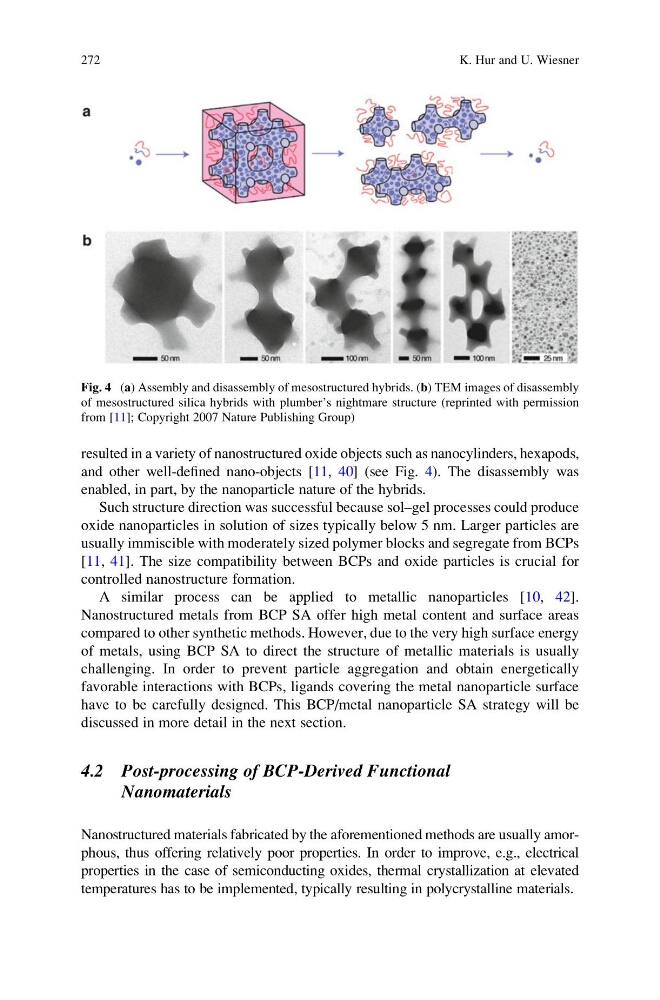
resulted in a variety of nanostructured oxide objects such as nanocylinders, hexapods,
and other well-defined nano-objects [11, 40] (see Fig. 4). The disassembly was
enabled, in part, by the nanoparticle nature of the hybrids.
Such structure direction was successful because sol–gel processes could produce
oxide nanoparticles in solution of sizes typically below 5 nm. Larger particles are
usually immiscible with moderately sized polymer blocks and segregate from BCPs
[11, 41]. The size compatibility between BCPs and oxide particles is crucial for
controlled nanostructure formation.
A similar process can be applied to metallic nanoparticles [10, 42].
Nanostructured metals from BCP SA offer high metal content and surface areas
compared to other synthetic methods. However, due to the very high surface energy
of metals, using BCP SA to direct the structure of metallic materials is usually
challenging. In order to prevent particle aggregation and obtain energetically
favorable interactions with BCPs, ligands covering the metal nanoparticle surface
have to be carefully designed. This BCP/metal nanoparticle SA strategy will be
discussed in more detail in the next section.
4.2 Post-processing of BCP-Derived Functional
Nanomaterials
Nanostructured materials fabricated by the aforementioned methods are usually amorphous, thus offering relatively poor properties. In order to improve, e.g., electrical
properties in the case of semiconducting oxides, thermal crystallization at elevated
temperatures has to be implemented, typically resulting in polycrystalline materials.
Fig. 4 (a) Assembly and disassembly of mesostructured hybrids. (b) TEM images of disassembly
of mesostructured silica hybrids with plumber’s nightmare structure (reprinted with permission
from [11]; Copyright 2007 Nature Publishing Group)
272
K. Hur and U. Wiesner
and other well-defined nano-objects [11, 40] (see Fig. 4). The disassembly was
enabled, in part, by the nanoparticle nature of the hybrids.
Such structure direction was successful because sol–gel processes could produce
oxide nanoparticles in solution of sizes typically below 5 nm. Larger particles are
usually immiscible with moderately sized polymer blocks and segregate from BCPs
[11, 41]. The size compatibility between BCPs and oxide particles is crucial for
controlled nanostructure formation.
A similar process can be applied to metallic nanoparticles [10, 42].
Nanostructured metals from BCP SA offer high metal content and surface areas
compared to other synthetic methods. However, due to the very high surface energy
of metals, using BCP SA to direct the structure of metallic materials is usually
challenging. In order to prevent particle aggregation and obtain energetically
favorable interactions with BCPs, ligands covering the metal nanoparticle surface
have to be carefully designed. This BCP/metal nanoparticle SA strategy will be
discussed in more detail in the next section.
4.2 Post-processing of BCP-Derived Functional
Nanomaterials
Nanostructured materials fabricated by the aforementioned methods are usually amorphous, thus offering relatively poor properties. In order to improve, e.g., electrical
properties in the case of semiconducting oxides, thermal crystallization at elevated
temperatures has to be implemented, typically resulting in polycrystalline materials.
Fig. 4 (a) Assembly and disassembly of mesostructured hybrids. (b) TEM images of disassembly
of mesostructured silica hybrids with plumber’s nightmare structure (reprinted with permission
from [11]; Copyright 2007 Nature Publishing Group)
272
K. Hur and U. Wiesner