

(clusters) reformed and the original mechanical properties were recovered. Furthermore, Kalista et al. investigated the self-healing behavior of EMAA materials at
temperatures between À50 and 140
C [60]. The authors could demonstrate that
self-healing is possible below the order–disorder temperature due to the reversible
formation of hydrogen bonds from the carboxylic acids. Furthermore, they showed
that the self-healing efficiency at different temperatures strongly depends on the
ionic content. Thus, high ionic contents are better for healing at high temperatures
(above the order–disorder transition) and low amounts of cluster are required for
healing at low temperatures. Metallopolymers could also feature comparable ionic
clusters due to their charged complexes. These could also contribute to the selfhealing process.
3 Stimuli-Responsive Metallopolymers
The introduction of metal complexes into polymeric materials can lead to interesting properties and, particularly, the structural properties of these complexes
are of importance in self-healing materials [9]. It can be important for the
self-healing process that special properties can be changed upon application
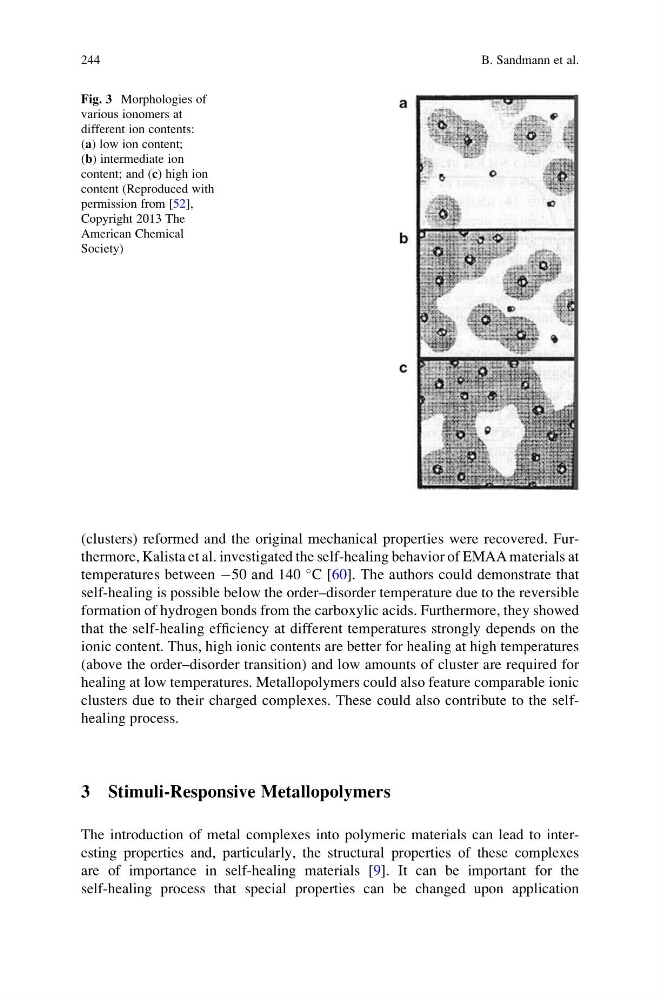
Fig. 3 Morphologies of
various ionomers at
different ion contents:
(a) low ion content;
(b) intermediate ion
content; and (c) high ion
content (Reproduced with
permission from [52],
Copyright 2013 The
American Chemical
Society)
244
B. Sandmann et al.
temperatures between À50 and 140
C [60]. The authors could demonstrate that
self-healing is possible below the order–disorder temperature due to the reversible
formation of hydrogen bonds from the carboxylic acids. Furthermore, they showed
that the self-healing efficiency at different temperatures strongly depends on the
ionic content. Thus, high ionic contents are better for healing at high temperatures
(above the order–disorder transition) and low amounts of cluster are required for
healing at low temperatures. Metallopolymers could also feature comparable ionic
clusters due to their charged complexes. These could also contribute to the selfhealing process.
3 Stimuli-Responsive Metallopolymers
The introduction of metal complexes into polymeric materials can lead to interesting properties and, particularly, the structural properties of these complexes
are of importance in self-healing materials [9]. It can be important for the
self-healing process that special properties can be changed upon application
Fig. 3 Morphologies of
various ionomers at
different ion contents:
(a) low ion content;
(b) intermediate ion
content; and (c) high ion
content (Reproduced with
permission from [52],
Copyright 2013 The
American Chemical
Society)
244
B. Sandmann et al.