

interactions with respective areas of the polymer structure [50]. Ionomers are
generated by a neutralization process. The ionic component (pendant acid groups)
is attached to the polymer backbone. After neutralization the ionic groups are part
of the polymer structure of the resulting ionomer (or ionic copolymer). The ionic
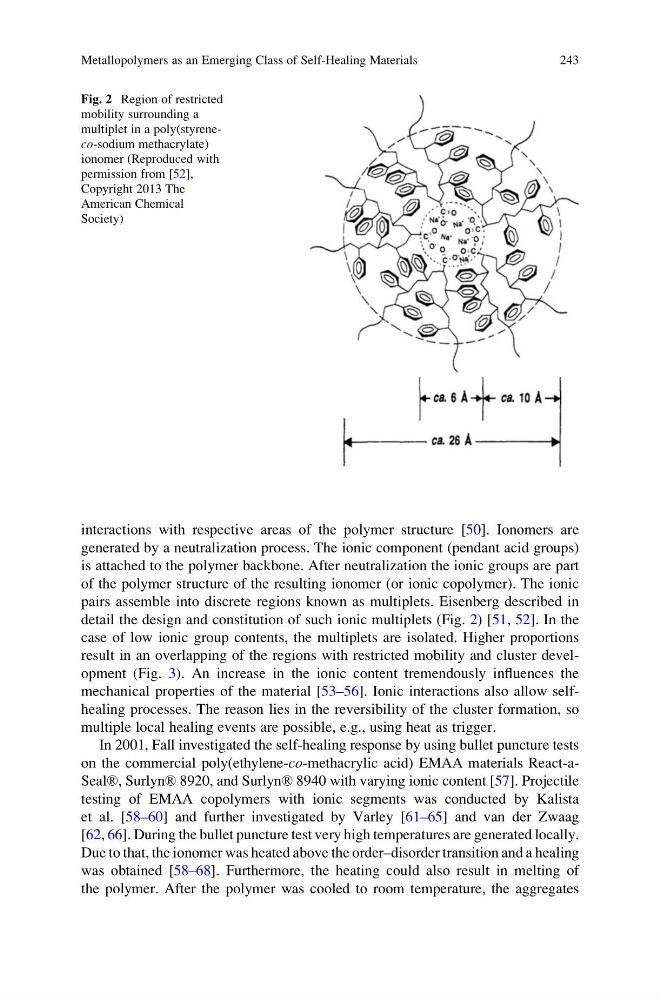
pairs assemble into discrete regions known as multiplets. Eisenberg described in
detail the design and constitution of such ionic multiplets (Fig. 2) [51, 52]. In the
case of low ionic group contents, the multiplets are isolated. Higher proportions
result in an overlapping of the regions with restricted mobility and cluster development (Fig. 3). An increase in the ionic content tremendously influences the
mechanical properties of the material [53–56]. Ionic interactions also allow selfhealing processes. The reason lies in the reversibility of the cluster formation, so
multiple local healing events are possible, e.g., using heat as trigger.
In 2001, Fall investigated the self-healing response by using bullet puncture tests
on the commercial poly(ethylene-co-methacrylic acid) EMAA materials React-aSeal®, Surlyn® 8920, and Surlyn® 8940 with varying ionic content [57]. Projectile
testing of EMAA copolymers with ionic segments was conducted by Kalista
et al. [58–60] and further investigated by Varley [61–65] and van der Zwaag
[62, 66]. During the bullet puncture test very high temperatures are generated locally.
Due to that, the ionomer was heated above the order–disorder transition and a healing
was obtained [58–68]. Furthermore, the heating could also result in melting of
the polymer. After the polymer was cooled to room temperature, the aggregates
Fig. 2 Region of restricted
mobility surrounding a
multiplet in a poly(styreneco-sodium methacrylate)
ionomer (Reproduced with
permission from [52],
Copyright 2013 The
American Chemical
Society)
Metallopolymers as an Emerging Class of Self-Healing Materials
243
generated by a neutralization process. The ionic component (pendant acid groups)
is attached to the polymer backbone. After neutralization the ionic groups are part
of the polymer structure of the resulting ionomer (or ionic copolymer). The ionic
pairs assemble into discrete regions known as multiplets. Eisenberg described in
detail the design and constitution of such ionic multiplets (Fig. 2) [51, 52]. In the
case of low ionic group contents, the multiplets are isolated. Higher proportions
result in an overlapping of the regions with restricted mobility and cluster development (Fig. 3). An increase in the ionic content tremendously influences the
mechanical properties of the material [53–56]. Ionic interactions also allow selfhealing processes. The reason lies in the reversibility of the cluster formation, so
multiple local healing events are possible, e.g., using heat as trigger.
In 2001, Fall investigated the self-healing response by using bullet puncture tests
on the commercial poly(ethylene-co-methacrylic acid) EMAA materials React-aSeal®, Surlyn® 8920, and Surlyn® 8940 with varying ionic content [57]. Projectile
testing of EMAA copolymers with ionic segments was conducted by Kalista
et al. [58–60] and further investigated by Varley [61–65] and van der Zwaag
[62, 66]. During the bullet puncture test very high temperatures are generated locally.
Due to that, the ionomer was heated above the order–disorder transition and a healing
was obtained [58–68]. Furthermore, the heating could also result in melting of
the polymer. After the polymer was cooled to room temperature, the aggregates
Fig. 2 Region of restricted
mobility surrounding a
multiplet in a poly(styreneco-sodium methacrylate)
ionomer (Reproduced with
permission from [52],
Copyright 2013 The
American Chemical
Society)
Metallopolymers as an Emerging Class of Self-Healing Materials
243