

6.3 Graft Copolymers of Polythiophene
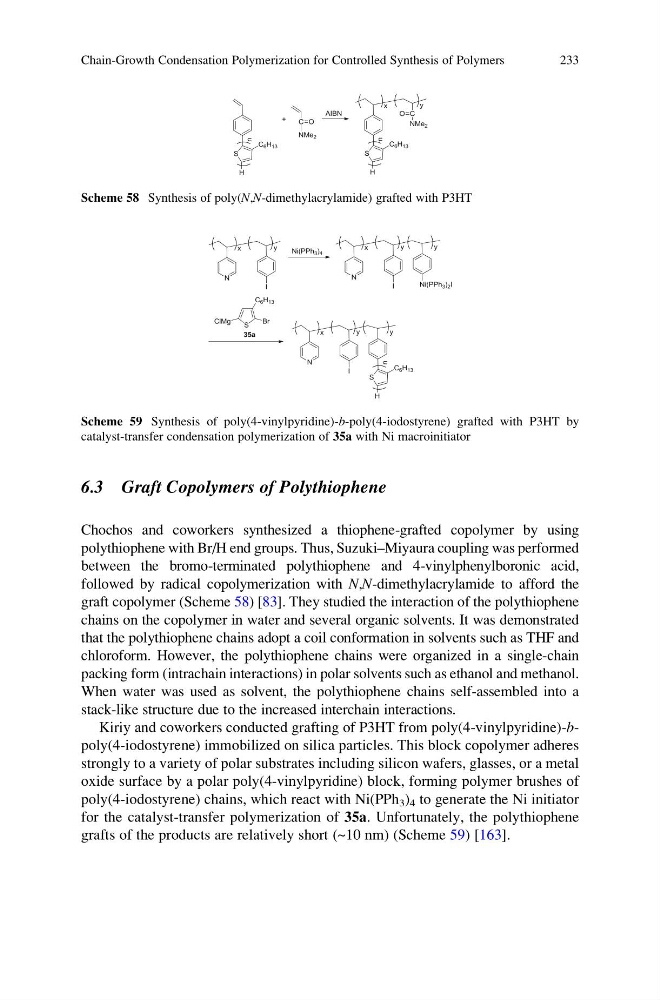
Chochos and coworkers synthesized a thiophene-grafted copolymer by using
polythiophene with Br/H end groups. Thus, Suzuki–Miyaura coupling was performed
between the bromo-terminated polythiophene and 4-vinylphenylboronic acid,
followed by radical copolymerization with N,N-dimethylacrylamide to afford the
graft copolymer (Scheme 58) [83]. They studied the interaction of the polythiophene
chains on the copolymer in water and several organic solvents. It was demonstrated
that the polythiophene chains adopt a coil conformation in solvents such as THF and
chloroform. However, the polythiophene chains were organized in a single-chain
packing form (intrachain interactions) in polar solvents such as ethanol and methanol.
When water was used as solvent, the polythiophene chains self-assembled into a
stack-like structure due to the increased interchain interactions.
Kiriy and coworkers conducted grafting of P3HT from poly(4-vinylpyridine)-bpoly(4-iodostyrene) immobilized on silica particles. This block copolymer adheres
strongly to a variety of polar substrates including silicon wafers, glasses, or a metal
oxide surface by a polar poly(4-vinylpyridine) block, forming polymer brushes of
poly(4-iodostyrene) chains, which react with Ni(PPh 3 ) 4 to generate the Ni initiator
for the catalyst-transfer polymerization of 35a. Unfortunately, the polythiophene
grafts of the products are relatively short (~10 nm) (Scheme 59) [163].
Scheme 58 Synthesis of poly(N,N-dimethylacrylamide) grafted with P3HT
Scheme 59 Synthesis of poly(4-vinylpyridine)-b-poly(4-iodostyrene) grafted with P3HT by
catalyst-transfer condensation polymerization of 35a with Ni macroinitiator
Chain-Growth Condensation Polymerization for Controlled Synthesis of Polymers
233
Chochos and coworkers synthesized a thiophene-grafted copolymer by using
polythiophene with Br/H end groups. Thus, Suzuki–Miyaura coupling was performed
between the bromo-terminated polythiophene and 4-vinylphenylboronic acid,
followed by radical copolymerization with N,N-dimethylacrylamide to afford the
graft copolymer (Scheme 58) [83]. They studied the interaction of the polythiophene
chains on the copolymer in water and several organic solvents. It was demonstrated
that the polythiophene chains adopt a coil conformation in solvents such as THF and
chloroform. However, the polythiophene chains were organized in a single-chain
packing form (intrachain interactions) in polar solvents such as ethanol and methanol.
When water was used as solvent, the polythiophene chains self-assembled into a
stack-like structure due to the increased interchain interactions.
Kiriy and coworkers conducted grafting of P3HT from poly(4-vinylpyridine)-bpoly(4-iodostyrene) immobilized on silica particles. This block copolymer adheres
strongly to a variety of polar substrates including silicon wafers, glasses, or a metal
oxide surface by a polar poly(4-vinylpyridine) block, forming polymer brushes of
poly(4-iodostyrene) chains, which react with Ni(PPh 3 ) 4 to generate the Ni initiator
for the catalyst-transfer polymerization of 35a. Unfortunately, the polythiophene
grafts of the products are relatively short (~10 nm) (Scheme 59) [163].
Scheme 58 Synthesis of poly(N,N-dimethylacrylamide) grafted with P3HT
Scheme 59 Synthesis of poly(4-vinylpyridine)-b-poly(4-iodostyrene) grafted with P3HT by
catalyst-transfer condensation polymerization of 35a with Ni macroinitiator
Chain-Growth Condensation Polymerization for Controlled Synthesis of Polymers
233