

Michaelis–Menten equation (1) and, for simplicity, a pseudo-first order rate
Eq. (2) were applied for the reaction analysis:
E þ S
k
0
ES !
k cat P þ E
(1)
À
d S
½
dt
¼ k
0 E
½ S
½ ¼ k S
½ k
0 E
½ ¼ k
(2)
where E, S, and P denote enzyme, substrate, and product, respectively. Plots of the
integrated form of equation (2) gave k values of 3.7 Â 10
4 s
À1 for MeDLa;
4.4 Â 10
4 s
À1 EtDLa; 3.7 Â 10
4 s
À1 PrDLa; and 3.4 Â 10
4 s
À1 BuDLa.
In order to elucidate the inhibition function of EtLLa toward the oligomerization
of EtDLa, EtLLa was added to the EtDLa reaction. The reaction rate, namely the
EtDLa consumption rate (ν 0 mol L
À1 s
À1 ), was evaluated and the values plotted
according to Lineweaver–Burk plots. The plots demonstrated that inhibition of the
oligomerization of EtDLa by EtLLa is of a “competitive” nature. From the plots, the
Michaelis constant K m ¼ 2.35 mol L
À1 and the maximum rate V max ¼ 1.48 Â 10
À3
mol L
À1 s
À1 were obtained.
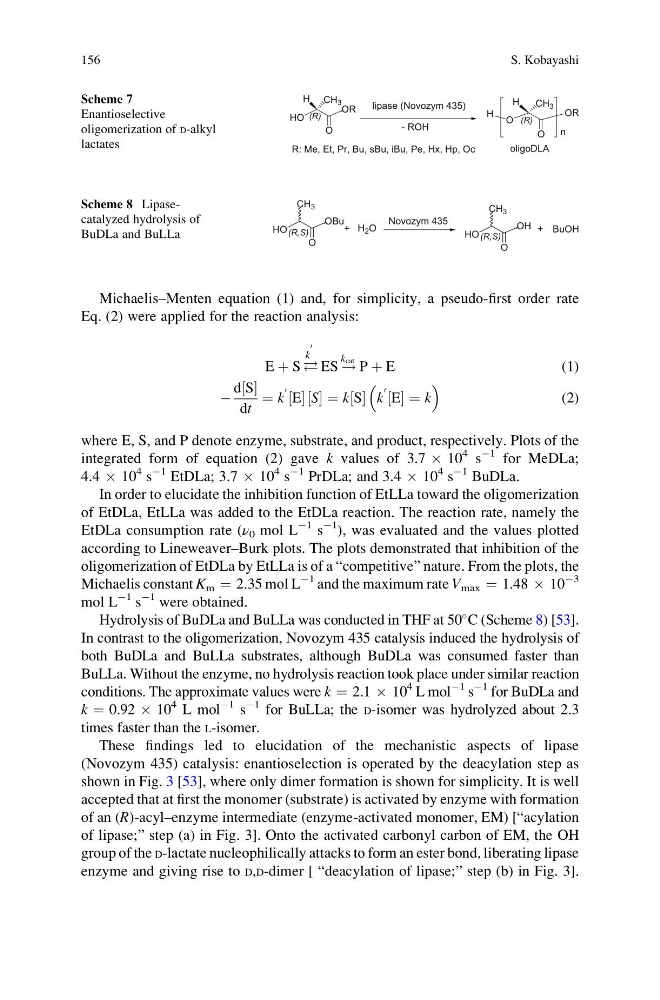
Hydrolysis of BuDLa and BuLLa was conducted in THF at 50
C (Scheme 8) [53].
In contrast to the oligomerization, Novozym 435 catalysis induced the hydrolysis of
both BuDLa and BuLLa substrates, although BuDLa was consumed faster than
BuLLa. Without the enzyme, no hydrolysis reaction took place under similar reaction
conditions. The approximate values were k ¼ 2.1 Â 10
4 L mol
À1 s
À1 for BuDLa and
k ¼ 0.92 Â 10
4 L mol
À1 s
À1 for BuLLa; the D-isomer was hydrolyzed about 2.3
times faster than the L-isomer.
These findings led to elucidation of the mechanistic aspects of lipase
(Novozym 435) catalysis: enantioselection is operated by the deacylation step as
shown in Fig. 3 [53], where only dimer formation is shown for simplicity. It is well
accepted that at first the monomer (substrate) is activated by enzyme with formation
of an (R)-acyl–enzyme intermediate (enzyme-activated monomer, EM) [“acylation
of lipase;” step (a) in Fig. 3]. Onto the activated carbonyl carbon of EM, the OH
group of the D-lactate nucleophilically attacks to form an ester bond, liberating lipase
enzyme and giving rise to D,D-dimer [ “deacylation of lipase;” step (b) in Fig. 3].
(R)
HO
H CH 3
O
OR
(R)
O
H
CH 3
O
OR
H
n
lipase (Novozym 435)
- ROH
R: Me, Et, Pr, Bu, sBu, iBu, Pe, Hx, Hp, Oc
oligoDLA
Scheme 7
Enantioselective
oligomerization of D-alkyl
lactates
CH 3
HO
O
OBu
H 2 O
HO
O
OH
CH 3
BuOH
Novozym 435
+
+
(R,S)
(R,S)
Scheme 8 Lipasecatalyzed hydrolysis of
BuDLa and BuLLa
156
S. Kobayashi
Eq. (2) were applied for the reaction analysis:
E þ S
k
0
ES !
k cat P þ E
(1)
À
d S
½
dt
¼ k
0 E
½ S
½ ¼ k S
½ k
0 E
½ ¼ k
(2)
where E, S, and P denote enzyme, substrate, and product, respectively. Plots of the
integrated form of equation (2) gave k values of 3.7 Â 10
4 s
À1 for MeDLa;
4.4 Â 10
4 s
À1 EtDLa; 3.7 Â 10
4 s
À1 PrDLa; and 3.4 Â 10
4 s
À1 BuDLa.
In order to elucidate the inhibition function of EtLLa toward the oligomerization
of EtDLa, EtLLa was added to the EtDLa reaction. The reaction rate, namely the
EtDLa consumption rate (ν 0 mol L
À1 s
À1 ), was evaluated and the values plotted
according to Lineweaver–Burk plots. The plots demonstrated that inhibition of the
oligomerization of EtDLa by EtLLa is of a “competitive” nature. From the plots, the
Michaelis constant K m ¼ 2.35 mol L
À1 and the maximum rate V max ¼ 1.48 Â 10
À3
mol L
À1 s
À1 were obtained.
Hydrolysis of BuDLa and BuLLa was conducted in THF at 50
C (Scheme 8) [53].
In contrast to the oligomerization, Novozym 435 catalysis induced the hydrolysis of
both BuDLa and BuLLa substrates, although BuDLa was consumed faster than
BuLLa. Without the enzyme, no hydrolysis reaction took place under similar reaction
conditions. The approximate values were k ¼ 2.1 Â 10
4 L mol
À1 s
À1 for BuDLa and
k ¼ 0.92 Â 10
4 L mol
À1 s
À1 for BuLLa; the D-isomer was hydrolyzed about 2.3
times faster than the L-isomer.
These findings led to elucidation of the mechanistic aspects of lipase
(Novozym 435) catalysis: enantioselection is operated by the deacylation step as
shown in Fig. 3 [53], where only dimer formation is shown for simplicity. It is well
accepted that at first the monomer (substrate) is activated by enzyme with formation
of an (R)-acyl–enzyme intermediate (enzyme-activated monomer, EM) [“acylation
of lipase;” step (a) in Fig. 3]. Onto the activated carbonyl carbon of EM, the OH
group of the D-lactate nucleophilically attacks to form an ester bond, liberating lipase
enzyme and giving rise to D,D-dimer [ “deacylation of lipase;” step (b) in Fig. 3].
(R)
HO
H CH 3
O
OR
(R)
O
H
CH 3
O
OR
H
n
lipase (Novozym 435)
- ROH
R: Me, Et, Pr, Bu, sBu, iBu, Pe, Hx, Hp, Oc
oligoDLA
Scheme 7
Enantioselective
oligomerization of D-alkyl
lactates
CH 3
HO
O
OBu
H 2 O
HO
O
OH
CH 3
BuOH
Novozym 435
+
+
(R,S)
(R,S)
Scheme 8 Lipasecatalyzed hydrolysis of
BuDLa and BuLLa
156
S. Kobayashi