

in vitro with bond forming when the lipase catalyst and substrate monomer are
appropriately combined for the reaction. This view seems logical because in vivo
enzymatic reactions are virtually reversible. Lipase catalyzes hydrolysis of the ester
bond through L-enantioselective cleavage. To conduct green polymer chemistry, we
employed lipase as catalyst for synthesis of polymers and oligomers.
3.1 Lipase-Catalyzed Synthesis of Reactive Polyesters
Ring-opening polymerization (ROP) of cyclic esters (lactones) by lipase catalysis to
produce polyesters was discovered in 1993 by our group [47, 48] and another [49].
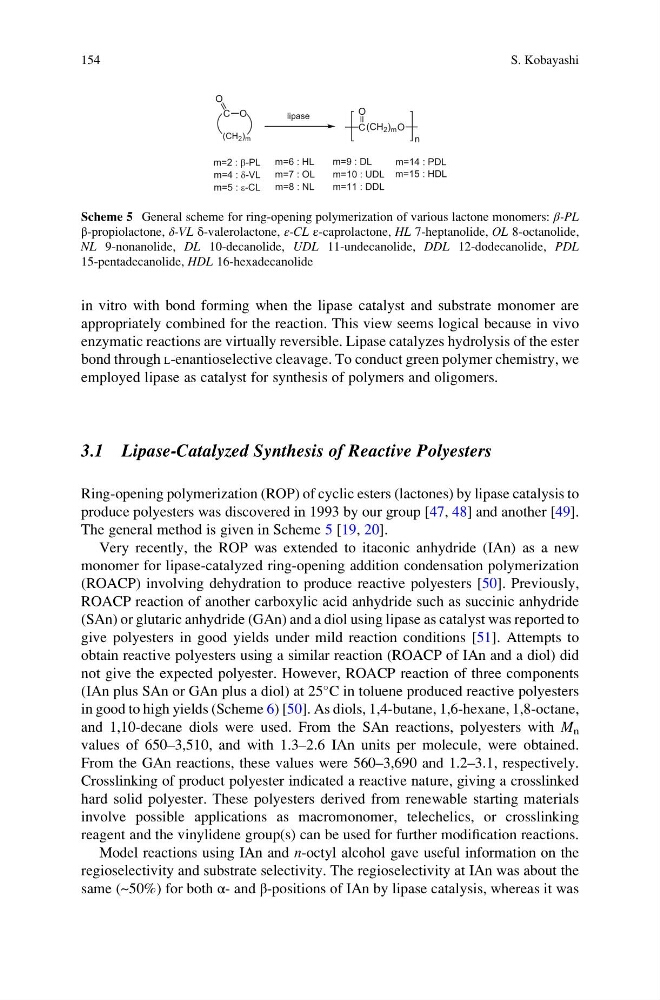
The general method is given in Scheme 5 [19, 20].
Very recently, the ROP was extended to itaconic anhydride (IAn) as a new
monomer for lipase-catalyzed ring-opening addition condensation polymerization
(ROACP) involving dehydration to produce reactive polyesters [50]. Previously,
ROACP reaction of another carboxylic acid anhydride such as succinic anhydride
(SAn) or glutaric anhydride (GAn) and a diol using lipase as catalyst was reported to
give polyesters in good yields under mild reaction conditions [51]. Attempts to
obtain reactive polyesters using a similar reaction (ROACP of IAn and a diol) did
not give the expected polyester. However, ROACP reaction of three components
(IAn plus SAn or GAn plus a diol) at 25
C in toluene produced reactive polyesters
in good to high yields (Scheme 6) [50]. As diols, 1,4-butane, 1,6-hexane, 1,8-octane,
and 1,10-decane diols were used. From the SAn reactions, polyesters with M n
values of 650–3,510, and with 1.3–2.6 IAn units per molecule, were obtained.
From the GAn reactions, these values were 560–3,690 and 1.2–3.1, respectively.
Crosslinking of product polyester indicated a reactive nature, giving a crosslinked
hard solid polyester. These polyesters derived from renewable starting materials
involve possible applications as macromonomer, telechelics, or crosslinking
reagent and the vinylidene group(s) can be used for further modification reactions.
Model reactions using IAn and n-octyl alcohol gave useful information on the
regioselectivity and substrate selectivity. The regioselectivity at IAn was about the
same (~50%) for both α- and β-positions of IAn by lipase catalysis, whereas it was
C O
O
C
O
(CH 2 ) m O
m=4 : d-VL
m=5 : e-CL
m=10 : UDL
m=11 : DDL
(CH 2 ) m
lipase
n
m=14 : PDL
m=2 : b-PL
m=7 : OL
m=15 : HDL
m=8 : NL
m=6 : HL
m=9 : DL
Scheme 5 General scheme for ring-opening polymerization of various lactone monomers: β-PL
β-propiolactone, δ-VL δ-valerolactone, ε-CL ε-caprolactone, HL 7-heptanolide, OL 8-octanolide,
NL 9-nonanolide, DL 10-decanolide, UDL 11-undecanolide, DDL 12-dodecanolide, PDL
15-pentadecanolide, HDL 16-hexadecanolide
154
S. Kobayashi
appropriately combined for the reaction. This view seems logical because in vivo
enzymatic reactions are virtually reversible. Lipase catalyzes hydrolysis of the ester
bond through L-enantioselective cleavage. To conduct green polymer chemistry, we
employed lipase as catalyst for synthesis of polymers and oligomers.
3.1 Lipase-Catalyzed Synthesis of Reactive Polyesters
Ring-opening polymerization (ROP) of cyclic esters (lactones) by lipase catalysis to
produce polyesters was discovered in 1993 by our group [47, 48] and another [49].
The general method is given in Scheme 5 [19, 20].
Very recently, the ROP was extended to itaconic anhydride (IAn) as a new
monomer for lipase-catalyzed ring-opening addition condensation polymerization
(ROACP) involving dehydration to produce reactive polyesters [50]. Previously,
ROACP reaction of another carboxylic acid anhydride such as succinic anhydride
(SAn) or glutaric anhydride (GAn) and a diol using lipase as catalyst was reported to
give polyesters in good yields under mild reaction conditions [51]. Attempts to
obtain reactive polyesters using a similar reaction (ROACP of IAn and a diol) did
not give the expected polyester. However, ROACP reaction of three components
(IAn plus SAn or GAn plus a diol) at 25
C in toluene produced reactive polyesters
in good to high yields (Scheme 6) [50]. As diols, 1,4-butane, 1,6-hexane, 1,8-octane,
and 1,10-decane diols were used. From the SAn reactions, polyesters with M n
values of 650–3,510, and with 1.3–2.6 IAn units per molecule, were obtained.
From the GAn reactions, these values were 560–3,690 and 1.2–3.1, respectively.
Crosslinking of product polyester indicated a reactive nature, giving a crosslinked
hard solid polyester. These polyesters derived from renewable starting materials
involve possible applications as macromonomer, telechelics, or crosslinking
reagent and the vinylidene group(s) can be used for further modification reactions.
Model reactions using IAn and n-octyl alcohol gave useful information on the
regioselectivity and substrate selectivity. The regioselectivity at IAn was about the
same (~50%) for both α- and β-positions of IAn by lipase catalysis, whereas it was
C O
O
C
O
(CH 2 ) m O
m=4 : d-VL
m=5 : e-CL
m=10 : UDL
m=11 : DDL
(CH 2 ) m
lipase
n
m=14 : PDL
m=2 : b-PL
m=7 : OL
m=15 : HDL
m=8 : NL
m=6 : HL
m=9 : DL
Scheme 5 General scheme for ring-opening polymerization of various lactone monomers: β-PL
β-propiolactone, δ-VL δ-valerolactone, ε-CL ε-caprolactone, HL 7-heptanolide, OL 8-octanolide,
NL 9-nonanolide, DL 10-decanolide, UDL 11-undecanolide, DDL 12-dodecanolide, PDL
15-pentadecanolide, HDL 16-hexadecanolide
154
S. Kobayashi