

resistance, and abrasion resistance. The pencil hardness of the cured film was F, and the
biomass content of the film was 29 wt% (44 wt% when succinic anhydride taken into
account), showing that the film could be classed as a biomass plastic [44, 45].
2.5 Miniemulsion System
From the environmental viewpoint, the solvent used for coating or film-forming
materials is important. The macromonomer technique was therefore applied to form
a miniemulsion system of PLA-graft copolymers, as a typical example of the use
of water as a green solvent. Four MMm macromonomers (m ¼ 4, 6, 8, and 12;
Scheme 1) were prepared and used as comonomer. In the copolymerization, BMA
or BA was employed as the vinyl monomer (reaction 2, Scheme 1) [41]. Sodium
dodecyl sulfate (SDS) and sodium dioctyl sulfosuccinate (PEREX), both anionic,
were found to be appropriate surfactants. To form a stable emulsion system,
ultrasound sonication was applied to the mixture of comonomers and surfactant
in water before the copolymerization. Then, radical copolymerization was
carried out (Table 3) [41, 42]. Relevant to the use of water as reaction solvent,
Sect. 4 describes the use of green solvents in enzyme-catalyzed polymerizations.
With 1.0 or 3.0 wt% of the surfactant, all copolymerizations employing MM4,
MM6, or MM8 as comonomer afforded a stable miniemulsion system before and
after the reaction. However, the copolymerization system of MM12 gave a
miniemulsion before the reaction, whereas after the reaction a small portion
(3.9 wt%) of polymer aggregates formed and a stable miniemulsion system was
not obtained. Thus, an average chain length longer than 12 was not appropriate for
the copolymer emulsification, probably due to the hydrophobic nature of longer
PLA chains or SDS not being an effective surfactant, even at 3.0 wt%.
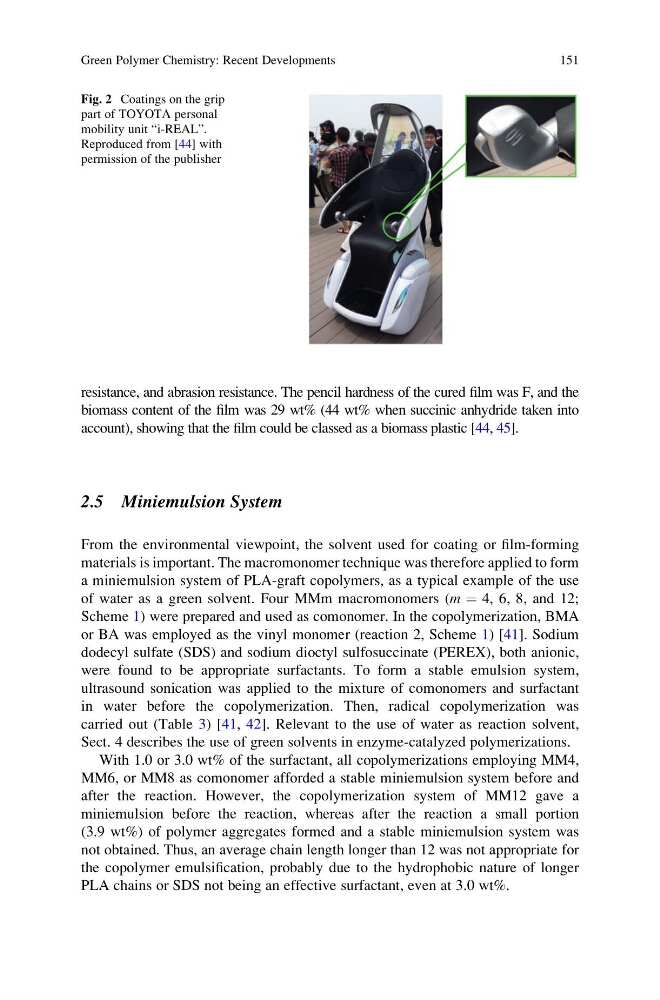
Fig. 2 Coatings on the grip
part of TOYOTA personal
mobility unit “i-REAL”.
Reproduced from [44] with
permission of the publisher
Green Polymer Chemistry: Recent Developments
151
biomass content of the film was 29 wt% (44 wt% when succinic anhydride taken into
account), showing that the film could be classed as a biomass plastic [44, 45].
2.5 Miniemulsion System
From the environmental viewpoint, the solvent used for coating or film-forming
materials is important. The macromonomer technique was therefore applied to form
a miniemulsion system of PLA-graft copolymers, as a typical example of the use
of water as a green solvent. Four MMm macromonomers (m ¼ 4, 6, 8, and 12;
Scheme 1) were prepared and used as comonomer. In the copolymerization, BMA
or BA was employed as the vinyl monomer (reaction 2, Scheme 1) [41]. Sodium
dodecyl sulfate (SDS) and sodium dioctyl sulfosuccinate (PEREX), both anionic,
were found to be appropriate surfactants. To form a stable emulsion system,
ultrasound sonication was applied to the mixture of comonomers and surfactant
in water before the copolymerization. Then, radical copolymerization was
carried out (Table 3) [41, 42]. Relevant to the use of water as reaction solvent,
Sect. 4 describes the use of green solvents in enzyme-catalyzed polymerizations.
With 1.0 or 3.0 wt% of the surfactant, all copolymerizations employing MM4,
MM6, or MM8 as comonomer afforded a stable miniemulsion system before and
after the reaction. However, the copolymerization system of MM12 gave a
miniemulsion before the reaction, whereas after the reaction a small portion
(3.9 wt%) of polymer aggregates formed and a stable miniemulsion system was
not obtained. Thus, an average chain length longer than 12 was not appropriate for
the copolymer emulsification, probably due to the hydrophobic nature of longer
PLA chains or SDS not being an effective surfactant, even at 3.0 wt%.
Fig. 2 Coatings on the grip
part of TOYOTA personal
mobility unit “i-REAL”.
Reproduced from [44] with
permission of the publisher
Green Polymer Chemistry: Recent Developments
151