

investigated for a miniemulsion system (see Sect. 2.5). Here, we give the results of
solution copolymerization of MMm (having m values of 6, 12, 18, and 30) with
n-butyl methacrylate (BMA) and methyl methacrylate (MMA). Various graft
copolymers [PB(M)MA-g-PLAm] (reaction 2, Scheme 1) were obtained and their
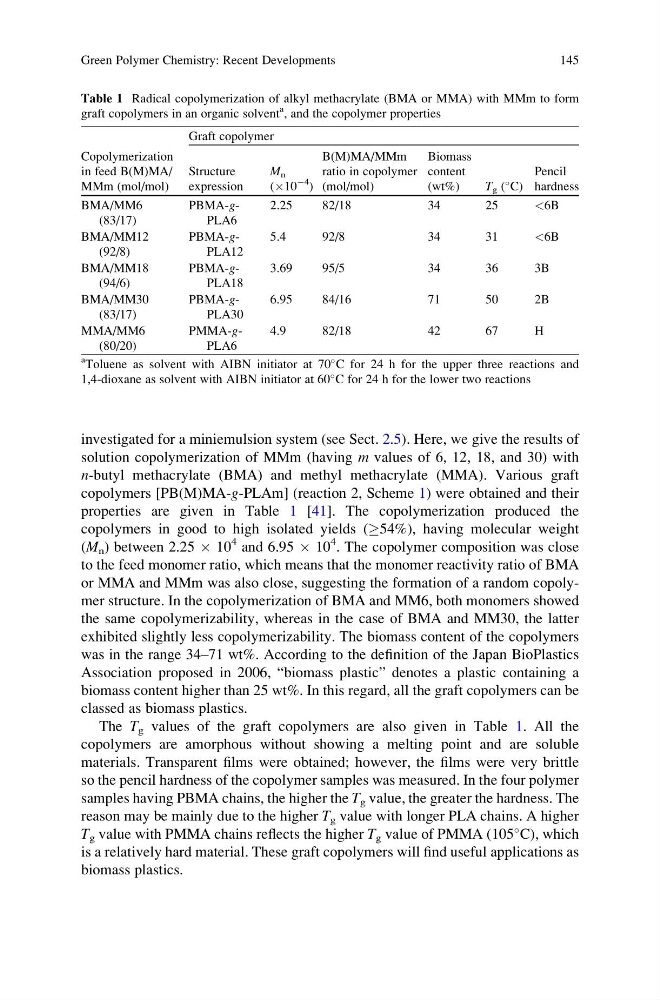
properties are given in Table 1 [41]. The copolymerization produced the
copolymers in good to high isolated yields (!54%), having molecular weight
(M n ) between 2.25 Â 10
4 and 6.95 Â 10
4 . The copolymer composition was close
to the feed monomer ratio, which means that the monomer reactivity ratio of BMA
or MMA and MMm was also close, suggesting the formation of a random copolymer structure. In the copolymerization of BMA and MM6, both monomers showed
the same copolymerizability, whereas in the case of BMA and MM30, the latter
exhibited slightly less copolymerizability. The biomass content of the copolymers
was in the range 34–71 wt%. According to the definition of the Japan BioPlastics
Association proposed in 2006, “biomass plastic” denotes a plastic containing a
biomass content higher than 25 wt%. In this regard, all the graft copolymers can be
classed as biomass plastics.
The T g values of the graft copolymers are also given in Table 1. All the
copolymers are amorphous without showing a melting point and are soluble
materials. Transparent films were obtained; however, the films were very brittle
so the pencil hardness of the copolymer samples was measured. In the four polymer
samples having PBMA chains, the higher the T g value, the greater the hardness. The
reason may be mainly due to the higher T g value with longer PLA chains. A higher
T g value with PMMA chains reflects the higher T g value of PMMA (105
C), which
is a relatively hard material. These graft copolymers will find useful applications as
biomass plastics.
Table 1 Radical copolymerization of alkyl methacrylate (BMA or MMA) with MMm to form
graft copolymers in an organic solvent
a
, and the copolymer properties
Copolymerization
in feed B(M)MA/
MMm (mol/mol)
Graft copolymer
Structure
expression
M n
(Â10
À4
)
B(M)MA/MMm
ratio in copolymer
(mol/mol)
Biomass
content
(wt%)
T g (
C)
Pencil
hardness
BMA/MM6
(83/17)
PBMA-gPLA6
2.25
82/18
34
25
<6B
BMA/MM12
(92/8)
PBMA-gPLA12
5.4
92/8
34
31
<6B
BMA/MM18
(94/6)
PBMA-gPLA18
3.69
95/5
34
36
3B
BMA/MM30
(83/17)
PBMA-gPLA30
6.95
84/16
71
50
2B
MMA/MM6
(80/20)
PMMA-gPLA6
4.9
82/18
42
67
H
a
Toluene as solvent with AIBN initiator at 70
C for 24 h for the upper three reactions and
1,4-dioxane as solvent with AIBN initiator at 60
C for 24 h for the lower two reactions
Green Polymer Chemistry: Recent Developments
145
solution copolymerization of MMm (having m values of 6, 12, 18, and 30) with
n-butyl methacrylate (BMA) and methyl methacrylate (MMA). Various graft
copolymers [PB(M)MA-g-PLAm] (reaction 2, Scheme 1) were obtained and their
properties are given in Table 1 [41]. The copolymerization produced the
copolymers in good to high isolated yields (!54%), having molecular weight
(M n ) between 2.25 Â 10
4 and 6.95 Â 10
4 . The copolymer composition was close
to the feed monomer ratio, which means that the monomer reactivity ratio of BMA
or MMA and MMm was also close, suggesting the formation of a random copolymer structure. In the copolymerization of BMA and MM6, both monomers showed
the same copolymerizability, whereas in the case of BMA and MM30, the latter
exhibited slightly less copolymerizability. The biomass content of the copolymers
was in the range 34–71 wt%. According to the definition of the Japan BioPlastics
Association proposed in 2006, “biomass plastic” denotes a plastic containing a
biomass content higher than 25 wt%. In this regard, all the graft copolymers can be
classed as biomass plastics.
The T g values of the graft copolymers are also given in Table 1. All the
copolymers are amorphous without showing a melting point and are soluble
materials. Transparent films were obtained; however, the films were very brittle
so the pencil hardness of the copolymer samples was measured. In the four polymer
samples having PBMA chains, the higher the T g value, the greater the hardness. The
reason may be mainly due to the higher T g value with longer PLA chains. A higher
T g value with PMMA chains reflects the higher T g value of PMMA (105
C), which
is a relatively hard material. These graft copolymers will find useful applications as
biomass plastics.
Table 1 Radical copolymerization of alkyl methacrylate (BMA or MMA) with MMm to form
graft copolymers in an organic solvent
a
, and the copolymer properties
Copolymerization
in feed B(M)MA/
MMm (mol/mol)
Graft copolymer
Structure
expression
M n
(Â10
À4
)
B(M)MA/MMm
ratio in copolymer
(mol/mol)
Biomass
content
(wt%)
T g (
C)
Pencil
hardness
BMA/MM6
(83/17)
PBMA-gPLA6
2.25
82/18
34
25
<6B
BMA/MM12
(92/8)
PBMA-gPLA12
5.4
92/8
34
31
<6B
BMA/MM18
(94/6)
PBMA-gPLA18
3.69
95/5
34
36
3B
BMA/MM30
(83/17)
PBMA-gPLA30
6.95
84/16
71
50
2B
MMA/MM6
(80/20)
PMMA-gPLA6
4.9
82/18
42
67
H
a
Toluene as solvent with AIBN initiator at 70
C for 24 h for the upper three reactions and
1,4-dioxane as solvent with AIBN initiator at 60
C for 24 h for the lower two reactions
Green Polymer Chemistry: Recent Developments
145