

lactic acid) and direct polycondensation of lactic acid [29, 30]. Thus, we prepared
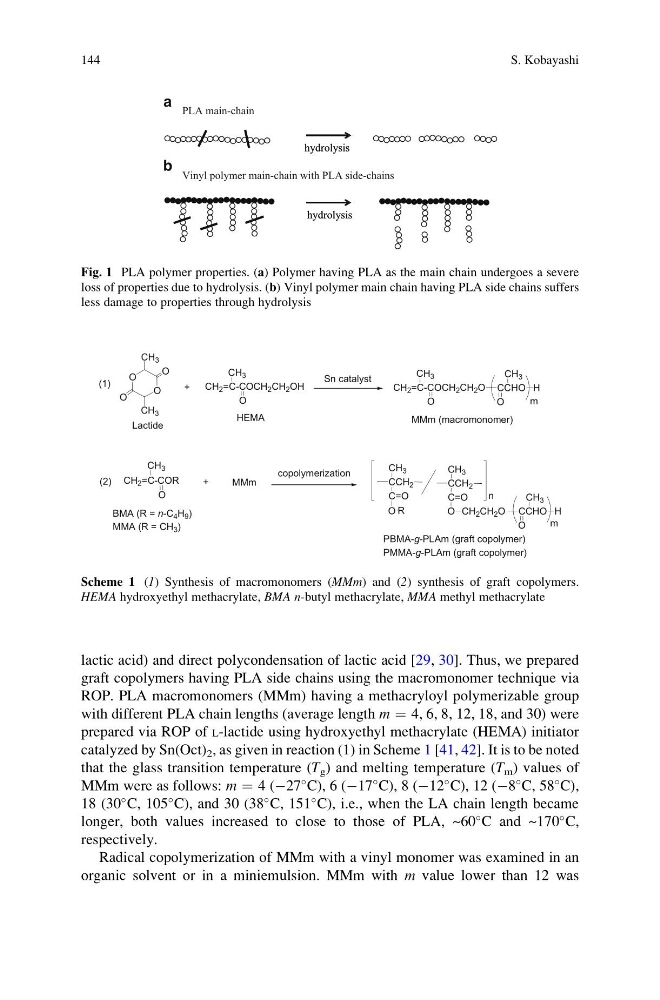
graft copolymers having PLA side chains using the macromonomer technique via
ROP. PLA macromonomers (MMm) having a methacryloyl polymerizable group
with different PLA chain lengths (average length m ¼ 4, 6, 8, 12, 18, and 30) were
prepared via ROP of L-lactide using hydroxyethyl methacrylate (HEMA) initiator
catalyzed by Sn(Oct) 2 , as given in reaction (1) in Scheme 1 [41, 42]. It is to be noted
that the glass transition temperature (T g ) and melting temperature (T m ) values of
MMm were as follows: m ¼ 4 (À27
C), 6 (À17
C), 8 (À12
C), 12 (À8
C, 58
C),
18 (30
C, 105
C), and 30 (38
C, 151
C), i.e., when the LA chain length became
longer, both values increased to close to those of PLA, ~60
C and ~170
C,
respectively.
Radical copolymerization of MMm with a vinyl monomer was examined in an
organic solvent or in a miniemulsion. MMm with m value lower than 12 was
PLA main-chain
Vinyl polymer main-chain with PLA side-chains
hydrolysis
hydrolysis
hydrolysis
hydrolysis
b
a
Fig. 1 PLA polymer properties. (a) Polymer having PLA as the main chain undergoes a severe
loss of properties due to hydrolysis. (b) Vinyl polymer main chain having PLA side chains suffers
less damage to properties through hydrolysis
O
O
O
O
CH 3
CH 3
CH 2 =C-COR
CH 3
O
CH 2 =C-COCH 2 CH 2 OH
CH 3
O
BMA (R = n-C 4 H 9 )
CCH 2
CH 3
C=O
O R
CH 2 =C-COCH 2 CH 2 O
CH 3
O
CCHO
O
CH 3
H
CCH 2
CH 3
C=O
O CH 2 CH 2 O CCHO
O
CH 3
H
m
+
Sn catalyst
HEMA
MMm
+
m
n
copolymerization
(2)
(1)
MMm (macromonomer)
Lactide
PMMA-g-PLAm (graft copolymer)
MMA (R = CH 3 )
PBMA-g-PLAm (graft copolymer)
Scheme 1 (1) Synthesis of macromonomers (MMm) and (2) synthesis of graft copolymers.
HEMA hydroxyethyl methacrylate, BMA n-butyl methacrylate, MMA methyl methacrylate
144
S. Kobayashi
graft copolymers having PLA side chains using the macromonomer technique via
ROP. PLA macromonomers (MMm) having a methacryloyl polymerizable group
with different PLA chain lengths (average length m ¼ 4, 6, 8, 12, 18, and 30) were
prepared via ROP of L-lactide using hydroxyethyl methacrylate (HEMA) initiator
catalyzed by Sn(Oct) 2 , as given in reaction (1) in Scheme 1 [41, 42]. It is to be noted
that the glass transition temperature (T g ) and melting temperature (T m ) values of
MMm were as follows: m ¼ 4 (À27
C), 6 (À17
C), 8 (À12
C), 12 (À8
C, 58
C),
18 (30
C, 105
C), and 30 (38
C, 151
C), i.e., when the LA chain length became
longer, both values increased to close to those of PLA, ~60
C and ~170
C,
respectively.
Radical copolymerization of MMm with a vinyl monomer was examined in an
organic solvent or in a miniemulsion. MMm with m value lower than 12 was
PLA main-chain
Vinyl polymer main-chain with PLA side-chains
hydrolysis
hydrolysis
hydrolysis
hydrolysis
b
a
Fig. 1 PLA polymer properties. (a) Polymer having PLA as the main chain undergoes a severe
loss of properties due to hydrolysis. (b) Vinyl polymer main chain having PLA side chains suffers
less damage to properties through hydrolysis
O
O
O
O
CH 3
CH 3
CH 2 =C-COR
CH 3
O
CH 2 =C-COCH 2 CH 2 OH
CH 3
O
BMA (R = n-C 4 H 9 )
CCH 2
CH 3
C=O
O R
CH 2 =C-COCH 2 CH 2 O
CH 3
O
CCHO
O
CH 3
H
CCH 2
CH 3
C=O
O CH 2 CH 2 O CCHO
O
CH 3
H
m
+
Sn catalyst
HEMA
MMm
+
m
n
copolymerization
(2)
(1)
MMm (macromonomer)
Lactide
PMMA-g-PLAm (graft copolymer)
MMA (R = CH 3 )
PBMA-g-PLAm (graft copolymer)
Scheme 1 (1) Synthesis of macromonomers (MMm) and (2) synthesis of graft copolymers.
HEMA hydroxyethyl methacrylate, BMA n-butyl methacrylate, MMA methyl methacrylate
144
S. Kobayashi