

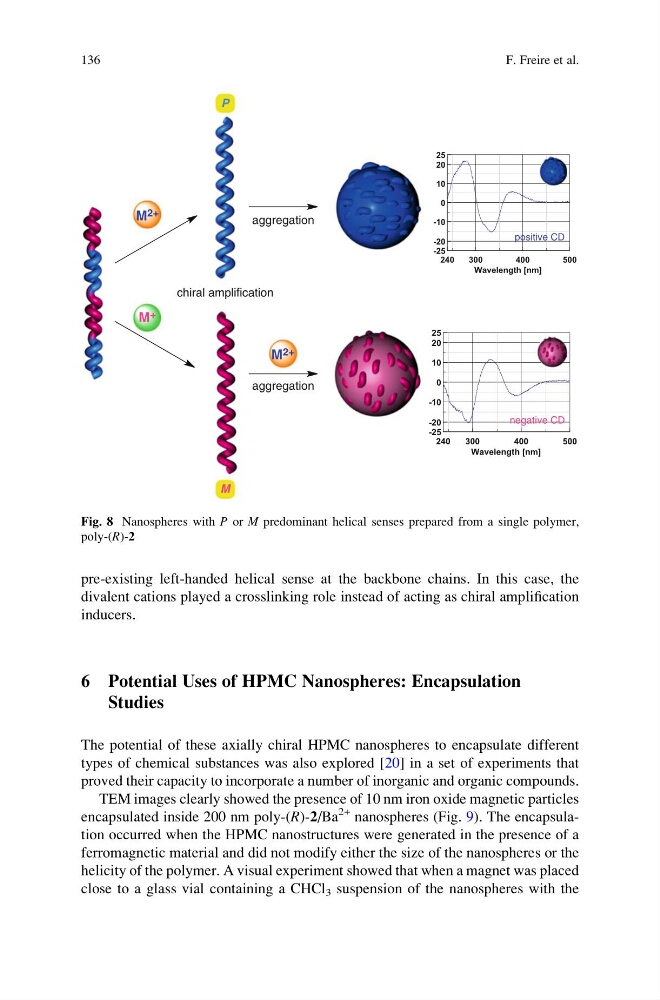
pre-existing left-handed helical sense at the backbone chains. In this case, the
divalent cations played a crosslinking role instead of acting as chiral amplification
inducers.
6 Potential Uses of HPMC Nanospheres: Encapsulation
Studies
The potential of these axially chiral HPMC nanospheres to encapsulate different
types of chemical substances was also explored [20] in a set of experiments that
proved their capacity to incorporate a number of inorganic and organic compounds.
TEM images clearly showed the presence of 10 nm iron oxide magnetic particles
encapsulated inside 200 nm poly-(R)-2/Ba
2+ nanospheres (Fig. 9). The encapsulation occurred when the HPMC nanostructures were generated in the presence of a
ferromagnetic material and did not modify either the size of the nanospheres or the
helicity of the polymer. A visual experiment showed that when a magnet was placed
close to a glass vial containing a CHCl 3 suspension of the nanospheres with the
-25
25
-20
-10
0
10
20
240
500
300
400
Wavelength [nm]
negative CD
-25
25
-20
-10
0
10
20
240
500
300
400
Wavelength [nm]
positive CD
M +
M 2+
M 2+
aggregation
aggregation
P
M
Fig. 8 Nanospheres with P or M predominant helical senses prepared from a single polymer,
poly-(R)-2
136
F. Freire et al.
divalent cations played a crosslinking role instead of acting as chiral amplification
inducers.
6 Potential Uses of HPMC Nanospheres: Encapsulation
Studies
The potential of these axially chiral HPMC nanospheres to encapsulate different
types of chemical substances was also explored [20] in a set of experiments that
proved their capacity to incorporate a number of inorganic and organic compounds.
TEM images clearly showed the presence of 10 nm iron oxide magnetic particles
encapsulated inside 200 nm poly-(R)-2/Ba
2+ nanospheres (Fig. 9). The encapsulation occurred when the HPMC nanostructures were generated in the presence of a
ferromagnetic material and did not modify either the size of the nanospheres or the
helicity of the polymer. A visual experiment showed that when a magnet was placed
close to a glass vial containing a CHCl 3 suspension of the nanospheres with the
-25
25
-20
-10
0
10
20
240
500
300
400
Wavelength [nm]
negative CD
-25
25
-20
-10
0
10
20
240
500
300
400
Wavelength [nm]
positive CD
M +
M 2+
M 2+
aggregation
aggregation
P
M
Fig. 8 Nanospheres with P or M predominant helical senses prepared from a single polymer,
poly-(R)-2
136
F. Freire et al.