

In the second approach, nanospheres with M or P helical senses could be
selectively prepared from a single polymer [i.e. from poly-(R)-2] as starting material by adequate use of the two roles played by the metal ions, as mentioned above.
For instance, divalent cations and poly-(R)-2 led to “right-handed” HPMC
nanospheres (as stated above). However, the sequential addition of mono- and
divalent cations to that same polymer [poly-(R)-2] allowed the preparation of the
“enantiomeric” nanospheres where “left-handed” helical senses predominated. In
both cases, the CD responses at the vinylic region were opposite (positive and
negative, respectively, Fig. 8).
The following are examples of standard experiments:
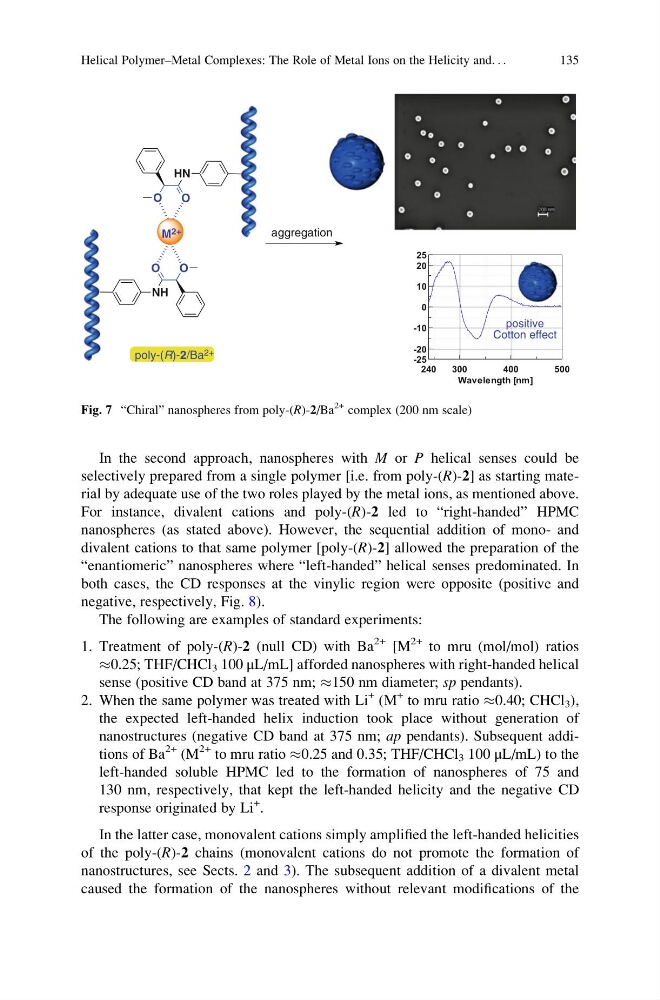
1. Treatment of poly-(R)-2 (null CD) with Ba
2+ [M
2+ to mru (mol/mol) ratios
%0.25; THF/CHCl 3 100 μL/mL] afforded nanospheres with right-handed helical
sense (positive CD band at 375 nm; %150 nm diameter; sp pendants).
2. When the same polymer was treated with Li
+ (M
+ to mru ratio %0.40; CHCl 3 ),
the expected left-handed helix induction took place without generation of
nanostructures (negative CD band at 375 nm; ap pendants). Subsequent additions of Ba
2+ (M
2+ to mru ratio %0.25 and 0.35; THF/CHCl 3 100 μL/mL) to the
left-handed soluble HPMC led to the formation of nanospheres of 75 and
130 nm, respectively, that kept the left-handed helicity and the negative CD
response originated by Li
+
.
In the latter case, monovalent cations simply amplified the left-handed helicities
of the poly-(R)-2 chains (monovalent cations do not promote the formation of
nanostructures, see Sects. 2 and 3). The subsequent addition of a divalent metal
caused the formation of the nanospheres without relevant modifications of the
NH
O
O
M 2+
HN
O
O
aggregation
poly-(R)-2/Ba 2+
-25
25
-20
-10
0
10
20
240
500
300
400
Wavelength [nm]
positive
Cotton effect
Fig. 7 “Chiral” nanospheres from poly-(R)-2/Ba
2+ complex (200 nm scale)
Helical Polymer–Metal Complexes: The Role of Metal Ions on the Helicity and. . .
135
selectively prepared from a single polymer [i.e. from poly-(R)-2] as starting material by adequate use of the two roles played by the metal ions, as mentioned above.
For instance, divalent cations and poly-(R)-2 led to “right-handed” HPMC
nanospheres (as stated above). However, the sequential addition of mono- and
divalent cations to that same polymer [poly-(R)-2] allowed the preparation of the
“enantiomeric” nanospheres where “left-handed” helical senses predominated. In
both cases, the CD responses at the vinylic region were opposite (positive and
negative, respectively, Fig. 8).
The following are examples of standard experiments:
1. Treatment of poly-(R)-2 (null CD) with Ba
2+ [M
2+ to mru (mol/mol) ratios
%0.25; THF/CHCl 3 100 μL/mL] afforded nanospheres with right-handed helical
sense (positive CD band at 375 nm; %150 nm diameter; sp pendants).
2. When the same polymer was treated with Li
+ (M
+ to mru ratio %0.40; CHCl 3 ),
the expected left-handed helix induction took place without generation of
nanostructures (negative CD band at 375 nm; ap pendants). Subsequent additions of Ba
2+ (M
2+ to mru ratio %0.25 and 0.35; THF/CHCl 3 100 μL/mL) to the
left-handed soluble HPMC led to the formation of nanospheres of 75 and
130 nm, respectively, that kept the left-handed helicity and the negative CD
response originated by Li
+
.
In the latter case, monovalent cations simply amplified the left-handed helicities
of the poly-(R)-2 chains (monovalent cations do not promote the formation of
nanostructures, see Sects. 2 and 3). The subsequent addition of a divalent metal
caused the formation of the nanospheres without relevant modifications of the
NH
O
O
M 2+
HN
O
O
aggregation
poly-(R)-2/Ba 2+
-25
25
-20
-10
0
10
20
240
500
300
400
Wavelength [nm]
positive
Cotton effect
Fig. 7 “Chiral” nanospheres from poly-(R)-2/Ba
2+ complex (200 nm scale)
Helical Polymer–Metal Complexes: The Role of Metal Ions on the Helicity and. . .
135