

mesogenic core axis can be easily understood. When the linking group X is replaced
by the carbonate group, the bimodal character of the distribution curve is largely
lost, and accordingly the distinction between those calculated for n ¼ odd and even
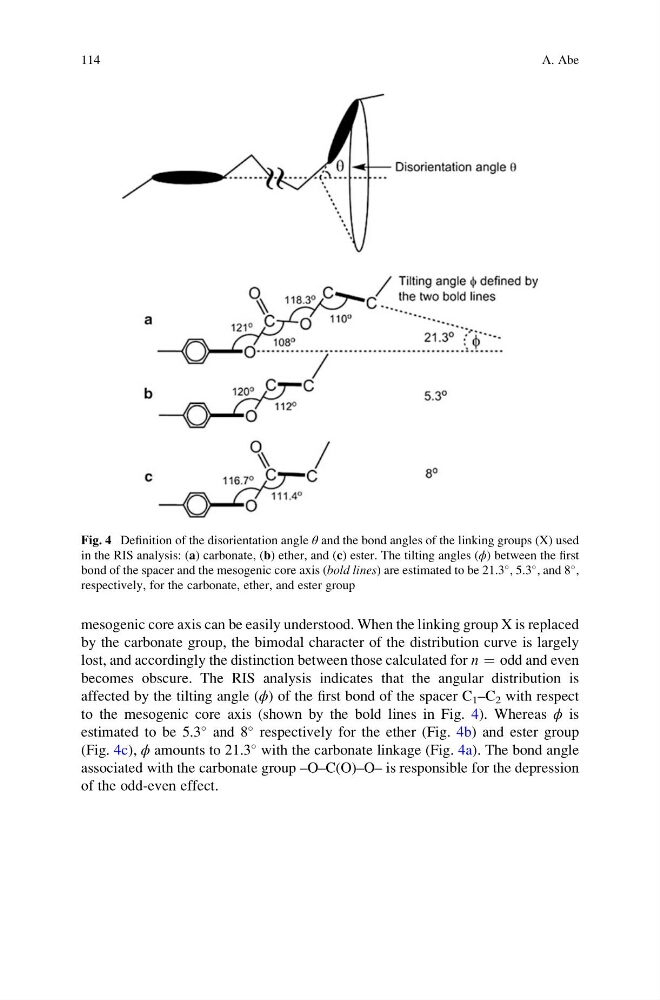
becomes obscure. The RIS analysis indicates that the angular distribution is
affected by the tilting angle (ϕ) of the first bond of the spacer C 1 –C 2 with respect
to the mesogenic core axis (shown by the bold lines in Fig. 4). Whereas ϕ is
estimated to be 5.3
and 8
respectively for the ether (Fig. 4b) and ester group
(Fig. 4c), ϕ amounts to 21.3
with the carbonate linkage (Fig. 4a). The bond angle
associated with the carbonate group –O–C(O)–O– is responsible for the depression
of the odd-even effect.
Fig. 4 Definition of the disorientation angle θ and the bond angles of the linking groups (X) used
in the RIS analysis: (a) carbonate, (b) ether, and (c) ester. The tilting angles (ϕ) between the first
bond of the spacer and the mesogenic core axis (bold lines) are estimated to be 21.3
, 5.3
, and 8
,
respectively, for the carbonate, ether, and ester group
114
A. Abe
by the carbonate group, the bimodal character of the distribution curve is largely
lost, and accordingly the distinction between those calculated for n ¼ odd and even
becomes obscure. The RIS analysis indicates that the angular distribution is
affected by the tilting angle (ϕ) of the first bond of the spacer C 1 –C 2 with respect
to the mesogenic core axis (shown by the bold lines in Fig. 4). Whereas ϕ is
estimated to be 5.3
and 8
respectively for the ether (Fig. 4b) and ester group
(Fig. 4c), ϕ amounts to 21.3
with the carbonate linkage (Fig. 4a). The bond angle
associated with the carbonate group –O–C(O)–O– is responsible for the depression
of the odd-even effect.
Fig. 4 Definition of the disorientation angle θ and the bond angles of the linking groups (X) used
in the RIS analysis: (a) carbonate, (b) ether, and (c) ester. The tilting angles (ϕ) between the first
bond of the spacer and the mesogenic core axis (bold lines) are estimated to be 21.3
, 5.3
, and 8
,
respectively, for the carbonate, ether, and ester group
114
A. Abe