

4 Characterization of the Nematic Conformation
of the Flexible Spacer
4.1 RIS Analysis of the Orientational Correlation
of the Neighboring Mesogens
A theoretical analysis has been put forward on the basis of the conformational
distribution estimated within the rotational isomeric state (RIS) approximation
[20, 21]. The integrated distribution curves of the disorientation angle θ between
the two successive mesogens (P(θ) À θ) were calculated for spacers comprising
odd and even numbers (n) of methylene units in the isotropic conformation
[13, 22]. Definition of θ and the bond angles of the linking group (X) adopted in
these calculations are shown in Fig. 4. For the ether and ester-type compounds, the
profiles of the bimodal distribution are distinctly different for n ¼ odd and even.
Whereas the conformers of n ¼ 9 are mostly populated in the range 45
< θ < 100
and 145
< θ < 180
, the fractional ranges for n ¼ even are 0 < θ < 30
and
85
< θ < 130
. The mutual orientation of the mesogenic cores on both terminals
of the spacer is antiparallel at θ ¼ 0 and parallel at θ ¼ 180
. In the nematic state,
the conformers incompatible with the uniaxial potential field should be suppressed.
Selection of conformers according to this simple rule intuitively suggests that the
conformer distribution may yield an odd-even effect with n for the ether and ester
series. By the same token, the observed odd-even trend of the order parameter of the
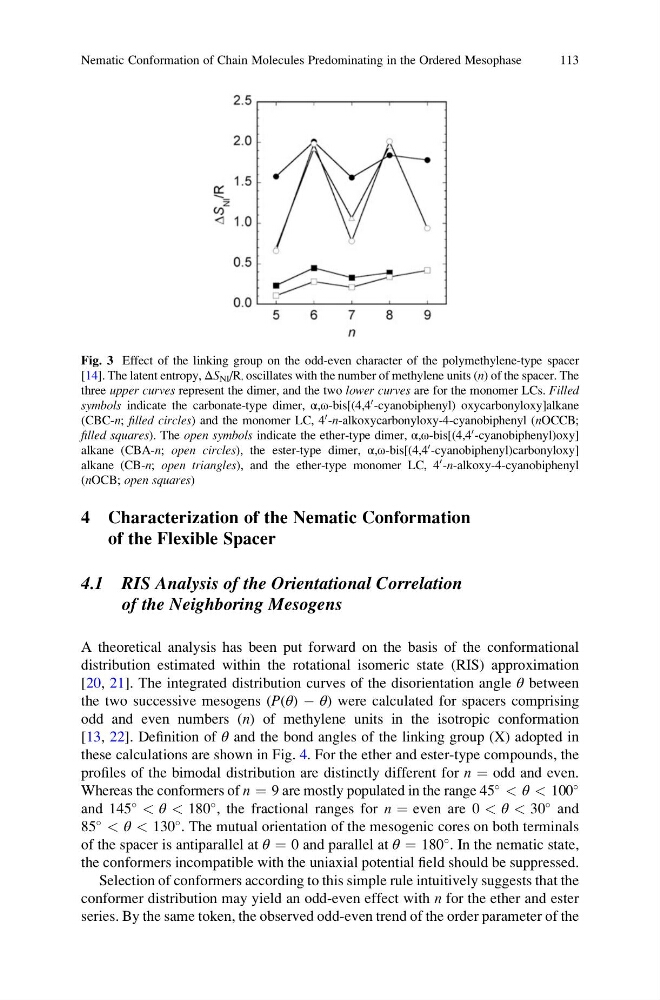
Fig. 3 Effect of the linking group on the odd-even character of the polymethylene-type spacer
[14]. The latent entropy, ΔS NI /R, oscillates with the number of methylene units (n) of the spacer. The
three upper curves represent the dimer, and the two lower curves are for the monomer LCs. Filled
symbols indicate the carbonate-type dimer, α,ω-bis[(4,4
0 -cyanobiphenyl) oxycarbonyloxy]alkane
(CBC-n; filled circles) and the monomer LC, 4
0 -n-alkoxycarbonyloxy-4-cyanobiphenyl (nOCCB;
filled squares). The open symbols indicate the ether-type dimer, α,ω-bis[(4,4
0 -cyanobiphenyl)oxy]
alkane (CBA-n; open circles), the ester-type dimer, α,ω-bis[(4,4
0 -cyanobiphenyl)carbonyloxy]
alkane (CB-n; open triangles), and the ether-type monomer LC, 4
0 -n-alkoxy-4-cyanobiphenyl
(nOCB; open squares)
Nematic Conformation of Chain Molecules Predominating in the Ordered Mesophase
113
of the Flexible Spacer
4.1 RIS Analysis of the Orientational Correlation
of the Neighboring Mesogens
A theoretical analysis has been put forward on the basis of the conformational
distribution estimated within the rotational isomeric state (RIS) approximation
[20, 21]. The integrated distribution curves of the disorientation angle θ between
the two successive mesogens (P(θ) À θ) were calculated for spacers comprising
odd and even numbers (n) of methylene units in the isotropic conformation
[13, 22]. Definition of θ and the bond angles of the linking group (X) adopted in
these calculations are shown in Fig. 4. For the ether and ester-type compounds, the
profiles of the bimodal distribution are distinctly different for n ¼ odd and even.
Whereas the conformers of n ¼ 9 are mostly populated in the range 45
< θ < 100
and 145
< θ < 180
, the fractional ranges for n ¼ even are 0 < θ < 30
and
85
< θ < 130
. The mutual orientation of the mesogenic cores on both terminals
of the spacer is antiparallel at θ ¼ 0 and parallel at θ ¼ 180
. In the nematic state,
the conformers incompatible with the uniaxial potential field should be suppressed.
Selection of conformers according to this simple rule intuitively suggests that the
conformer distribution may yield an odd-even effect with n for the ether and ester
series. By the same token, the observed odd-even trend of the order parameter of the
Fig. 3 Effect of the linking group on the odd-even character of the polymethylene-type spacer
[14]. The latent entropy, ΔS NI /R, oscillates with the number of methylene units (n) of the spacer. The
three upper curves represent the dimer, and the two lower curves are for the monomer LCs. Filled
symbols indicate the carbonate-type dimer, α,ω-bis[(4,4
0 -cyanobiphenyl) oxycarbonyloxy]alkane
(CBC-n; filled circles) and the monomer LC, 4
0 -n-alkoxycarbonyloxy-4-cyanobiphenyl (nOCCB;
filled squares). The open symbols indicate the ether-type dimer, α,ω-bis[(4,4
0 -cyanobiphenyl)oxy]
alkane (CBA-n; open circles), the ester-type dimer, α,ω-bis[(4,4
0 -cyanobiphenyl)carbonyloxy]
alkane (CB-n; open triangles), and the ether-type monomer LC, 4
0 -n-alkoxy-4-cyanobiphenyl
(nOCB; open squares)
Nematic Conformation of Chain Molecules Predominating in the Ordered Mesophase
113