

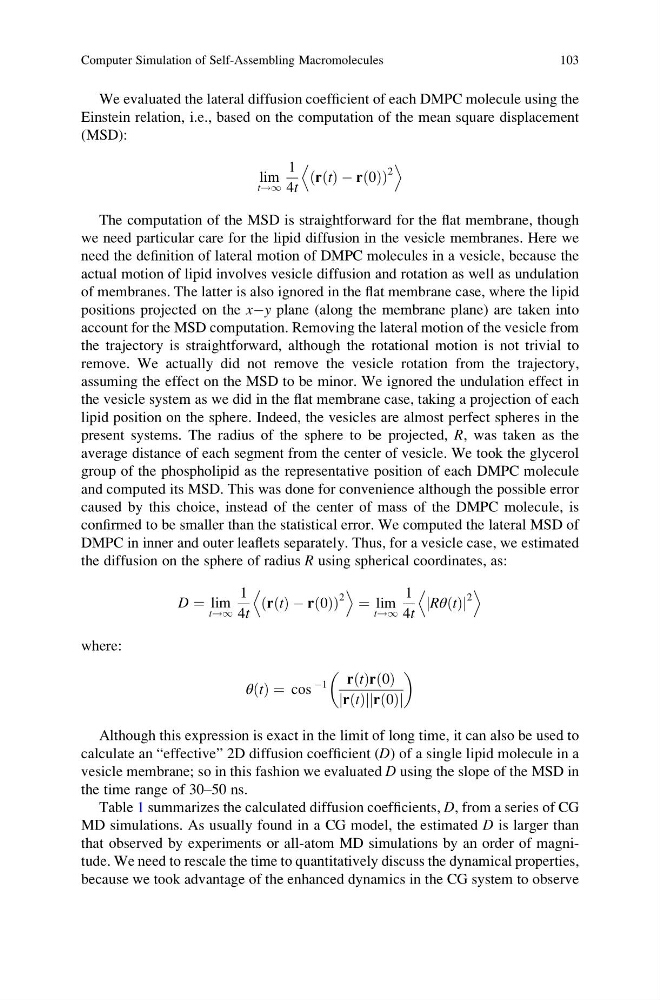
We evaluated the lateral diffusion coefficient of each DMPC molecule using the
Einstein relation, i.e., based on the computation of the mean square displacement
(MSD):
lim
t!1
1
4t
r t
ð Þ À r 0
ð Þ
ð
Þ
2
D
E
The computation of the MSD is straightforward for the flat membrane, though
we need particular care for the lipid diffusion in the vesicle membranes. Here we
need the definition of lateral motion of DMPC molecules in a vesicle, because the
actual motion of lipid involves vesicle diffusion and rotation as well as undulation
of membranes. The latter is also ignored in the flat membrane case, where the lipid
positions projected on the xÀy plane (along the membrane plane) are taken into
account for the MSD computation. Removing the lateral motion of the vesicle from
the trajectory is straightforward, although the rotational motion is not trivial to
remove. We actually did not remove the vesicle rotation from the trajectory,
assuming the effect on the MSD to be minor. We ignored the undulation effect in
the vesicle system as we did in the flat membrane case, taking a projection of each
lipid position on the sphere. Indeed, the vesicles are almost perfect spheres in the
present systems. The radius of the sphere to be projected, R, was taken as the
average distance of each segment from the center of vesicle. We took the glycerol
group of the phospholipid as the representative position of each DMPC molecule
and computed its MSD. This was done for convenience although the possible error
caused by this choice, instead of the center of mass of the DMPC molecule, is
confirmed to be smaller than the statistical error. We computed the lateral MSD of
DMPC in inner and outer leaflets separately. Thus, for a vesicle case, we estimated
the diffusion on the sphere of radius R using spherical coordinates, as:
D ¼ lim
t!1
1
4t
r t
ð Þ À r 0
ð Þ
ð
Þ
2
D
E
¼ lim
t!1
1
4t
Rθ t
ð Þ
j
j
2
D
E
where:
θ t
ð Þ ¼ cos
À1
r t
ð Þr 0
ð Þ
r t
ð Þ
j
j r 0
ð Þ
j
j
Although this expression is exact in the limit of long time, it can also be used to
calculate an “effective” 2D diffusion coefficient (D) of a single lipid molecule in a
vesicle membrane; so in this fashion we evaluated D using the slope of the MSD in
the time range of 30–50 ns.
Table 1 summarizes the calculated diffusion coefficients, D, from a series of CG
MD simulations. As usually found in a CG model, the estimated D is larger than
that observed by experiments or all-atom MD simulations by an order of magnitude. We need to rescale the time to quantitatively discuss the dynamical properties,
because we took advantage of the enhanced dynamics in the CG system to observe
Computer Simulation of Self-Assembling Macromolecules
103
Einstein relation, i.e., based on the computation of the mean square displacement
(MSD):
lim
t!1
1
4t
r t
ð Þ À r 0
ð Þ
ð
Þ
2
D
E
The computation of the MSD is straightforward for the flat membrane, though
we need particular care for the lipid diffusion in the vesicle membranes. Here we
need the definition of lateral motion of DMPC molecules in a vesicle, because the
actual motion of lipid involves vesicle diffusion and rotation as well as undulation
of membranes. The latter is also ignored in the flat membrane case, where the lipid
positions projected on the xÀy plane (along the membrane plane) are taken into
account for the MSD computation. Removing the lateral motion of the vesicle from
the trajectory is straightforward, although the rotational motion is not trivial to
remove. We actually did not remove the vesicle rotation from the trajectory,
assuming the effect on the MSD to be minor. We ignored the undulation effect in
the vesicle system as we did in the flat membrane case, taking a projection of each
lipid position on the sphere. Indeed, the vesicles are almost perfect spheres in the
present systems. The radius of the sphere to be projected, R, was taken as the
average distance of each segment from the center of vesicle. We took the glycerol
group of the phospholipid as the representative position of each DMPC molecule
and computed its MSD. This was done for convenience although the possible error
caused by this choice, instead of the center of mass of the DMPC molecule, is
confirmed to be smaller than the statistical error. We computed the lateral MSD of
DMPC in inner and outer leaflets separately. Thus, for a vesicle case, we estimated
the diffusion on the sphere of radius R using spherical coordinates, as:
D ¼ lim
t!1
1
4t
r t
ð Þ À r 0
ð Þ
ð
Þ
2
D
E
¼ lim
t!1
1
4t
Rθ t
ð Þ
j
j
2
D
E
where:
θ t
ð Þ ¼ cos
À1
r t
ð Þr 0
ð Þ
r t
ð Þ
j
j r 0
ð Þ
j
j
Although this expression is exact in the limit of long time, it can also be used to
calculate an “effective” 2D diffusion coefficient (D) of a single lipid molecule in a
vesicle membrane; so in this fashion we evaluated D using the slope of the MSD in
the time range of 30–50 ns.
Table 1 summarizes the calculated diffusion coefficients, D, from a series of CG
MD simulations. As usually found in a CG model, the estimated D is larger than
that observed by experiments or all-atom MD simulations by an order of magnitude. We need to rescale the time to quantitatively discuss the dynamical properties,
because we took advantage of the enhanced dynamics in the CG system to observe
Computer Simulation of Self-Assembling Macromolecules
103