

4 Self-Assembly of Dendrimers into Complex Architectures
The ability of CG simulations to predict the self-assembly of macromolecules has an
immediate application to the synthesis of new macromolecules that recombine the
physical and chemical properties of biological molecules to create superstructures of
tunable complexity. A particularly interesting group of such macromolecules are
dendrimers, multiply branched organic polymers whose internal structure has direct,
nontrivial outcomes on the topology of their superstructures. A library of Janus
dendrimers (amphiphilic polymers formed by chemically linking two dendritic
macromolecules) was recently synthesized, and the structure of their assembly
measured by cryo-electron microscopy [8]. The morphologies of the supramolecular
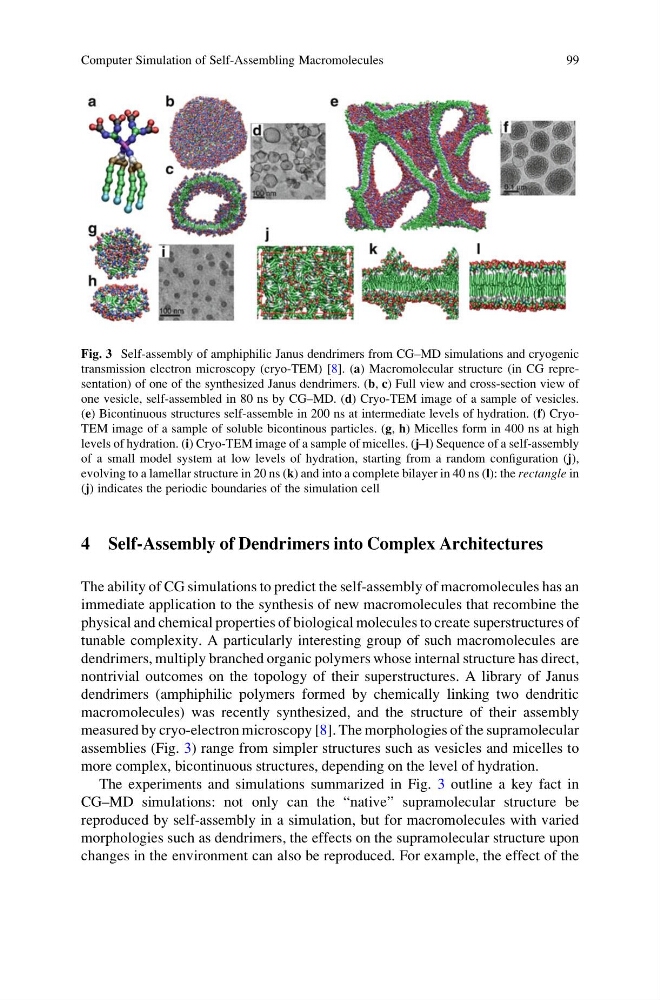
assemblies (Fig. 3) range from simpler structures such as vesicles and micelles to
more complex, bicontinuous structures, depending on the level of hydration.
The experiments and simulations summarized in Fig. 3 outline a key fact in
CG–MD simulations: not only can the “native” supramolecular structure be
reproduced by self-assembly in a simulation, but for macromolecules with varied
morphologies such as dendrimers, the effects on the supramolecular structure upon
changes in the environment can also be reproduced. For example, the effect of the
Fig. 3 Self-assembly of amphiphilic Janus dendrimers from CG–MD simulations and cryogenic
transmission electron microscopy (cryo-TEM) [8]. (a) Macromolecular structure (in CG representation) of one of the synthesized Janus dendrimers. (b, c) Full view and cross-section view of
one vesicle, self-assembled in 80 ns by CG–MD. (d) Cryo-TEM image of a sample of vesicles.
(e) Bicontinuous structures self-assemble in 200 ns at intermediate levels of hydration. (f) CryoTEM image of a sample of soluble bicontinous particles. (g, h) Micelles form in 400 ns at high
levels of hydration. (i) Cryo-TEM image of a sample of micelles. (j–l) Sequence of a self-assembly
of a small model system at low levels of hydration, starting from a random configuration (j),
evolving to a lamellar structure in 20 ns (k) and into a complete bilayer in 40 ns (l): the rectangle in
(j) indicates the periodic boundaries of the simulation cell
Computer Simulation of Self-Assembling Macromolecules
99
The ability of CG simulations to predict the self-assembly of macromolecules has an
immediate application to the synthesis of new macromolecules that recombine the
physical and chemical properties of biological molecules to create superstructures of
tunable complexity. A particularly interesting group of such macromolecules are
dendrimers, multiply branched organic polymers whose internal structure has direct,
nontrivial outcomes on the topology of their superstructures. A library of Janus
dendrimers (amphiphilic polymers formed by chemically linking two dendritic
macromolecules) was recently synthesized, and the structure of their assembly
measured by cryo-electron microscopy [8]. The morphologies of the supramolecular
assemblies (Fig. 3) range from simpler structures such as vesicles and micelles to
more complex, bicontinuous structures, depending on the level of hydration.
The experiments and simulations summarized in Fig. 3 outline a key fact in
CG–MD simulations: not only can the “native” supramolecular structure be
reproduced by self-assembly in a simulation, but for macromolecules with varied
morphologies such as dendrimers, the effects on the supramolecular structure upon
changes in the environment can also be reproduced. For example, the effect of the
Fig. 3 Self-assembly of amphiphilic Janus dendrimers from CG–MD simulations and cryogenic
transmission electron microscopy (cryo-TEM) [8]. (a) Macromolecular structure (in CG representation) of one of the synthesized Janus dendrimers. (b, c) Full view and cross-section view of
one vesicle, self-assembled in 80 ns by CG–MD. (d) Cryo-TEM image of a sample of vesicles.
(e) Bicontinuous structures self-assemble in 200 ns at intermediate levels of hydration. (f) CryoTEM image of a sample of soluble bicontinous particles. (g, h) Micelles form in 400 ns at high
levels of hydration. (i) Cryo-TEM image of a sample of micelles. (j–l) Sequence of a self-assembly
of a small model system at low levels of hydration, starting from a random configuration (j),
evolving to a lamellar structure in 20 ns (k) and into a complete bilayer in 40 ns (l): the rectangle in
(j) indicates the periodic boundaries of the simulation cell
Computer Simulation of Self-Assembling Macromolecules
99