

same functions that are typically used to model interatomic potentials. Later, this
model was refined, extended to proteins, and released as the “MARTINI” model
[27]. At the same time, Klein and coworkers developed a new CG model (called the
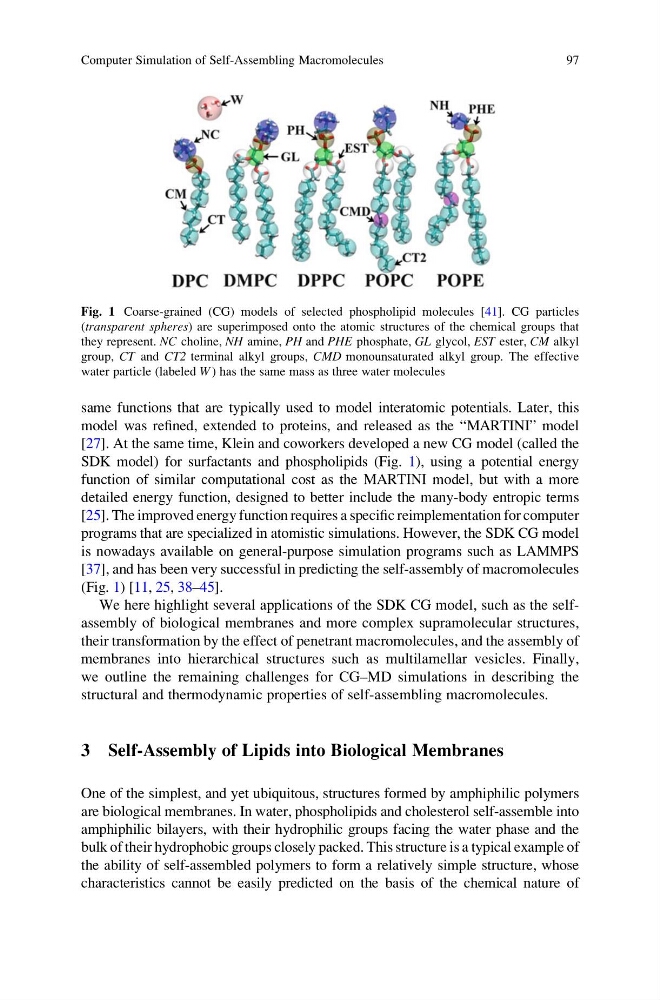
SDK model) for surfactants and phospholipids (Fig. 1), using a potential energy
function of similar computational cost as the MARTINI model, but with a more
detailed energy function, designed to better include the many-body entropic terms
[25]. The improved energy function requires a specific reimplementation for computer
programs that are specialized in atomistic simulations. However, the SDK CG model
is nowadays available on general-purpose simulation programs such as LAMMPS
[37], and has been very successful in predicting the self-assembly of macromolecules
(Fig. 1) [11, 25, 38–45].
We here highlight several applications of the SDK CG model, such as the selfassembly of biological membranes and more complex supramolecular structures,
their transformation by the effect of penetrant macromolecules, and the assembly of
membranes into hierarchical structures such as multilamellar vesicles. Finally,
we outline the remaining challenges for CG–MD simulations in describing the
structural and thermodynamic properties of self-assembling macromolecules.
3 Self-Assembly of Lipids into Biological Membranes
One of the simplest, and yet ubiquitous, structures formed by amphiphilic polymers
are biological membranes. In water, phospholipids and cholesterol self-assemble into
amphiphilic bilayers, with their hydrophilic groups facing the water phase and the
bulk of their hydrophobic groups closely packed. This structure is a typical example of
the ability of self-assembled polymers to form a relatively simple structure, whose
characteristics cannot be easily predicted on the basis of the chemical nature of
Fig. 1 Coarse-grained (CG) models of selected phospholipid molecules [41]. CG particles
(transparent spheres) are superimposed onto the atomic structures of the chemical groups that
they represent. NC choline, NH amine, PH and PHE phosphate, GL glycol, EST ester, CM alkyl
group, CT and CT2 terminal alkyl groups, CMD monounsaturated alkyl group. The effective
water particle (labeled W ) has the same mass as three water molecules
Computer Simulation of Self-Assembling Macromolecules
97
model was refined, extended to proteins, and released as the “MARTINI” model
[27]. At the same time, Klein and coworkers developed a new CG model (called the
SDK model) for surfactants and phospholipids (Fig. 1), using a potential energy
function of similar computational cost as the MARTINI model, but with a more
detailed energy function, designed to better include the many-body entropic terms
[25]. The improved energy function requires a specific reimplementation for computer
programs that are specialized in atomistic simulations. However, the SDK CG model
is nowadays available on general-purpose simulation programs such as LAMMPS
[37], and has been very successful in predicting the self-assembly of macromolecules
(Fig. 1) [11, 25, 38–45].
We here highlight several applications of the SDK CG model, such as the selfassembly of biological membranes and more complex supramolecular structures,
their transformation by the effect of penetrant macromolecules, and the assembly of
membranes into hierarchical structures such as multilamellar vesicles. Finally,
we outline the remaining challenges for CG–MD simulations in describing the
structural and thermodynamic properties of self-assembling macromolecules.
3 Self-Assembly of Lipids into Biological Membranes
One of the simplest, and yet ubiquitous, structures formed by amphiphilic polymers
are biological membranes. In water, phospholipids and cholesterol self-assemble into
amphiphilic bilayers, with their hydrophilic groups facing the water phase and the
bulk of their hydrophobic groups closely packed. This structure is a typical example of
the ability of self-assembled polymers to form a relatively simple structure, whose
characteristics cannot be easily predicted on the basis of the chemical nature of
Fig. 1 Coarse-grained (CG) models of selected phospholipid molecules [41]. CG particles
(transparent spheres) are superimposed onto the atomic structures of the chemical groups that
they represent. NC choline, NH amine, PH and PHE phosphate, GL glycol, EST ester, CM alkyl
group, CT and CT2 terminal alkyl groups, CMD monounsaturated alkyl group. The effective
water particle (labeled W ) has the same mass as three water molecules
Computer Simulation of Self-Assembling Macromolecules
97