

82
Methods of Architectural� Element Analysis
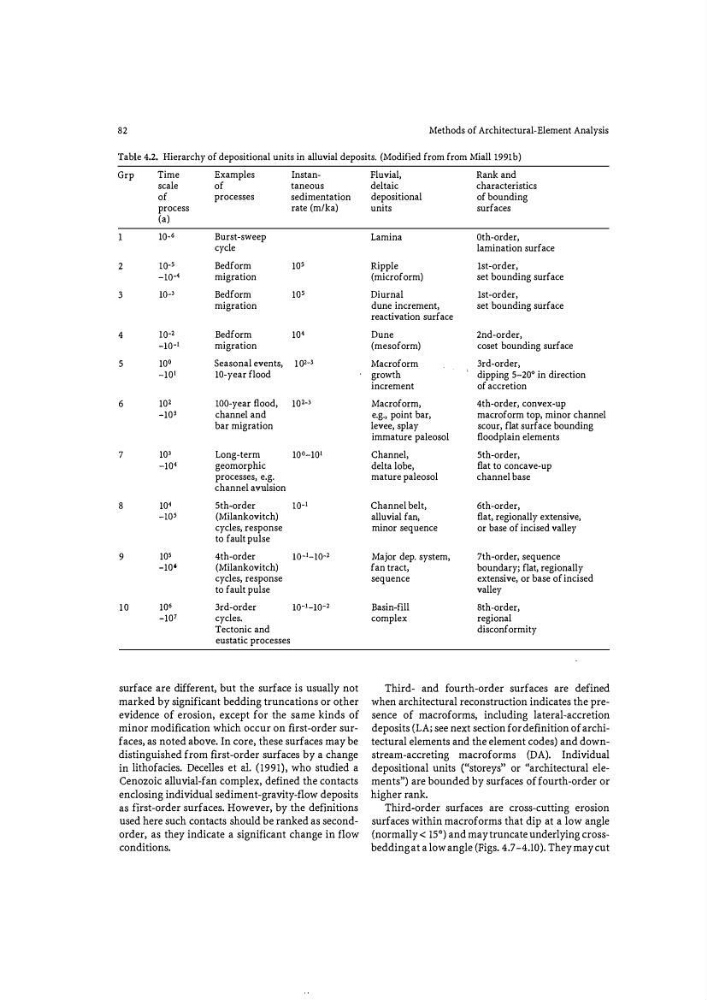
Table 4.2. Hierarchy of depositional units in alluvial deposits. (Modified from from Miall l99lb)
Grp
Time
Examples
Instan�
scale
of
taneous
of
processes
sedimentation
process
rate (m/ka)
(a)
1Q�6
Burst-sweep
cycle
2
lQ - 5
Bedform
105
-lQ - 4
migration
3
lQ-3
Bedform
105
migration
4
IQ - 2
Bedform
10'
-lQ-1
migration
5
10'
Seasonal events, 102-3
-101
10-year flood
6
102
lOO�year flood,
102 - 3
-103
channel and
bar migration
7
10'
Long�term
1Q0-1Ql
-104
geomorphic
processes, e.g.
channel avulsion
8
104
5th-order
lQ-1
-lOS
(Milankovitch)
cycles, response
to fault pulse
9
105
4th-order
lQ-1-IQ-2
-106
(Milankovitch)
cycles, response
to fault pulse
10
10°
3rd-order
lQ-LlQ-2
-107
cycles.
Tectonic and
eustatic processes
surface are different, but the surface is usually not
marked by significant bedding truncations or other
evidence of erosion, except for the same kinds of
minor modification which occur on first-order surfaces, as noted above. In core, these surfaces may be
distinguished from first-order surfaces by a change
in lithofacies. Decelles et al. (1991), who studied a
Cenozoic alluvial-fan complex, defined the contacts
enclosing individual sediment-gravity-flow deposits
as first-order surfaces. However, by the definitions
used here such contacts should be ranked as secondorder, as they indicate a significant change in flow
conditions.
Fluvial,
Rank and
deltaic
characteristics
depositional
of bounding
units
surfaces
Lamina
Oth-order,
lamination surface
Ripple
1st-order,
(microform)
set bounding surface
Diurnal
1st-order,
dune increment,
set bounding surface
reactivation surface
Dune
2nd-order,
(meso form)
coset bounding surface
Macroform
3rd-order,
growth
dipping 5-20° in direction
increment
of accretion
Macroform,
4th-order, convex-up
e.g., point bar,
macroform top, minor channel
levee, splay
scour, flat surface bounding
immature paleosol
floodplain elements
Channel,
5th-order,
delta lobe,
flat to concave-up
mature paleosol
channel base
Channel belt,
6th-order,
alluvial fan,
flat, regionally extensive,
minor sequence
or base of incised valley
Major dep. system,
7th-order, sequence
fan tract,
boundary; flat, regionally
sequence
extensive, or base of incised
valley
Basin-fill
8th-order,
complex
regional
disconformity
Third- and fourth-order surfaces are defined
when architectural reconstruction indicates the presence of macroforms, including lateral-accretion
deposits (LA; see next section for definition of architectural elements and the element codes) and downstream-accreting macroforms (DA). Individual
depositional units C'storeys)) or "architectural elements") are bounded by surfaces of fourth-order or
higher rank.
Third-order surfaces are cross-cutting erosion
surfaces within macroforms that dip at a low angle
(normally < 15°) and may truncate underlying crossbedding at a low angle (Figs. 4.7-4.!0). They may cut
Methods of Architectural� Element Analysis
Table 4.2. Hierarchy of depositional units in alluvial deposits. (Modified from from Miall l99lb)
Grp
Time
Examples
Instan�
scale
of
taneous
of
processes
sedimentation
process
rate (m/ka)
(a)
1Q�6
Burst-sweep
cycle
2
lQ - 5
Bedform
105
-lQ - 4
migration
3
lQ-3
Bedform
105
migration
4
IQ - 2
Bedform
10'
-lQ-1
migration
5
10'
Seasonal events, 102-3
-101
10-year flood
6
102
lOO�year flood,
102 - 3
-103
channel and
bar migration
7
10'
Long�term
1Q0-1Ql
-104
geomorphic
processes, e.g.
channel avulsion
8
104
5th-order
lQ-1
-lOS
(Milankovitch)
cycles, response
to fault pulse
9
105
4th-order
lQ-1-IQ-2
-106
(Milankovitch)
cycles, response
to fault pulse
10
10°
3rd-order
lQ-LlQ-2
-107
cycles.
Tectonic and
eustatic processes
surface are different, but the surface is usually not
marked by significant bedding truncations or other
evidence of erosion, except for the same kinds of
minor modification which occur on first-order surfaces, as noted above. In core, these surfaces may be
distinguished from first-order surfaces by a change
in lithofacies. Decelles et al. (1991), who studied a
Cenozoic alluvial-fan complex, defined the contacts
enclosing individual sediment-gravity-flow deposits
as first-order surfaces. However, by the definitions
used here such contacts should be ranked as secondorder, as they indicate a significant change in flow
conditions.
Fluvial,
Rank and
deltaic
characteristics
depositional
of bounding
units
surfaces
Lamina
Oth-order,
lamination surface
Ripple
1st-order,
(microform)
set bounding surface
Diurnal
1st-order,
dune increment,
set bounding surface
reactivation surface
Dune
2nd-order,
(meso form)
coset bounding surface
Macroform
3rd-order,
growth
dipping 5-20° in direction
increment
of accretion
Macroform,
4th-order, convex-up
e.g., point bar,
macroform top, minor channel
levee, splay
scour, flat surface bounding
immature paleosol
floodplain elements
Channel,
5th-order,
delta lobe,
flat to concave-up
mature paleosol
channel base
Channel belt,
6th-order,
alluvial fan,
flat, regionally extensive,
minor sequence
or base of incised valley
Major dep. system,
7th-order, sequence
fan tract,
boundary; flat, regionally
sequence
extensive, or base of incised
valley
Basin-fill
8th-order,
complex
regional
disconformity
Third- and fourth-order surfaces are defined
when architectural reconstruction indicates the presence of macroforms, including lateral-accretion
deposits (LA; see next section for definition of architectural elements and the element codes) and downstream-accreting macroforms (DA). Individual
depositional units C'storeys)) or "architectural elements") are bounded by surfaces of fourth-order or
higher rank.
Third-order surfaces are cross-cutting erosion
surfaces within macroforms that dip at a low angle
(normally < 15°) and may truncate underlying crossbedding at a low angle (Figs. 4.7-4.!0). They may cut