

50
Historical Background
1111
� �
Ill 1111
O
a.., """''"" ••"''�'''
bowt ooo.< r '"'rooo
ud•moo< '1\ltU
$1fO>OM tO "'OM
o<;l
) f(
'"'''"
-
co
w
t>
2
z
•
<
u
It�\
0
3
M• . . . oood, .. �. 00<1 moO Modoto" •«01�/I"
eo"" o<>
l>o*P ''"'""" '" ... ,.
0
l
. . � .... ... . , Sloooo•
"""' iolill
VO
..,. .
, . ., .
�··""' "''' ...... too«l
•
•
-
t � �
�
'p'"''
w
l� (�
2
;; "
%A§
u
0
•
Gom""'M11 1•'1 ood moo
LOw IO v<
.. .,
, . , . . . .
So•• ""'"''"'" (; ,
I.MI�IO
HiQII·"Iiol «:ow �ilh
"''"'�·· 01
""'"""'tn otwodOM
w
-��
"""b<>nl mL/
0
0!<4P b.loko, """" UQ•
llf
2
""""" ''fi "'"l!
Sy
w
1/Mllo
Historical Background
1111
� �
Ill 1111
O
a.., """''"" ••"''�'''
bowt ooo.< r '"'rooo
ud•moo< '1\ltU
$1fO>OM tO "'OM
) f(
'"'''"
-
co
w
t>
2
z
•
<
u
It�\
0
3
M• . . . oood, .. �. 00<1 moO Modoto" •«01�/
eo"" o<>
l>o*P ''"'""" '" ... ,.
0
l
. . � .... ... . , Sloooo•
"""' iolill
VO
..,. .
, . ., .
�··""' "''' ...... too«l
•
•
-
t � �
�
'p'"''
w
l� (�
2
;; "
%A§
u
0
•
Gom""'M11 1•'1 ood moo
LOw IO v<
.. .,
, . , . . . .
So•• ""'"''"'" (; ,
I.MI�IO
HiQII·"Iiol «:ow �ilh
"''"'�·· 01
""'"""'tn otwodOM
w
-��
"""b<>nl mL/
0
0!<4P b.loko, """" UQ•
llf
2
""""" ''fi "'"l!
S
w
1/Mllo
a
ll,.. mo!o<;,j, thl$, .,.
-
_, ,... .,
,.., , r:..
0
-··
-
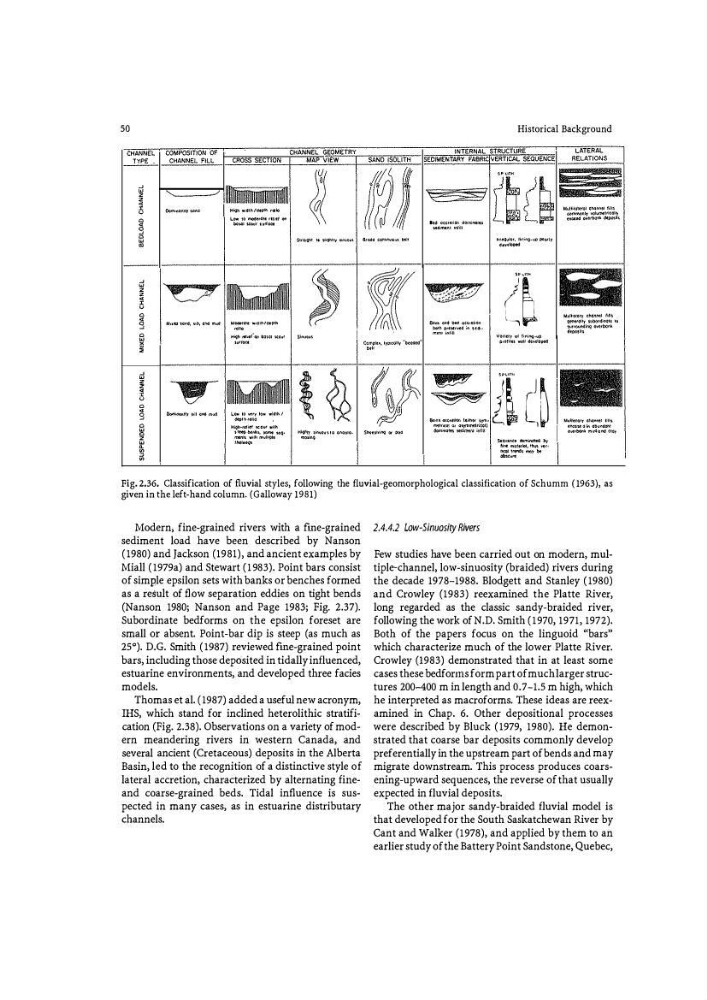
Fig. 2.36. Classification of fluvial styles, following the fluvial-geomorphological classification of Schumm (1963), as
given in the left�hand column. (Galloway 1981)
Modern, fine-grained rivers with a fm e-grained
sediment load have been described by Nanson
(1980) and jackson (1981), and ancient examples by
Miall (1979a) and Stewart (1983). Point bars consist
of simple epsilon sets with banks or benches formed
as a result of fl ow separation eddies on tight bends
(Nanson 1980; Nanson and Page 1983; Fig. 2.37).
Subordinate bedforms on the epsilon foreset are
small ot absent. Point-bar dip is steep (as much as
25°). D.G. Smith (1987) reviewed fm e-grained point
bars, including those depOsited in tidally influenced,
estuarine environments, and developed three facies
models.
Thomas et al. ( 1987) added a useful new acronym,
IHS, which stand for inclined heterolithic stratification (Fig. 2.38). Observations on a variety of modern meandering rivers in western Canada, and
several ancient (Cretaceous) deposits in the Alberta
Basin, led to the recognition of a distinctive style of
lateral accretion, characterized by alternating fineand coarse-grained beds. Tidal influence is suspected in many cases, as in estuarine distributary
channels.
2.4.4.2 Low-Sinuosity Rivers
Few studies have been carried out on modern, multiple-channel, low-sinuosity (braided) rivers during
the decade 1978-1988. Blodgett and Stanley ( 1980)
and Crowley (1983) reexamined the Platte River,
long regarded as the classic sandy-braided river,
following the work of N.D. Smith (1970, 1971, 1972).
Both of the papers focus on the linguoid "bars"
which characterize much of the lower Platte River.
Crowley (l983) demonstrated that in at least some
cases these bedforms form part of much larger structures 200-400 min length and 0.7-1.5 m high, which
he interpreted as macroforms. These ideas are reexamined in Chap. 6. Other depositional processes
were described by Bluck (1979, 1980). He demonstrated that coarse bar deposits commonly develop
preferentially in the upstream part of bends and may
migrate downstream. This process produces coarsening-upward sequences, the reverse of that usually
expected in fluvial deposits.
The other major sandy-braided fluvial model is
that developed for the South Saskatchewan River by
Cant and Walker (1978 ), and applied by them to an
earlier study of the Battery Point Sandstone, Quebec,