

44
Historical Background
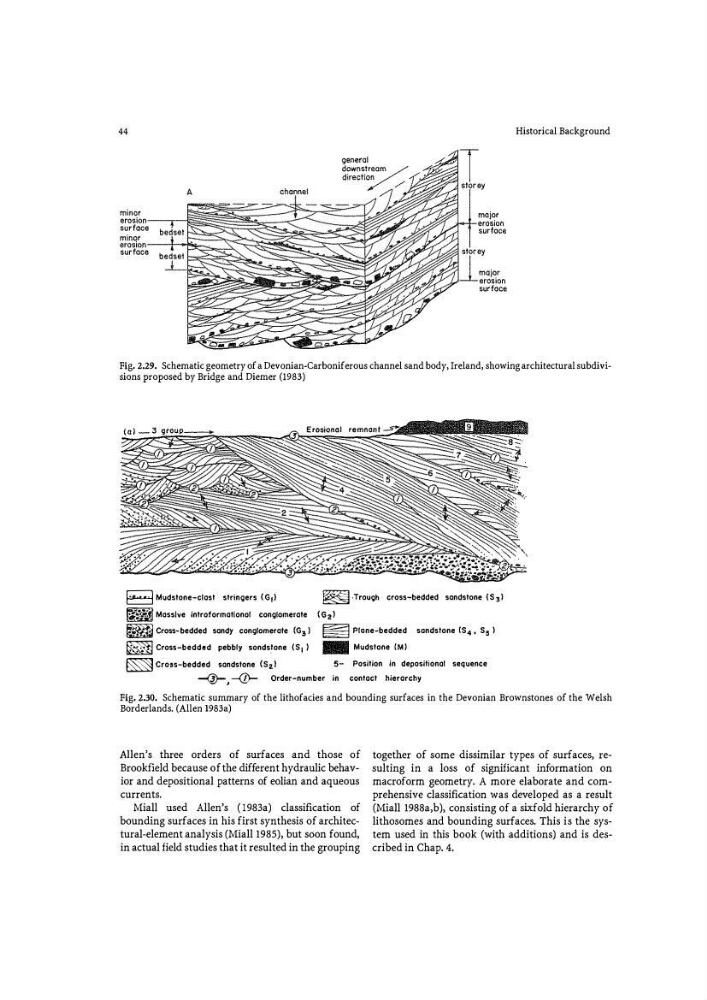
Fig. 2.29. Schematic geometry of a Devonian-Carboniferous channel sand body, Ireland, showing architectural subdivisions proposed by Bridge and Diemer (1983)
8 Mudstone-clast stringers {G1)
� ·TrouQh cross-bedded sandstone (S3l
ft<:';\�[ Massive introformatlonol conglomerate (G2)
� Cross� bedded sandy conglomerate (G3 J � Plene-bedded sandstone {S4 , S5 l
� Cross -bedded pebbly sonds�one (S1 ) - Mudstone (M)
� Cross-bedded sandstone (S2J
5- Position in depositional sequence
--
Borderlands. (Allen 1983a)
Allen's three orders of surfaces and those of
Brookfield because of the different hydraulic behavior and depositional patterns of eolian and aqueous
currents.
Miall used Allen's (1983a) classification of
bounding surfaces in his first synthesis of architecw
iural-element analysis (Miall l985), but s6on found,
in actual field studies that it resulted in the grouping
together of some dissimilar types of surfaces, resulting in a loss of significant information on
macroform geometry. A more elaborate and comprehensive classification was developed as a result
(Miall l988a,b), consisting of a sixfold hierarchy of
lithosomes and bounding surfaces. This is the system used in this book (with additions) and is described in Chap. 4.
Historical Background
Fig. 2.29. Schematic geometry of a Devonian-Carboniferous channel sand body, Ireland, showing architectural subdivisions proposed by Bridge and Diemer (1983)
8 Mudstone-clast stringers {G1)
� ·TrouQh cross-bedded sandstone (S3l
ft<:';\�[ Massive introformatlonol conglomerate (G2)
� Cross� bedded sandy conglomerate (G3 J � Plene-bedded sandstone {S4 , S5 l
� Cross -bedded pebbly sonds�one (S1 ) - Mudstone (M)
� Cross-bedded sandstone (S2J
5- Position in depositional sequence
--
Borderlands. (Allen 1983a)
Allen's three orders of surfaces and those of
Brookfield because of the different hydraulic behavior and depositional patterns of eolian and aqueous
currents.
Miall used Allen's (1983a) classification of
bounding surfaces in his first synthesis of architecw
iural-element analysis (Miall l985), but s6on found,
in actual field studies that it resulted in the grouping
together of some dissimilar types of surfaces, resulting in a loss of significant information on
macroform geometry. A more elaborate and comprehensive classification was developed as a result
(Miall l988a,b), consisting of a sixfold hierarchy of
lithosomes and bounding surfaces. This is the system used in this book (with additions) and is described in Chap. 4.