

Grow th of Present� Day Concepts, 1978-1988
43
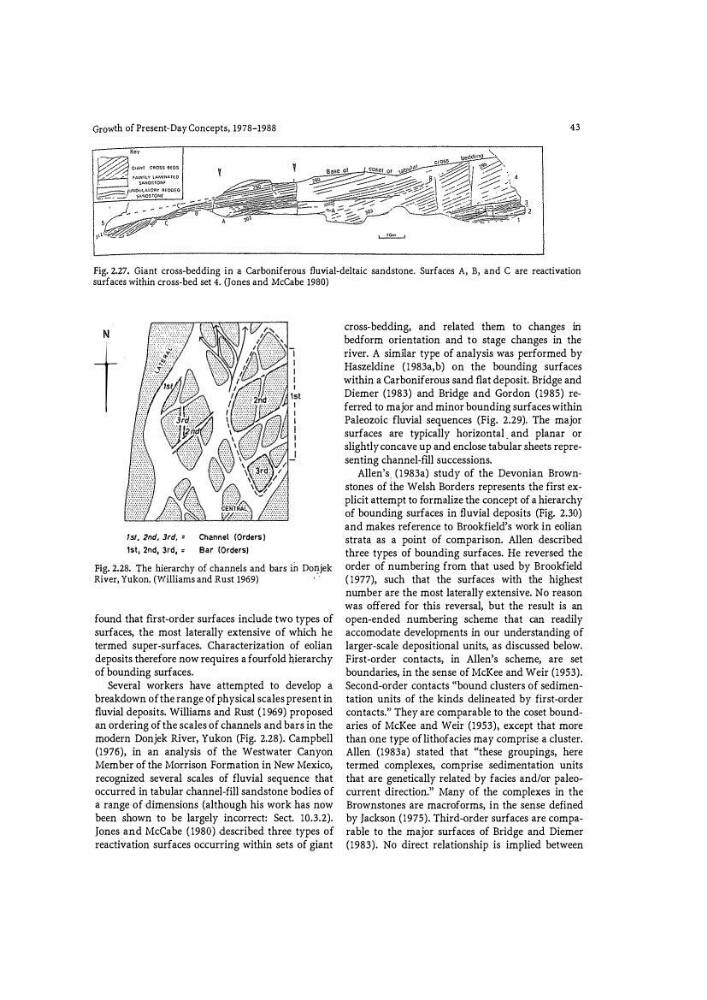
fig. 2.27. Giant cross-bedding in a Carboniferous fl uvial-deltaic sandstone. Surfaces A, B, and C are reactivation
surfaces within cross-bed set 4. (Jones and McCabe 1980)
N
t
lSI, 2nd, 3rd, =
Channel {Orders )
1st, 2nd, 3rd, =
Bar {Orders)
Fig. 2.28. The hierarchy of channels and bars i O DoJ!.jek
River, Yukon. (Williams and Rust 1969)
found that fr rst-order surfaces include two types of
surfaces, the most laterally extensive of which he
termed super-surfaces. Characterization of eolian
deposits therefore now requires a fourfold hierarchy
of bounding surfaces.
Several workers have attempted to develop a
breakdown of the range of physical scales present in
fluvial deposits. Williams and Rust (1969) proposed
an ordering of the scales of channels and bars in the
modern Donjek River, Yukon (Fig. 2.2: 8). Campbell
(1976), in an analysis of the Westwater Canyon
Member of the Morrison Formation in New Mexico,
recognized several scales of fluvial sequence that
occurred in tabular channel-fill sandstone bodies of
a range of dimensions (although his work has now
been shown to be largely incorrect: Sect. 10.3.2).
Jones and McCabe ( 1980) described three types of
reactivation surfaces occurring within sets of giant
cross-bedding, and related them to changes in
bedform orientation and to stage changes in the
river. A similar type of analysis was performed by
Haszeldine (1983a,b) on the bounding surfaces
within a Carboniferous sand flat deposit. Bridge and
Diemer (1983) and Bridge and Gordon (1985) referred to major and minor bounding surfaces within
Paleozoic fluvial sequences (Fig. 2.29). The major
surfaces are typically horizontal . and planar or
slightly concave up and enclose tabular sheets representing channel-fill successions.
Allen's (1983a) study of the Devonian Brownstones of the Welsh Borders represents the first explicit attempt to fo rmalize the concept of a hierarchy
of bounding surfaces in fl uvial deposits (Fig. 2.30)
and makes reference to Brookfield 1 s work in eolian
strata as a point of comparison. Allen described
three types of bounding surfaces. He reversed the
order of numbering from that used by Brookfield
(1977), such that the surfaces with the highest
number are the most laterally extensive. No reason
was offered for this reversal, but the result is an
open�ended numbering scheme that can readily
accomodate developments in our understanding of
larger-scale depositional units, as discussed below.
First-order contacts, in Allen's scheme, are set
boundaries, in the sense of McKee and Weir (1953).
Second-order contacts «bound clusters of sedimentation units of the kinds delineated by first-order
contacts." They are comparable to the coset boundaries of McKee and Weir (1953), except that more
than one type of lithofacies may comprise a cluster.
Allen (1983a) stated that "these groupings, here
termed complexes, comprise sedimentation units
that are genetically related by facies and/or paleocurrent direction." Many of the complexes in the
Brownstones are macroforms, in the sense defined
by jackson (1975). Third-order surfaces are comparable to the major surfaces of Bridge and Diemer
(1983). No direct relationship is implied between
43
fig. 2.27. Giant cross-bedding in a Carboniferous fl uvial-deltaic sandstone. Surfaces A, B, and C are reactivation
surfaces within cross-bed set 4. (Jones and McCabe 1980)
N
t
lSI, 2nd, 3rd, =
Channel {Orders )
1st, 2nd, 3rd, =
Bar {Orders)
Fig. 2.28. The hierarchy of channels and bars i O DoJ!.jek
River, Yukon. (Williams and Rust 1969)
found that fr rst-order surfaces include two types of
surfaces, the most laterally extensive of which he
termed super-surfaces. Characterization of eolian
deposits therefore now requires a fourfold hierarchy
of bounding surfaces.
Several workers have attempted to develop a
breakdown of the range of physical scales present in
fluvial deposits. Williams and Rust (1969) proposed
an ordering of the scales of channels and bars in the
modern Donjek River, Yukon (Fig. 2.2: 8). Campbell
(1976), in an analysis of the Westwater Canyon
Member of the Morrison Formation in New Mexico,
recognized several scales of fluvial sequence that
occurred in tabular channel-fill sandstone bodies of
a range of dimensions (although his work has now
been shown to be largely incorrect: Sect. 10.3.2).
Jones and McCabe ( 1980) described three types of
reactivation surfaces occurring within sets of giant
cross-bedding, and related them to changes in
bedform orientation and to stage changes in the
river. A similar type of analysis was performed by
Haszeldine (1983a,b) on the bounding surfaces
within a Carboniferous sand flat deposit. Bridge and
Diemer (1983) and Bridge and Gordon (1985) referred to major and minor bounding surfaces within
Paleozoic fluvial sequences (Fig. 2.29). The major
surfaces are typically horizontal . and planar or
slightly concave up and enclose tabular sheets representing channel-fill successions.
Allen's (1983a) study of the Devonian Brownstones of the Welsh Borders represents the first explicit attempt to fo rmalize the concept of a hierarchy
of bounding surfaces in fl uvial deposits (Fig. 2.30)
and makes reference to Brookfield 1 s work in eolian
strata as a point of comparison. Allen described
three types of bounding surfaces. He reversed the
order of numbering from that used by Brookfield
(1977), such that the surfaces with the highest
number are the most laterally extensive. No reason
was offered for this reversal, but the result is an
open�ended numbering scheme that can readily
accomodate developments in our understanding of
larger-scale depositional units, as discussed below.
First-order contacts, in Allen's scheme, are set
boundaries, in the sense of McKee and Weir (1953).
Second-order contacts «bound clusters of sedimentation units of the kinds delineated by first-order
contacts." They are comparable to the coset boundaries of McKee and Weir (1953), except that more
than one type of lithofacies may comprise a cluster.
Allen (1983a) stated that "these groupings, here
termed complexes, comprise sedimentation units
that are genetically related by facies and/or paleocurrent direction." Many of the complexes in the
Brownstones are macroforms, in the sense defined
by jackson (1975). Third-order surfaces are comparable to the major surfaces of Bridge and Diemer
(1983). No direct relationship is implied between