

Channel-and-Bar Reservoirs (CB Type)
28
4
CJ 0 - 10' (0 - 3.0 m)
� 10 - 2.0' (3.0 - 6.1
� 20 - - 30' (6.1 - 9.1 m)
� 30 - - 40' (9.1 - 12.2 m)
� > 40' (>12.2 m)
o
f e et 3000
o meters 900
R8E
T
4
N
25
T
5
N
513
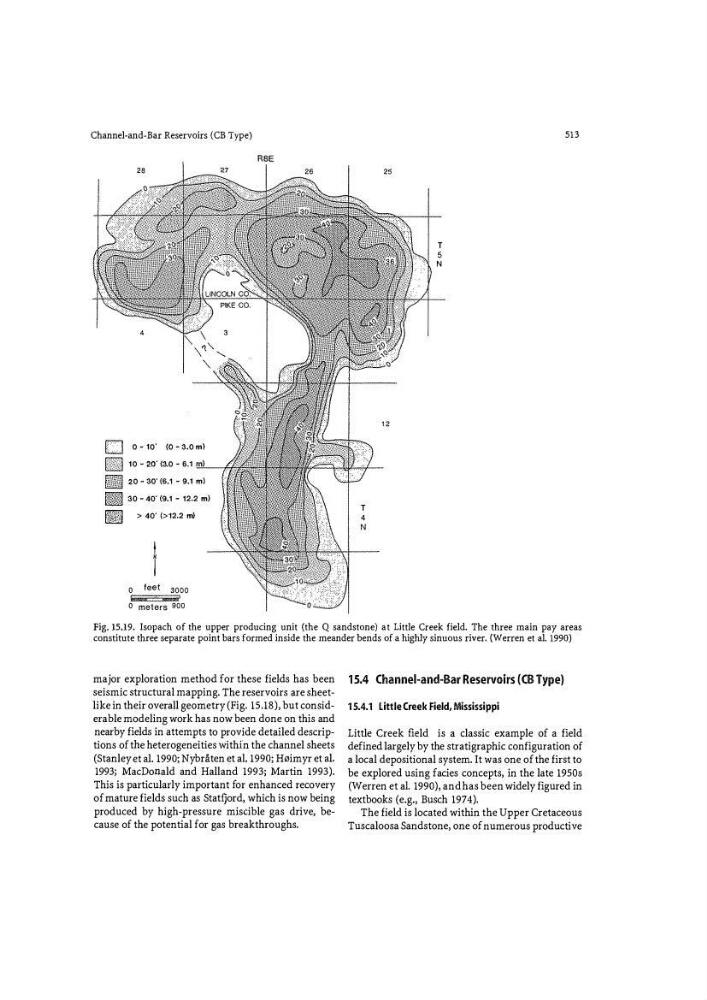
Fig. 15.19. Isopach of the upper producing unit (the Q sandstone) at Little Creek field. The three main pay areas
constitute three separate point bars formed inside the meander bends of a highly sinuous river. {Werren et al. 1990)
major exploration method for these fields has been
seismic structural mapping. The reservoirs are sheetlike in their overall geometry (Fig. 15.18), but considerable modeling work has now been done on this and
nearby fields in attempts to provide detailed descriptions of the heterogeneities within the channel sheets
(Stanley et a!. 1990; N yb raten et a!. 1990; H0imyr et a!.
1993; MacDonald and Hal!and 1993; Martin 1993).
This is particularly important fo r enhanced recovery
of mature fields such as Statfjord, which is now being
produced by high-pressure misCible gas drive, because of the potential for gas breakthroughs.
15.4 Channel-and-Bar Reservoirs (CB Type)
1 5.4.1 little Creek Field, Mississippi
Little Creek field is a classic example of a field
defined largely by the stratigraphic configuration of
a local depositional system. It was one of the first to
be explored using facies concepts, in the late 1950s
(Werren et a!. 1990), and has been widely figured in
textbooks (e.g., Busch 1974).
The field is located within the Upper Cretaceous
Tuscaloosa Sandstone, one of numerous productive