

Styles of Fluvial Reservoir
®
®
' f: -
1 :: ·.
'
.. . . .
. . . . .
.
.
.
.
.
t
0 1 2
LLJ
km
< 1.2m
1.2-2 .
4 m
[[!]]] ] 2 .
4-3.6 m
· · ····: fe(Ttrt >3.6m
. · .:· . : · \ .·. �
' .
..
. . . . . . . . .
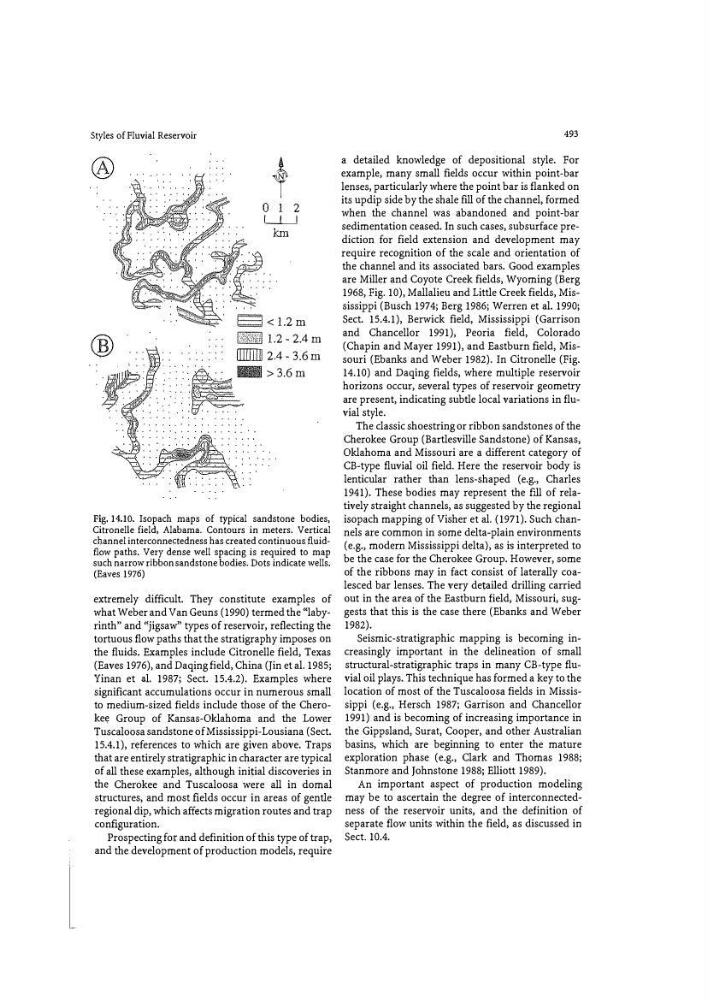
Fig. 11.10. Isopach maps of typical sandstone bodies,
Citronelle field, Alabama. Contours in meters. Vertical
channel interconne(:tedness has created continuous. fluidflow paths. Very dense well spacing is required to map
such narrow ribbon sandstone bodies. Dots indicate wells.
(Eaves 1976)
extremely difficult. They constitute examples of
what Weber and Van Geuns (1990) termed the "labyrinth'' and (�jigsaw'' types of reservoir, reflecting the
tortuous flow paths that the stratigraphy imposes on
the fluids. Examples include Citronelle field, Texas
(Eaves 1976), and Daqing field, China ()in et al. 1985;
Yinan et al. 1987; Sect. 15.4.2). Examples where
significant accumulations occur in numerous small
to medium-sized fields include those of the Cheroke� Group of Kansas-Oklahoma and the Lower
Tuscaloosa sandstone of Mississippi-Lousiana (Sect.
15.4.1), r�ferences to which are given above. Traps
that are entirely stratigraphic in character are typical
of all these examples, although initial discoveries in
the Cherokee and Tuscaloosa were all in domal
structures, and most fields occur in areas of gentle
regional dip, which affects migration routes and trap
configuration.
Prospecting for and definition of this type of trap,
and the development of production models, require
493
a detailed knowledge of depositional style. For
example, many small fields occur within point-bar
lenses, particularly where the point bar is flanked on
its updip side by the shale fill Qf the channel, formed
when the channel was abandoned and point-bar
sedimentation ceased. In such cases, subsurface prediction for field extension and development may
require recognition of the scale and orientation of
the channel and its associated bar$. Good examples
are Miller and Coyote Creek fields, Wyoming (Berg
1968, Fig. 10), Mallalieu and Little Creek fields, Mississippi (Busch 1974; Berg 1986; Werren et al. 1990;
Sect. 15.4.1), Berwick field, Mississippi (Garrison
and Chancellor 1991), Peoria field, Colorado
(Chapin and Mayer 1991), and Eastburn field, Missouri (Ebanks and Weber 1982). In Citronelle (Fig.
14.10) and Daqing fields, where multiple reservoir
horizons occur, several types of reservoir geometry
are present, indicating subtle local variations in fluvial style.
The classic shoestring or ribbon sandstones of the
Cherokee Group (Bartlesville Sandstone) of Kansas,
Oklahoma and Missouri are a different category of
CB-type fluvial oil field. Here the reservoir body is
lenticular rather than lens-shaped (e.g., Charles
1941). These bodies may represent the fill of relatively straight channels, as suggested by the regional
isopach mapping of Visher et al. (1971). Such channels are common in some delta-plain environments
(e.g., modern Mississippi delta), as is interpreted to
be the case for the Cherokee Group. However, some
of the ribbons may in fact consist of laterally coalesced bar lenses. The very detailed drilling carried
out in the area of the Eastburn field, Missouri, suggests that this is the case there (Ebanks and Weber
1982).
Seismic-stratigraphic mapping is becoming increasingly important in the delineation of small
structural-stratigraphic traps in many CB-type fluvial oil plays. This technique has formed a key to the
location of most of the Tuscaloosa fields in Mississippi (e.g., Hersch 1987; Gar"rison and Chancellor
1991) and is becoming of increasing importance in
the Gippsland, Sural, Cooper, and other Australian
basins, which are beginning to enter the mature
exploration phase (e.g., Clark and Thomas 1988;
Stanmore and Johnstone 1988; Elliott 1989).
An important aspect of production modeling
may be to ascertain the degree of interconnectedness of the reservoir units, and the definition of
separate flow units within the field, as discussed in
Sect. 10.4.
®
®
' f: -
1 :: ·.
'
.. . . .
. . . . .
.
.
.
.
.
t
0 1 2
LLJ
km
< 1.2m
1.2-2 .
4 m
[[!]]] ] 2 .
4-3.6 m
· · ····: fe(Ttrt >3.6m
. · .:· . : · \ .·. �
' .
..
. . . . . . . . .
Fig. 11.10. Isopach maps of typical sandstone bodies,
Citronelle field, Alabama. Contours in meters. Vertical
channel interconne(:tedness has created continuous. fluidflow paths. Very dense well spacing is required to map
such narrow ribbon sandstone bodies. Dots indicate wells.
(Eaves 1976)
extremely difficult. They constitute examples of
what Weber and Van Geuns (1990) termed the "labyrinth'' and (�jigsaw'' types of reservoir, reflecting the
tortuous flow paths that the stratigraphy imposes on
the fluids. Examples include Citronelle field, Texas
(Eaves 1976), and Daqing field, China ()in et al. 1985;
Yinan et al. 1987; Sect. 15.4.2). Examples where
significant accumulations occur in numerous small
to medium-sized fields include those of the Cheroke� Group of Kansas-Oklahoma and the Lower
Tuscaloosa sandstone of Mississippi-Lousiana (Sect.
15.4.1), r�ferences to which are given above. Traps
that are entirely stratigraphic in character are typical
of all these examples, although initial discoveries in
the Cherokee and Tuscaloosa were all in domal
structures, and most fields occur in areas of gentle
regional dip, which affects migration routes and trap
configuration.
Prospecting for and definition of this type of trap,
and the development of production models, require
493
a detailed knowledge of depositional style. For
example, many small fields occur within point-bar
lenses, particularly where the point bar is flanked on
its updip side by the shale fill Qf the channel, formed
when the channel was abandoned and point-bar
sedimentation ceased. In such cases, subsurface prediction for field extension and development may
require recognition of the scale and orientation of
the channel and its associated bar$. Good examples
are Miller and Coyote Creek fields, Wyoming (Berg
1968, Fig. 10), Mallalieu and Little Creek fields, Mississippi (Busch 1974; Berg 1986; Werren et al. 1990;
Sect. 15.4.1), Berwick field, Mississippi (Garrison
and Chancellor 1991), Peoria field, Colorado
(Chapin and Mayer 1991), and Eastburn field, Missouri (Ebanks and Weber 1982). In Citronelle (Fig.
14.10) and Daqing fields, where multiple reservoir
horizons occur, several types of reservoir geometry
are present, indicating subtle local variations in fluvial style.
The classic shoestring or ribbon sandstones of the
Cherokee Group (Bartlesville Sandstone) of Kansas,
Oklahoma and Missouri are a different category of
CB-type fluvial oil field. Here the reservoir body is
lenticular rather than lens-shaped (e.g., Charles
1941). These bodies may represent the fill of relatively straight channels, as suggested by the regional
isopach mapping of Visher et al. (1971). Such channels are common in some delta-plain environments
(e.g., modern Mississippi delta), as is interpreted to
be the case for the Cherokee Group. However, some
of the ribbons may in fact consist of laterally coalesced bar lenses. The very detailed drilling carried
out in the area of the Eastburn field, Missouri, suggests that this is the case there (Ebanks and Weber
1982).
Seismic-stratigraphic mapping is becoming increasingly important in the delineation of small
structural-stratigraphic traps in many CB-type fluvial oil plays. This technique has formed a key to the
location of most of the Tuscaloosa fields in Mississippi (e.g., Hersch 1987; Gar"rison and Chancellor
1991) and is becoming of increasing importance in
the Gippsland, Sural, Cooper, and other Australian
basins, which are beginning to enter the mature
exploration phase (e.g., Clark and Thomas 1988;
Stanmore and Johnstone 1988; Elliott 1989).
An important aspect of production modeling
may be to ascertain the degree of interconnectedness of the reservoir units, and the definition of
separate flow units within the field, as discussed in
Sect. 10.4.