

Chapter 14
Stratigraphic and Tectonic Controls on the Distribution
:;md Architecture of Fluvial Clil and Gas Reservoirs
14.1 Introduction
Significant volumes of oil and gas are trapped in
fluvial sandstones. Major reservoirs in clude the
Statfj ord Formation (Triassic-jurassic) of the North
Sea Basin, the Sadlerochit Group (Permian�Triassic)
of Prudhoe Bay on the Alaskan North Slope, the
Lower Cretaceous reservoirs of the gian t Daqing
field of the Songliao Basin, China, the heavy-oil
sands of the Cretaceous Athabasca and related deposits in Alberta, Cartada, and numerous large to
small fields in mature areas such as the Alberta Basin
(Mannville fi elds, Cretaceous-age reservoirs), the
southern Midcontinent (Cherokee fields, Pennsylvanian), and Gulf Coast (Cretaceous Tuscaloosa and
Travis Peak fields, and Oligocene Frio fi elds). The
tectonic setting and reservoir geometries of these
and other fluvial reservoirs are varied, but this chapter demonstrates that oi l and gas fields in fluvial
sandstones fall into three broad classes, on the basis
of two maj or descriptive criteria. An extensive review of fields aroun d the world is drawn upon to
il lustrate this classification.
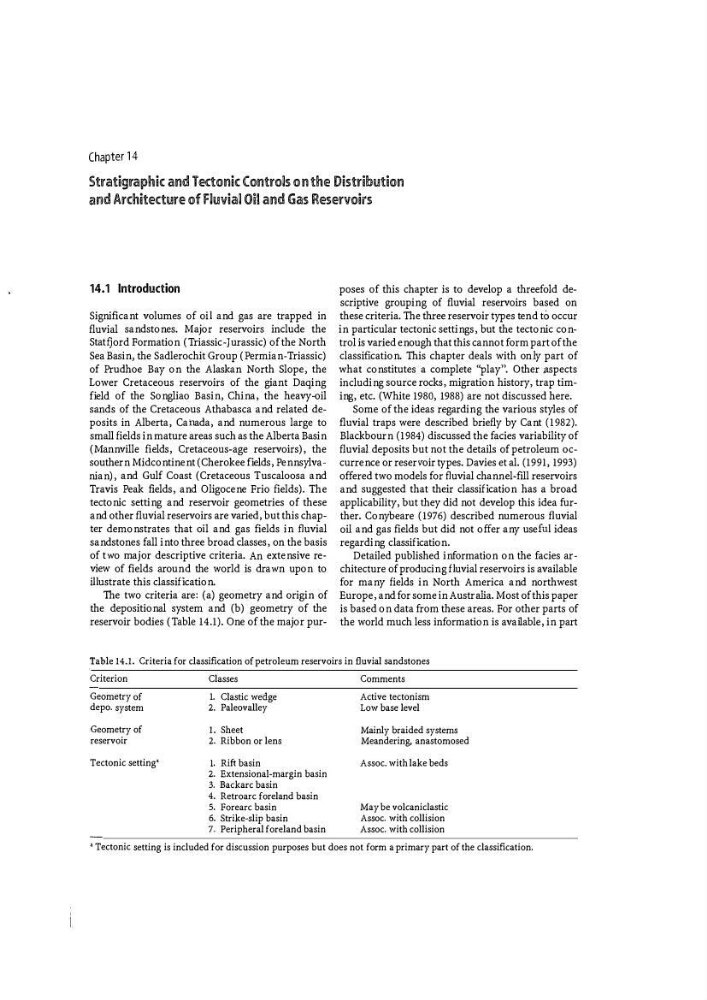
The two criteria are: (a) geometry and origin of
the depositional system and (b) geometry of the
reservoir bodies (Table 14.1). One of the major purposes of this chapter is to develop a threefold descriptive grouping of fluvial reservoirs based on
these criteria. The three reservoir types ten d tO occur
in particular tectonic settings, but the tectonic control is varied enough that this cannot form part of the
classification. This chapter deals with only part of
what constitutes a complete "play''. Other .aspects
in cluding source rocks, migration history, trap timing, etc. (W hite 1980, 1988) are not discussed here.
Some of the ideas regardin g the various styles of
fluvial traps were described briefly by Cant (1982).
Blackbourn (1984) discussed the facies variability of
fluvial deposits but not the details of petroleum occurrence or reservoir ty pes. Davies et al. (1991, 1993)
offered two models for fluvial chann el-fill reservoirs
and suggested that their classification has a broad
applicability, but they did not develop this idea further. Conybeare (1976) described numerous fl uvial
oil and gas fi elds but did not offer any useful ideas
regarding cl assification.
Detailed published information on the facies architecture of producin g fluvial reservoirs is available
for many fields in North America and northwest
Europe, and for some in Australia. Most of this paper
is based on data from these areas. For other parts of
the world much less in formation is available, in part
Table 14.1. Criteria for classification of petroleum reservoirs in fl uvial sandstones
Criterion
Geometry of
depo. system
Geometry of
reservoir
Tectonic setting"
Classes
1. Clastic wedge
2. Paleovalley
1. Sheet
2. Ribbon or lens
1. Rift basin
2. Extensional-margin basin
3. Backarc basin
4. Retroarc foreland basin
5. Forearc basin
6. Strike�slip basin
7. Peripheral foreland basin
Comments
Active tectonism
Low base level
Mainly braided systems
Meandering, anastomosed
Assoc. with lake beds
May be volcaniclastic
Assoc. with collision
Assoc. with collision
"Tectonic setting is included for discussion purposes but does not form a primary part of the classification.
Stratigraphic and Tectonic Controls on the Distribution
:;md Architecture of Fluvial Clil and Gas Reservoirs
14.1 Introduction
Significant volumes of oil and gas are trapped in
fluvial sandstones. Major reservoirs in clude the
Statfj ord Formation (Triassic-jurassic) of the North
Sea Basin, the Sadlerochit Group (Permian�Triassic)
of Prudhoe Bay on the Alaskan North Slope, the
Lower Cretaceous reservoirs of the gian t Daqing
field of the Songliao Basin, China, the heavy-oil
sands of the Cretaceous Athabasca and related deposits in Alberta, Cartada, and numerous large to
small fields in mature areas such as the Alberta Basin
(Mannville fi elds, Cretaceous-age reservoirs), the
southern Midcontinent (Cherokee fields, Pennsylvanian), and Gulf Coast (Cretaceous Tuscaloosa and
Travis Peak fields, and Oligocene Frio fi elds). The
tectonic setting and reservoir geometries of these
and other fluvial reservoirs are varied, but this chapter demonstrates that oi l and gas fields in fluvial
sandstones fall into three broad classes, on the basis
of two maj or descriptive criteria. An extensive review of fields aroun d the world is drawn upon to
il lustrate this classification.
The two criteria are: (a) geometry and origin of
the depositional system and (b) geometry of the
reservoir bodies (Table 14.1). One of the major purposes of this chapter is to develop a threefold descriptive grouping of fluvial reservoirs based on
these criteria. The three reservoir types ten d tO occur
in particular tectonic settings, but the tectonic control is varied enough that this cannot form part of the
classification. This chapter deals with only part of
what constitutes a complete "play''. Other .aspects
in cluding source rocks, migration history, trap timing, etc. (W hite 1980, 1988) are not discussed here.
Some of the ideas regardin g the various styles of
fluvial traps were described briefly by Cant (1982).
Blackbourn (1984) discussed the facies variability of
fluvial deposits but not the details of petroleum occurrence or reservoir ty pes. Davies et al. (1991, 1993)
offered two models for fluvial chann el-fill reservoirs
and suggested that their classification has a broad
applicability, but they did not develop this idea further. Conybeare (1976) described numerous fl uvial
oil and gas fi elds but did not offer any useful ideas
regarding cl assification.
Detailed published information on the facies architecture of producin g fluvial reservoirs is available
for many fields in North America and northwest
Europe, and for some in Australia. Most of this paper
is based on data from these areas. For other parts of
the world much less in formation is available, in part
Table 14.1. Criteria for classification of petroleum reservoirs in fl uvial sandstones
Criterion
Geometry of
depo. system
Geometry of
reservoir
Tectonic setting"
Classes
1. Clastic wedge
2. Paleovalley
1. Sheet
2. Ribbon or lens
1. Rift basin
2. Extensional-margin basin
3. Backarc basin
4. Retroarc foreland basin
5. Forearc basin
6. Strike�slip basin
7. Peripheral foreland basin
Comments
Active tectonism
Low base level
Mainly braided systems
Meandering, anastomosed
Assoc. with lake beds
May be volcaniclastic
Assoc. with collision
Assoc. with collision
"Tectonic setting is included for discussion purposes but does not form a primary part of the classification.