

466
revealed the subtle nature of such boundaries. They
reflect major tectonic, and possibly climatic changes
that may have no relationship to changes in sea level.
13.3.2 Lowstand Systems Tract
The lowstand systems tract is defined as the succession of beds between the sequence boundary and
the first widespread transgressive surface. Most sequence models, including those developed for
nonmarine deposits (Figs. 13.4, 13.5), indicate that
lowstand deposits occupy incised valleys and are
laterally limited in extent. This may indeed be the
>SABI NE
·
.. PASS :.
·
. ·
,,
0
·-·
2.0 Mileo
0
30 Kilome!ors
LOUISIA NA
Sequence Stratigraphy
case; fo r example, studies by Hopkins (1981, 1985),
Wood and Hopkins (1989, 1992), Shanley and
McCabe (1991, 1993), Legarreta and Uliana (1991),
Kvale and Vondra (1993), Gibling and Bird (1994),
Gibling and Wightman (1994), and Aitken and Flint
(1995) all described laterally limited lowstand
paleovalley fills. A recent book on incised-valley systems (Dalrymple et al. 1994) contains numerous
examples of fluvial to estuarine lowstand deposits.
Ribbon sandstone bodies occupying linear, commonly sinuous paleovalleys incised into unconformities are an important type of fl uvial oil and gas
reservoir (Harms 1966; Wood and Hopkins 1989,
1992; Weimer 1986; Chaps. 14, 15). In Ordos basin,
�-- � �
:
'
'
'
'
'
)
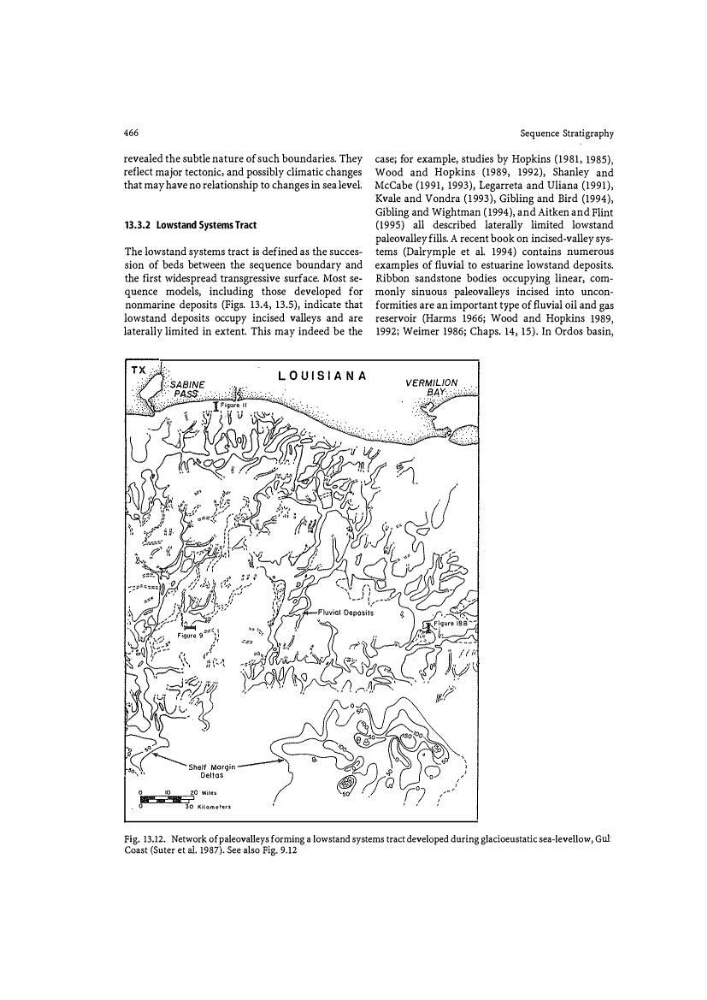
Fig. 13.12. Network ofpaleovalleys forming a lowstand systems tract developed during glacioeustatic sea-levellow1 Gu1
Coast (Suter et al. 1987). See also Fig. 9.12
revealed the subtle nature of such boundaries. They
reflect major tectonic, and possibly climatic changes
that may have no relationship to changes in sea level.
13.3.2 Lowstand Systems Tract
The lowstand systems tract is defined as the succession of beds between the sequence boundary and
the first widespread transgressive surface. Most sequence models, including those developed for
nonmarine deposits (Figs. 13.4, 13.5), indicate that
lowstand deposits occupy incised valleys and are
laterally limited in extent. This may indeed be the
>SABI NE
·
.. PASS :.
·
. ·
,,
0
·-·
2.0 Mileo
0
30 Kilome!ors
LOUISIA NA
Sequence Stratigraphy
case; fo r example, studies by Hopkins (1981, 1985),
Wood and Hopkins (1989, 1992), Shanley and
McCabe (1991, 1993), Legarreta and Uliana (1991),
Kvale and Vondra (1993), Gibling and Bird (1994),
Gibling and Wightman (1994), and Aitken and Flint
(1995) all described laterally limited lowstand
paleovalley fills. A recent book on incised-valley systems (Dalrymple et al. 1994) contains numerous
examples of fluvial to estuarine lowstand deposits.
Ribbon sandstone bodies occupying linear, commonly sinuous paleovalleys incised into unconformities are an important type of fl uvial oil and gas
reservoir (Harms 1966; Wood and Hopkins 1989,
1992; Weimer 1986; Chaps. 14, 15). In Ordos basin,
�-- � �
:
'
'
'
'
'
)
Fig. 13.12. Network ofpaleovalleys forming a lowstand systems tract developed during glacioeustatic sea-levellow1 Gu1
Coast (Suter et al. 1987). See also Fig. 9.12